

February 2, 2026
4 min read
Add Us On GoogleAdd SciAm
Astronomers declare rare dark-sky victory over scrapped energy project in Chile
After a year of protests from astronomers, authorities have abandoned plans for a giant, light-polluting renewable-energy facility in Chile’s Atacama Desert
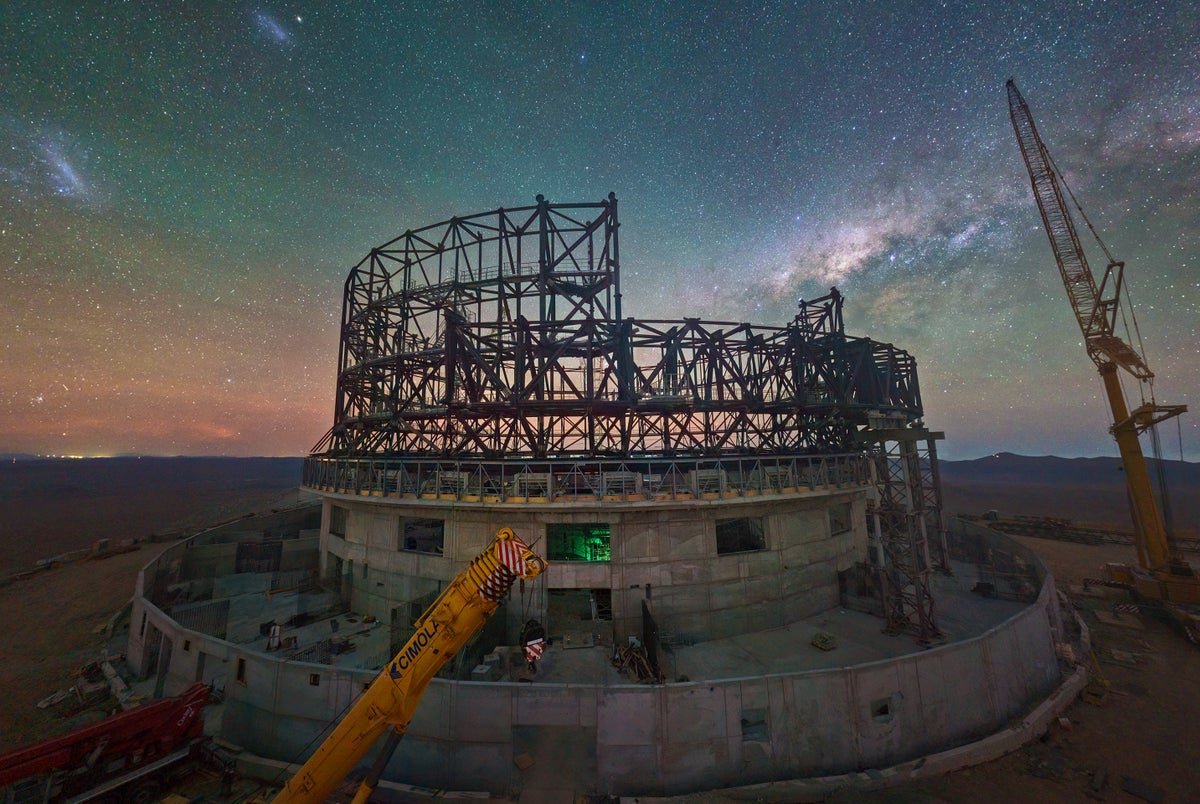
Europe’s Extremely Large Telescope, as seen at night in June 2023 while under construction atop the summit of Cerro Armazones in Chile’s Atacama Desert.
Astronomers around the globe are feeling relieved after a surprising victory in the struggle to preserve the sanctity of the sky. Last week AES Andes—a subsidiary of the AES Corporation, an American energy company—announced it had scrapped its plans for a sprawling, city-size renewable energy project in Chile’s Atacama Desert. The Atacama offers some of the world’s darkest, clearest skies—which is why it also hosts several of Earth’s most important ground-based telescopes, including those of the European Southern Observatory’s (ESO’s) Paranal Observatory, which could’ve been within a mere five kilometers of the green-energy facility, according to earlier plans.
The decision comes after a year of backlash from astronomers who have been relying on the telescopes under Chile’s world-class skies. They feared that light pollution from the project would ruin their celestial views. An ESO study had predicted that the project, called INNA (Integrated Energy Infrastructure Project for the Generation of Hydrogen and Green Ammonia), would increase light pollution by at least 35 percent for Paranal’s Very Large Telescope, a set of four interlinked 8.2-meter observatories at the forefront of astronomical research. The study also found that INNA’s operations would increase atmospheric turbulence, muddying what would otherwise be sharp images of the heavens from nearby telescopes.
In early 2025, as the potentially dire impacts of the project became more widely known, one astronomer—María Teresa Ruiz of the University of Chile—began an oppositional letter-writing campaign to news organizations and scientific journals. Meanwhile astrophysicist and Nobel laureate Reinhard Genzel accompanied Frank-Walter Steinmeier, president of Germany, on a trip to the Paranal Observatory to demand a resolution.
On supporting science journalism
If you’re enjoying this article, consider supporting our award-winning journalism by subscribing. By purchasing a subscription you are helping to ensure the future of impactful stories about the discoveries and ideas shaping our world today.
Later that year, in November 2025, plans for INNA were still proceeding, and Genzel—with dozens of other international astronomers—addressed an open letter to the Chilean government to call for the project’s relocation. “How about just moving 50 kilometers?” Genzel recalls he and his colleagues asking. “It’s not that we were saying, ‘Get out.’ We were only saying, ‘Please don’t do it right here.’”
A potential breakthrough came the following month, when Chile’s right-wing president-elect José Antonio Kast spoke out against the energy project. Kast’s support for astronomy may have been the nail in the coffin for INNA, Ruiz says. “When he came to the defense of the Chilean skies for astronomy, I woke up and had to celebrate with champagne because it was something that we were waiting for somebody to say,” she says. “I guess after that, the company said, ‘Well, maybe we should move.’”
In a January 23 statement, AES Andes announced that after a detailed analysis, the company had decided to abandon the project. ESO spokesperson Bárbara Ferreira notes, however, that the project’s withdrawal from Chile’s Environmental Impact Assessment System, which would formally confirm its cancellation, has yet to occur. Presuming it does, “we would be relieved and pleased that the INNA project will not be built near our Paranal Observatory,” she says.
For Ruiz, however, the struggle continues. She and other concerned astronomers are working with Chile’s senators to pass legislation that would seek to permanently protect the nation’s skies for astronomy. “We need legislation that will protect these sites forever,” Ruiz says, meaning “not only Paranal and the European observatories but all the observatory sites.” Chile is also home to the U.S.’s new Vera C. Rubin Observatory, which is using the world’s largest digital camera to map the night sky in unprecedented detail.
The organized communal effort that led to INNA’s demise may also be key to other issues plaguing astronomy—including ones where the observatories are what’s being protested. In Hawaii, for example, local groups have spent a more than a decade battling against the Thirty Meter Telescope (TMT)—a U.S.-led international observatory with partners in Canada, Japan and India that is meant to be built atop the sacred Mauna Kea volcano. The backlash may have peaked in 2019, when protesters blockaded the summit’s access road and multiple arrests occurred. But delays linked to the ongoing opposition have proved so costly for the TMT project that its leaders recently announced they were exploring opportunities for relocating the observatory to a site in Spain’s Canary Islands. A more robust and unified response from astronomers to anti-TMT protesters might have led to a different outcome. But according to Genzel, the turmoil might have been prevented altogether if the TMT partners had prioritized working alongside local Hawaiian groups.
Astronomers are also now banding together to win more public and political support against the runaway proliferation of satellite mega constellations—fleets of low-orbiting satellites such as SpaceX’s Starlink that provide high-speed global Internet and other telecommunications services. These swarming satellites spoil astronomical images—even those from some space telescopes—by leaving streaks across the field of view, like bugs on a windshield. Tweaks to observational campaigns and computer-assisted image correction can reduce this interference but can’t eliminate it entirely, and the problem could soon grow too immense for such work-arounds. Already nearly 10,000 active satellites orbit our planet—the vast majority for Starlink—and hundreds of thousands more are planned for the near future.
Professional organizations such as the American Astronomical Society and the International Astronomical Union have, for years, lobbied policymakers to take more meaningful action against the relentlessly rising numbers of satellites. Yet national governments continue approving more mega constellation projects and launches, with no end in sight. If the battle for Earth’s dark skies is ever to be won, it’ll take more than just pressure from astronomers, Genzel says. Ultimately, the issue demands “politicians who actually have respect for basic research,” he adds.
It’s Time to Stand Up for Science
If you enjoyed this article, I’d like to ask for your support. Scientific American has served as an advocate for science and industry for 180 years, and right now may be the most critical moment in that two-century history.
I’ve been a Scientific American subscriber since I was 12 years old, and it helped shape the way I look at the world. SciAm always educates and delights me, and inspires a sense of awe for our vast, beautiful universe. I hope it does that for you, too.
If you subscribe to Scientific American, you help ensure that our coverage is centered on meaningful research and discovery; that we have the resources to report on the decisions that threaten labs across the U.S.; and that we support both budding and working scientists at a time when the value of science itself too often goes unrecognized.
In return, you get essential news, captivating podcasts, brilliant infographics, can’t-miss newsletters, must-watch videos, challenging games, and the science world’s best writing and reporting. You can even gift someone a subscription.
There has never been a more important time for us to stand up and show why science matters. I hope you’ll support us in that mission.
