
Close Menu

    Subscribe to Updates

    Get the latest creative news from FooBar about art, design and business.

    What's Hot

    Eton head apologises after former teacher jailed for sexual assault of pupil | Private schools

    Drone strikes in Ethiopia’s Tigray kill one amid fears of renewed conflict | Conflict News

    How Claude Code is bringing vibe coding to everyone

    Facebook X (Twitter) Instagram
    Facebook X (Twitter) YouTube LinkedIn
    Naija Global News |
    Saturday, January 31
    • Business
    • Health
    • Politics
    • Science
    • Sports
    • Education
    • Social Issues
    • Technology
    • More
      • Crime & Justice
      • Environment
      • Entertainment
    Naija Global News |
    You are at:Home»Science»Mass grave in Jordan sheds new light on world’s earliest recorded pandemic | Infectious diseases
    Science

    Mass grave in Jordan sheds new light on world’s earliest recorded pandemic | Infectious diseases

    onlyplanz_80y6mtBy onlyplanz_80y6mtJanuary 31, 2026004 Mins Read
    Share Facebook Twitter Pinterest LinkedIn Tumblr Email
    Mass grave in Jordan sheds new light on world’s earliest recorded pandemic | Infectious diseases
    Researchers say their findings offer a rare window into the urban life, mobility and vulnerability of citizens affected by the Justinian plague. Photograph: Karen Hendrix/University of Sydney
    Share
    Facebook Twitter LinkedIn Pinterest Email

    A US-led research team has verified the first Mediterranean mass grave of the world’s earliest recorded pandemic, providing stark new details about the plague of Justinian that killed millions of people in the Byzantine empire between the sixth and eighth centuries.

    The findings, published in February’s Journal of Archaeological Science, offer what researchers say is a rare empirical window into the mobility, urban life and vulnerability of citizens affected by the pestilence.

    DNA taken from bodies at a mass burial ground at Jerash in modern-day Jordan show the grave represented “a single mortuary event”, instead of the normal, gradual growth over time of a traditional cemetery, according to the team that last year identified Yersinia pestis as the microbe that caused the plague.

    The new research focused on the victims, how they lived, their susceptibility to the disease and why they were in Jerash, a regional trade hub and the epicenter of the pandemic that raged from AD541 to AD750.

    “Earlier stories identified the plague organism. The Jerash site turns that genetic signal into a human story about who died, and how a city experienced crisis,” said Rays Jiang, the study’s lead author and associate professor in the University of South Florida’s department of global, environmental and genomic health sciences.

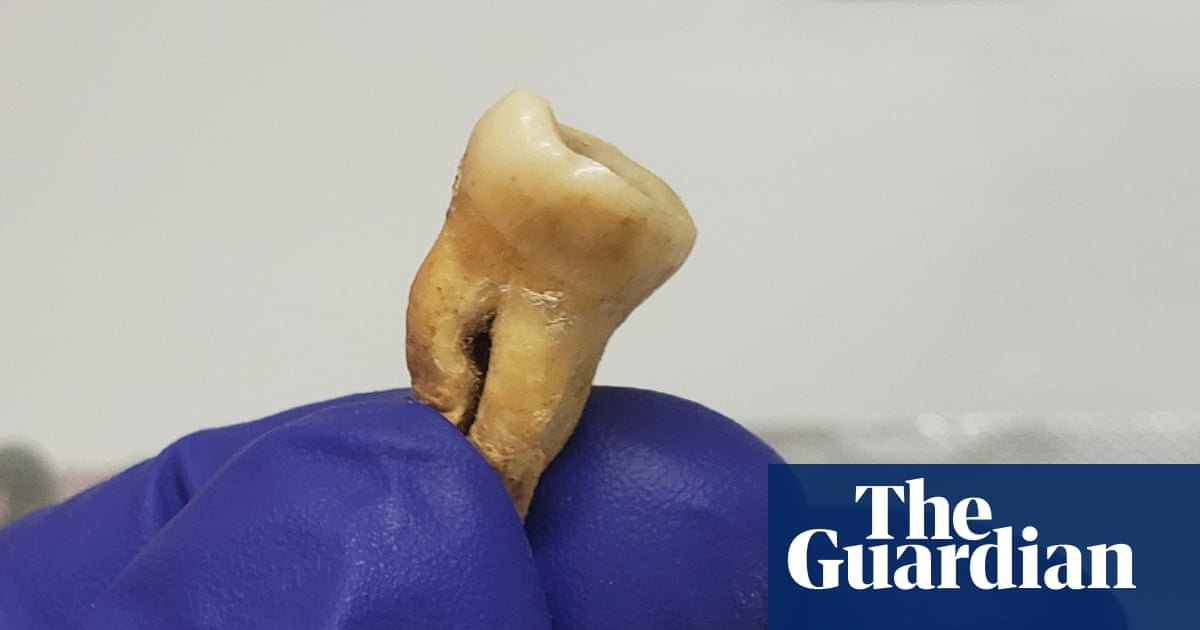
    A tooth from the site in Jerash. Photograph: Greg O’Corry/FAU-Crowe

    “Pandemics aren’t just biological events, they’re social events. By linking biological evidence from the bodies to the archaeological setting, we can see how disease affected real people within their social and environmental context.

    “This helps us understand pandemics in history as lived human health events, not just outbreaks recorded in text.”

    A multidisciplinary team of archaeologists, historians and genetic experts from the University of South Florida, Florida Atlantic University and the University of Sydney produced the paper, with Jiang and her researchers looking at DNA extracted from teeth.

    They found that a diverse demographic range of victims, which she said showed that a largely mobile population was together and effectively stuck in the same place by the disease, similar to how travel shut down during the Covid pandemic.

    “People move. They’re transient, and vulnerable, and normally they are disturbed, dispersed. Here, they were brought together by crisis,” Jiang said, adding that ancient pandemics thrived in densely populated cities shaped by travel and environmental change.

    Rays Jiang of the University of South Florida College of Public Health. Photograph: Torie Doll/University of South Florida

    Excavations revealed more than 200 people were buried in the grave at the hippodrome in Jerash, known as the Pompeii of the Middle East for its preserved Greco-Roman ruins. Jiang said they were a mix of men and women, old and young, “people in their prime, and teenagers”.

    “At that time there were slaves, mercenaries, all sorts of people, and our data is consistent with this being a transient population. That’s not a new thing,” she continued.

    Jiang said the research exposed other parallels in more modern pandemics, particularly Covid, dismissed by Donald Trump in its early days as “a hoax”.

    “There’s a whole school of thought that says the first pandemic did not happen,” she said. “The denialists argue that if you look at census data, the population did not collapse like the Black Death, if you look at economic tracking, you don’t see anything, if you study residence density maps you don’t see a disruption. And plus, no one had found a mass grave.

    “But the first plague is actually much easier to untangle than Covid. We have Yersinia pestis as the microbe; we have a mass grave, and bodies, hard evidence that it happened. Whether society or institutions collapsed is a separate matter. You can have a disease rampage through and don’t have to have a revolution, a revolt, a regime change to prove that it did.”

    diseases earliest grave infectious Jordan Light mass Pandemic Recorded sheds worlds
    Share. Facebook Twitter Pinterest LinkedIn Tumblr Email
    Previous ArticleFly-on-the-wall film makes Melania a lightning rod for criticism
    Next Article How Claude Code is bringing vibe coding to everyone
    onlyplanz_80y6mt
    • Website

    Related Posts

    Largest galaxy survey yet confirms that the Universe is not clumpy enough

    January 31, 2026

    Briefing Chat: What Brazilian centenarians could reveal about the science of ageing

    January 31, 2026

    Katharine Burr Blodgett’s legacy comes to light

    January 31, 2026
    Add A Comment
    Leave A Reply Cancel Reply

    Top Posts

    Watch Lady Gaga’s Perform ‘Vanish Into You’ on ‘Colbert’

    September 9, 20251 Views

    Advertisers flock to Fox seeking an ‘audience of one’ — Donald Trump

    July 13, 20251 Views

    A Setback for Maine’s Free Community College Program

    June 19, 20251 Views
    Stay In Touch
    • Facebook
    • YouTube
    • TikTok
    • WhatsApp
    • Twitter
    • Instagram
    Latest Reviews

    At Chile’s Vera Rubin Observatory, Earth’s Largest Camera Surveys the Sky

    By onlyplanz_80y6mtJune 19, 2025

    SpaceX Starship Explodes Before Test Fire

    By onlyplanz_80y6mtJune 19, 2025

    How the L.A. Port got hit by Trump’s Tariffs

    By onlyplanz_80y6mtJune 19, 2025

    Subscribe to Updates

    Get the latest tech news from FooBar about tech, design and biz.

    Most Popular

    Watch Lady Gaga’s Perform ‘Vanish Into You’ on ‘Colbert’

    September 9, 20251 Views

    Advertisers flock to Fox seeking an ‘audience of one’ — Donald Trump

    July 13, 20251 Views

    A Setback for Maine’s Free Community College Program

    June 19, 20251 Views
    Our Picks

    Eton head apologises after former teacher jailed for sexual assault of pupil | Private schools

    Drone strikes in Ethiopia’s Tigray kill one amid fears of renewed conflict | Conflict News

    How Claude Code is bringing vibe coding to everyone

    Recent Posts
    • Eton head apologises after former teacher jailed for sexual assault of pupil | Private schools
    • Drone strikes in Ethiopia’s Tigray kill one amid fears of renewed conflict | Conflict News
    • How Claude Code is bringing vibe coding to everyone
    • Mass grave in Jordan sheds new light on world’s earliest recorded pandemic | Infectious diseases
    • Fly-on-the-wall film makes Melania a lightning rod for criticism
    © 2026 naijaglobalnews. Designed by Pro.
    • About Us
    • Disclaimer
    • Get In Touch
    • Privacy Policy
    • Terms and Conditions

    Type above and press Enter to search. Press Esc to cancel.