

January 29, 2026
3 min read
Add Us On GoogleAdd SciAm
Svalbard’s polar bears are showing remarkable resilience to climate change
These polar bears appear to be maintaining their physical health despite the loss of sea ice—their preferred hunting grounds
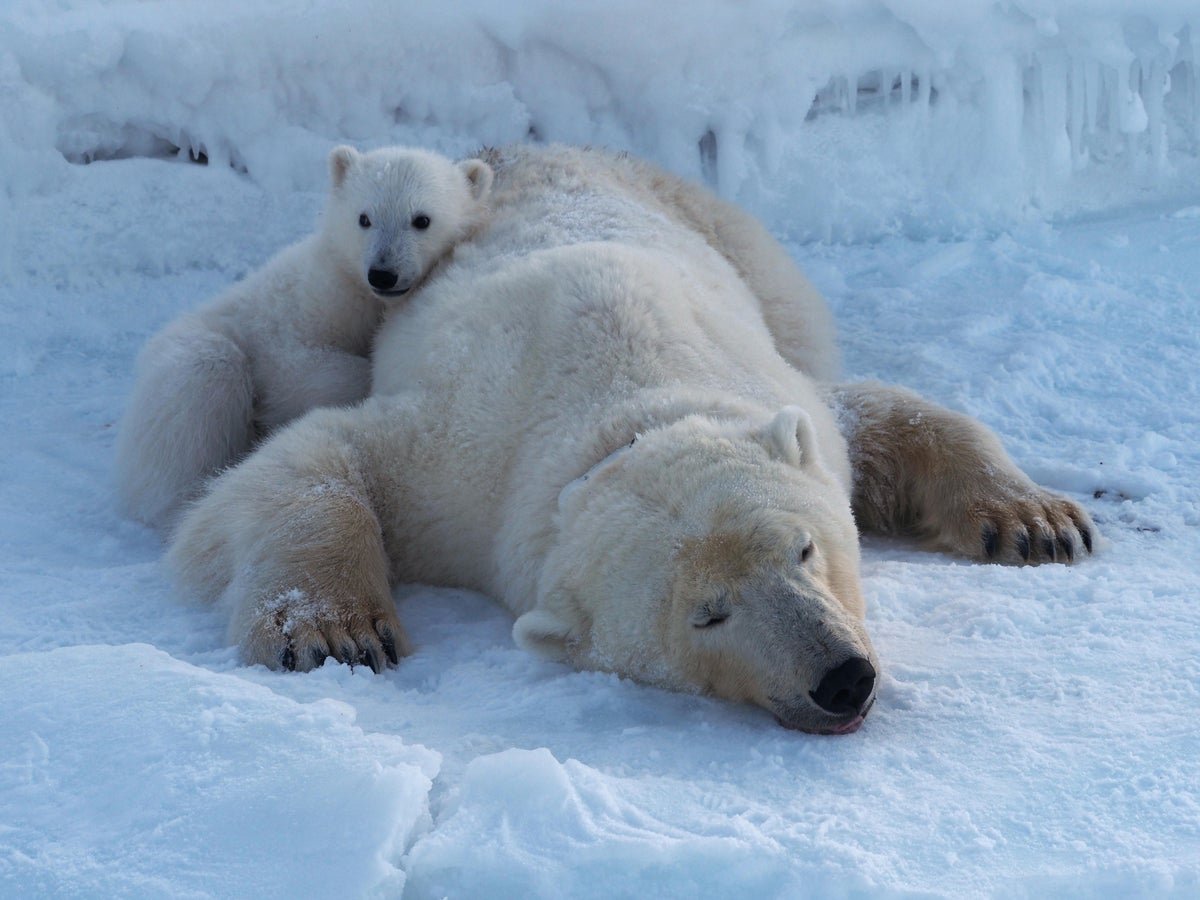
A sedated polar bear lies on the ice with its cub huddled against it.
Jon Aars/Norwegian Polar Institute
Polar bears are the poster children of climate change—and for good reason. These giant bears hunt, mate and spend their days hanging out on Arctic sea ice, which is rapidly disappearing as the climate warms. But some polar bears, it seems, are far more resilient than we realized: new research suggests that in one region, the bears are adapting to the declining sea ice.
Researchers took more than 1,000 body measurements from 770 polar bears over 24 years around Svalbard, a Norwegian archipelago in the Barents Sea—an area that has seen an especially acute decline in sea ice over the decades. By 2019, the region’s annual sea ice season shriveled to more than two months shorter than what it was 24 years prior.
Yet the bears showed no decline in their body condition between 2000 and 2019—even as sea ice in their area disappeared. The findings were published on Thursday in the journal Scientific Reports.
On supporting science journalism
If you’re enjoying this article, consider supporting our award-winning journalism by subscribing. By purchasing a subscription you are helping to ensure the future of impactful stories about the discoveries and ideas shaping our world today.
That flew in the face of what Jon Aars, a senior researcher at the Norwegian Polar Institute and lead author of the paper, and his team expected. They hypothesized that the Svalbard polar bears’ health would wane over the study period. Tracking each bear over the ice with helicopters and periodically darting them to take body measurements on the ground, the researchers were able to estimate the animals’ overall physical health—a metric called body condition index, or BCI.
Researchers record the mouth measurements of an anesthetized polar bear. Recapture of bears marked in previous years is important for obtaining accurate data on survival and reproduction.
Jon Aars/Norwegian Polar Institute
To Aars’s surprise, the polar bears were in “fairly good” condition, even recovering from a drop in BCI from the 1990s to 2000—the opposite of what he and his team had anticipated.
That’s not to say the bears were totally unaffected by the loss of sea ice; some had relocated den areas or shifted their habitats north to follow the receding ice, Aars says. And of course, it’s hard to know whether the polar bears would be in even better condition if it weren’t for climate change.
While what the team observed on Svalbard may be “useful” for studying other areas with similar ecosystems, Aars cautions that the findings don’t mean that all the tens of thousands of polar bears across the Arctic are in equally good shape.
Still, what gives? Why are the Svalbard bears doing so well? Aars and his colleagues aren’t sure, but they think it may have something to do with changes in the polar bears’ diet. It could be that, with less ice, seals “aggregate” on the ice that remains and are thus easier to hunt or that the bears are relying more on walrus carcasses or reindeer for food.
Three polar bear cubs gather around their tranquilized mother. She had a litter of three cubs — an unusual brood size — and the smallest cub only weighed five kilograms.
Jon Aars/Norwegian Polar Institute
Lori Quakenbush, a researcher at the Alaska Department of Fish and Game’s Arctic Marine Mammal Program, who was not involved in the study, says that polar bears are “part of a ‘complex relationship’ that includes habitat, multiple prey species, their ability as predators and their ability to store energy.” The new findings are similar to separate observations of a group of bears off Alaska and Russia, the Chukchi Sea subpopulation, which has similarly held strong despite “substantial” sea ice decline, she says.
“With continued monitoring of these and other subpopulations, we will likely learn more about the capabilities of polar bears as a species,” Quakenbush says.
While resilient, polar bears’ futures remain uncertain. It’s unclear what Svalbard will look like in five, 10 or 20 years, Aars says. Someday the polar bears might hit a tipping point—and with continued sea ice loss, the bears’ condition will eventually decline.
“But the good news is that we are not there yet,” he says.
A polar bear pictured standing on sea ice in the golden hour.
Trine Lise Sviggum Helgerud/Norwegian Polar Institute
It’s Time to Stand Up for Science
If you enjoyed this article, I’d like to ask for your support. Scientific American has served as an advocate for science and industry for 180 years, and right now may be the most critical moment in that two-century history.
I’ve been a Scientific American subscriber since I was 12 years old, and it helped shape the way I look at the world. SciAm always educates and delights me, and inspires a sense of awe for our vast, beautiful universe. I hope it does that for you, too.
If you subscribe to Scientific American, you help ensure that our coverage is centered on meaningful research and discovery; that we have the resources to report on the decisions that threaten labs across the U.S.; and that we support both budding and working scientists at a time when the value of science itself too often goes unrecognized.
In return, you get essential news, captivating podcasts, brilliant infographics, can’t-miss newsletters, must-watch videos, challenging games, and the science world’s best writing and reporting. You can even gift someone a subscription.
There has never been a more important time for us to stand up and show why science matters. I hope you’ll support us in that mission.
