

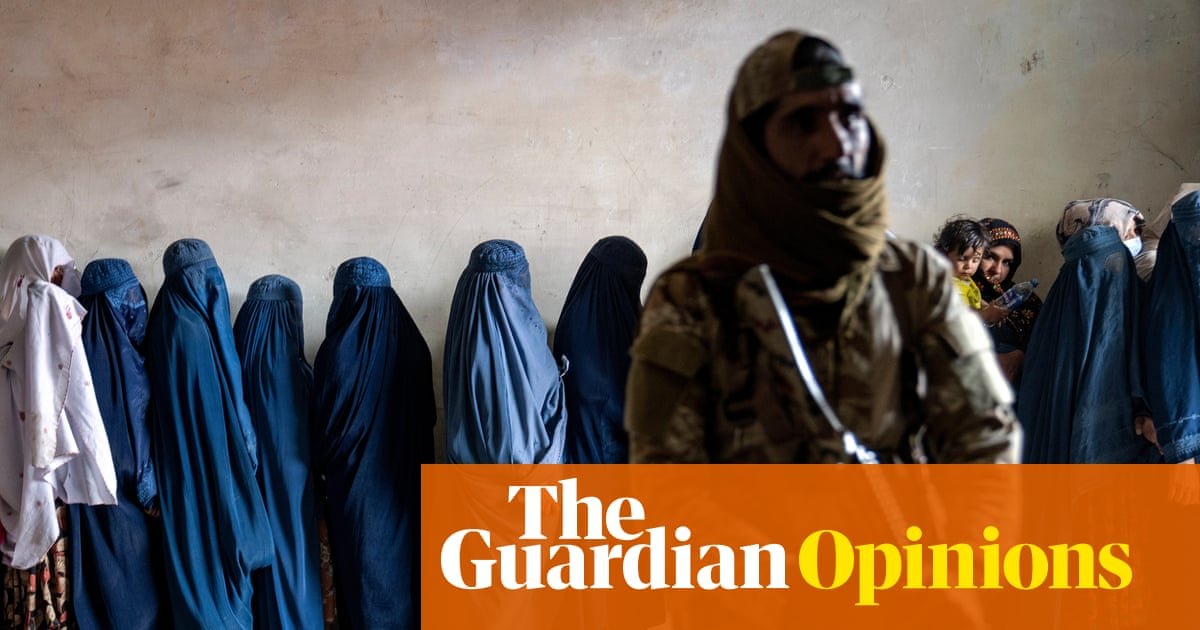
Afghanistan’s Taliban government has now issued its most extreme edict yet. It is already the only regime in the world where girls are excluded from secondary education. Now it has gone further, debarring all Afghan women from any contact with schools or education and doubling down on what has been rightly condemned as “gender apartheid”.
This latest wave of repression, which is likely to be classified by United Nations legal authorities as a crime against humanity, marks the victory of the extreme Kandahar clerical faction over Kabul-based government ministers. It is also the latest step in the plan of supreme leader Hibatullah Akhundzada to erase girls and women from public life.
This new ruling exposes, too, the miscalculations and errors being made by foreign governments that, even as the regime has stepped up the suppression of women, have recently sought to rebuild diplomatic relations with the Taliban regime. Four-and-a-half years into the Taliban’s ascent to power, more children than ever are being denied education. A total of 2.2 million girls have been excluded from secondary education, and up to 2.3 million primary school-age children are no longer attending lessons.
In successive edicts since 2021, women have now been banned from universities and most employment, including with the government and NGOs. They have been required to cover their faces, to be accompanied by male relatives for any long-distance travel, and have been warned they face arrest if seen in public spaces such as parks, gyms and beauty salons.
This appeasement of the Taliban, led by Russia, China and India and followed by some European governments, has led Afghans’ religious rulers to believe they can act with impunity.
December saw the arrest of a female journalist, Nazira Rashidi, in the northern city of Kunduz. Another young woman, Khadija Ahmadzada, was imprisoned in Herat for being in “violation” of rules by running a women’s sports gym and spent 13 days in jail until Richard Bennett, the United Nations special rapporteur on human rights in Afghanistan, successfully pressed for her release.
Bennett is warning that conditions for girls and women are deteriorating and that the Taliban’s newly issued criminal procedure code foreshadows even more violations of girls’ and women’s rights.
The latest repression marks the triumph of Akhundzada, the supreme ruler, and has seen key government departments and functions, including the control of weapons, redirected from Kabul to Kandahar. While the Kabul faction acknowledges that the economy requires women’s participation and access to technology, Akhundzada has become increasingly determined to impose a strict Islamic emirate, isolated from the modern world, where religious figures loyal to him control every aspect of society.
His ideology is so rigid that he approved of his son’s choice to become a suicide bomber. He lost out – but only momentarily – when, within days of his 29 September order for a complete internet shutdown that would have severed Afghanistan’s links with the world and prevented girls from enjoying online education, he was defied by the Kabul-based telecommunications ministry, which switched the service back on. But by December, as a UN monitoring team noted, Akhundzada’s consolidation of power had also involved “a continued buildup of security forces under the direct control of Kandahar”.
Central to the latest repression are internal disagreements within the Taliban, not least about the future of education and women’s employment. Indeed, evidence compiled by the BBC includes a tape of Akhundzada from January 2025 warning that “as a result of these divisions, the emirate will collapse and end”. The rifts are significant. After warning publicly of the regime “committing injustice against 20 million people” – the entire female population of the country – and saying the denial of education was “straying from the path of God”, Sher Mohammad Abbas Stanikzai, the then-deputy foreign minister, had to flee the country.
Russia became the first country to recognise the Taliban government and restore full diplomatic relations without securing any concessions on girls’ and women’s rights. China accepted the credentials of an ambassador from the Taliban regime in January 2024. India upgraded its ties with the regime, including by formally reopening its embassy in Kabul, and proclaimed that “the future of India-Afghanistan relations seems very bright”.
European countries have increased engagement with the Taliban as part of a push to deport failed Afghan asylum seekers, lending credibility to the regime despite its persecution of girls and women. Yet the 59th session of the UN human rights council, held in June–July 2025, debated this matter, and Bennett, the UN special rapporteur, has persistently advocated making girls’ rights a condition for engagement with the Taliban and devising mechanisms to hold the regime accountable, including referring the denial of education to the international criminal court (ICC).
They want to make gender apartheid an international crime, and already the UN’s sixth committee (legal) has advanced a draft global treaty targeting the denial of girls’ and women’s rights as crimes against humanity. In July, the pre-trial chamber of the ICC issued arrest warrants for Akhundzada and Abdul Hakim Haqqani, the two most senior Taliban officials charged with gender-based persecution. But because of the Taliban’s refusal even to discuss girls’ rights, and their insistence on excluding women’s organisations from any talks, international negotiations held in Doha, hosted by the UN and Qatar, have secured no concessions on girls’ schooling or women’s rights.
Whereas India, Iran and Russia backed forces that put the Taliban under real pressure in the 1990s, there is no organised armed anti-regime force within Afghanistan this time.
There is underground schooling in areas such as the Panjshir valley, where radio broadcasts cover everything from breastfeeding to basic school science lessons for women and girls. Girls also study in what are called “home schools”, or leave for Pakistan or Iran to continue their education abroad, even in the face of those countries’ repatriation of 2.6 million Afghan refugees in 2025. Some young women have recently come to Scotland on scholarships to study to become doctors.
There is a good reason why a failure to educate girls will eventually bring down the regime: Afghanistan’s population has swelled to more than 43 million and is only growing, with a predicted 17.4 million people food-insecure by March and 4.9 million mothers and children suffering from malnutrition. But building an economy that will take millions from poverty to prosperity will be impossible so long as the Taliban deny half their population the chance to be educated and to join the workforce. That is their failure. If we are in any way sanguine about this medieval repression, that will be ours.
