

Parwana* no longer recognises her own children. Once known for her beauty in her village in Kandahar province, the 36-year-old sits on the floor of her mother’s home, rocking silently. After nine pregnancies and six miscarriages, many under pressure from her husband and in-laws, Parwana has slipped into a permanent state of confusion.
“She is lost,” says her mother, Sharifa. “They broke her with fear, pregnancies and violence.”
Since the Taliban’s informal birth-control ban began spreading across Afghanistan in 2023, the country’s reproductive health system has gone into freefall. Contraceptives have disappeared, clinics have closed and complications are going untreated.
The ban was never formally announced, but by early 2023, doctors and midwives in multiple provinces reported the same pattern: supplies arriving late, then in smaller quantities and then not at all.
If we see you give this to women again, we will close your clinicTaliban fighters
In interviews with the Guardian and Zan Times, women from seven provinces have explained the same traumas: pregnancies they cannot prevent, miscarriages they cannot treat and violence they cannot escape.
Shakiba*, 42, a mother of 12 from the city of Kandahar, says she cannot rise without feeling faint. Her hair falls out in handfuls; her bones hurt constantly.
Now she is pregnant again. Her local clinic no longer offers contraceptives and her husband forbids her from seeking them elsewhere.
In rural Jawzjan, a province in northern Afghanistan, a doctor who has run a clinic for three decades says the disappearance was rapid. “After the Taliban came, the contraceptives started reducing. Within months, they were gone,” she says.
“Before, at least 30 out of 70 women who came to the clinic needed birth control. Now we tell them: we have nothing.”
Afghans wait at an overstretched hospital pharmacy in Ghazni province, where 30 clinics closed after the US cut off aid, compounding the Taliban’s healthcare restrictions. Photograph: Getty
In the northern province of Badghis, a doctor at a private clinic says Taliban fighters arrived and ordered staff to destroy all of the contraceptives. “‘If we see you give this to women again, we will close your clinic,’ they said. We stopped immediately.”
Two years ago, after an earthquake left Zarghona*, 29, and her family living in a tent, she went three days without access to a toilet and developed a life-threatening intestinal blockage. Surgeons operated and warned her husband plainly that another pregnancy could kill her.
They have anaemia, vitamin deficiencies, low blood pressure. Their bodies are too weak to carry pregnancies safelyDoctor in Jawzjan
A year after her surgery, with no contraception available and a husband insisting he “needed a daughter”, Zarghona became pregnant again. She spent nine months in fear, tried to end the pregnancy with herbs and saffron, and managed just one antenatal visit.
When her labour began, doctors in the city of Herat told her that both a caesarean and natural delivery carried a high chance of death. She survived, but weeks later is still bleeding and lives with constant pain.
Doctors say Zarghona must never be pregnant again, yet there are no injections or contraceptives in her area. “I’m still terrified. I have no way to protect myself,” she says.
According to the United Nations and the World Health Organization, more than 440 hospitals and clinics have closed or reduced their services since international funding was cut last year.
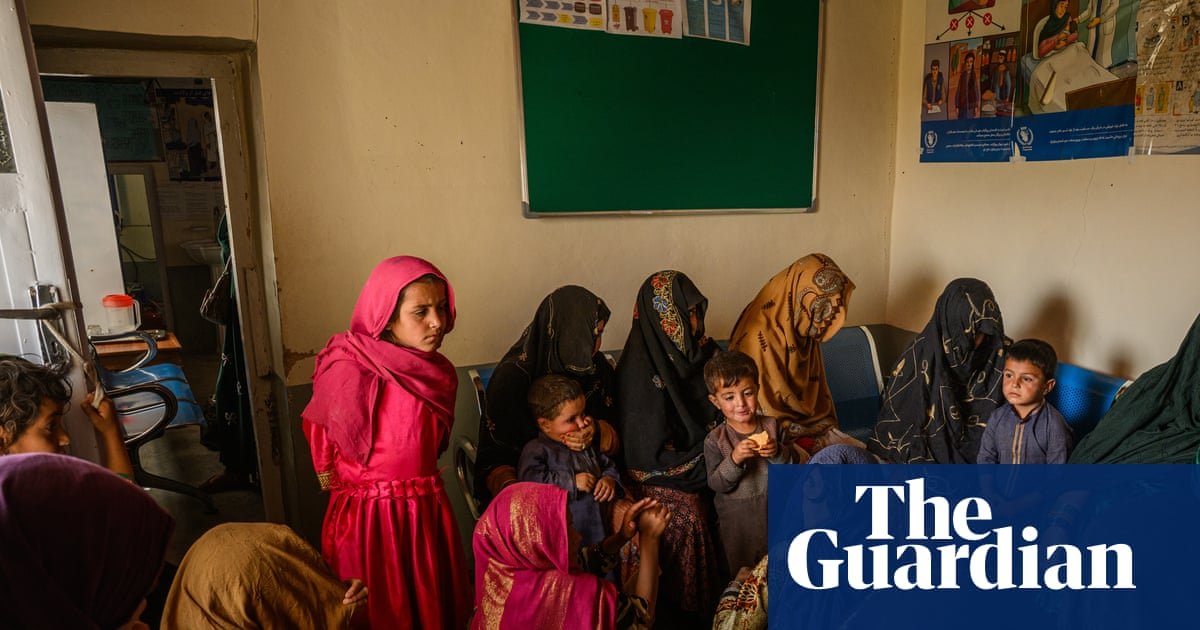
For women in rural provinces, the closure of clinics means hours of walking or giving birth at home, often alone. In villages isolated by mountains and mud roads, midwives say women can bleed for days before they reach a clinic.
A woman carries her child at a Médecins Sans Frontières clinic in Herat. There are now so few medical facilities that people travel hundreds of miles to reach a clinic. Photograph: AFP/Getty
The reproductive crisis has become inseparable from Afghanistan’s economic crisis. A doctor in the northern province of Jawzjan estimates that 80% of the pregnant and breastfeeding women she sees are malnourished.
“They have anaemia, vitamin deficiencies, low blood pressure. Their bodies are too weak to carry pregnancies safely,” she says.
Each time they hit her, she bled. She lost her baby
Domestic violence also emerges again and again in women’s testimonies, as a cause of miscarriage and a method of control in households where women cannot escape, cannot seek shelter and cannot access contraception.
In Kandahar, Reyhana* recounts how her sister Sakina*, a young widow, was forced by her in-laws to marry her brother-in-law. When she objected, they beat her repeatedly. “Each time they hit her, she bled. She lost her baby.”
Hamida*, a midwife who works in an overcrowded maternity ward in Kandahar, says violence is one of the leading causes of the miscarriages she sees. “Every 24 hours, we see more than 100 deliveries. About six miscarriages happen each day; many are from beatings, many are from women carrying heavy loads.”
Soraya, 35, whose local clinic had to shut, waits for medicine in Jaghori: ‘Now I only go to the doctor if I am very sick … But before I could walk an hour and reach the clinic.’ Photograph: Getty
Humaira*, 38, says she took abortion pills when she discovered she was pregnant with a girl. “My husband wanted a son. If I gave birth to another daughter, he would beat me or divorce me. So I bought medicine secretly.”
Her story is echoed by other women in Kandahar and Jawzjan who described miscarriages that were either forced, self-induced or the result of abuse after ultrasounds showed the foetus was female.
In the central province of Ghor, a 15-year-old girl says she miscarried after carrying two full jerrycans of water up a steep hill. “I was ashamed to tell anyone,” she says. “By the time my mother saw me, it was too late.”
In a remote part of Herat province, Shamsia*, 38, says she worked in construction and brickmaking throughout her pregnancies. “My mother-in-law forced me to breastfeed her baby too. I became weaker every day.” When the doctor told her she needed a blood transfusion, she says her family refused, calling it “haram” (meaning that it was forbidden or sinful).
Before the informal ban on contraceptives, rural clinics held regular sessions on spacing out births. Now those programmes have all been stopped. “There is no purpose in giving awareness when there is no medicine. The Taliban have not given written orders, but the fear is real. If we speak openly, they may shut us down,” says one doctor.
* Names have been changed to protect identities
Freshta Ghani contributed to this report
