

January 25, 2026
4 min read
Add Us On GoogleAdd SciAm
JWST unveils most intricate map yet of cosmic dark matter
Astronomers puzzled out minuscule distortions in images of faraway galaxies taken by JWST in order to chart the invisible
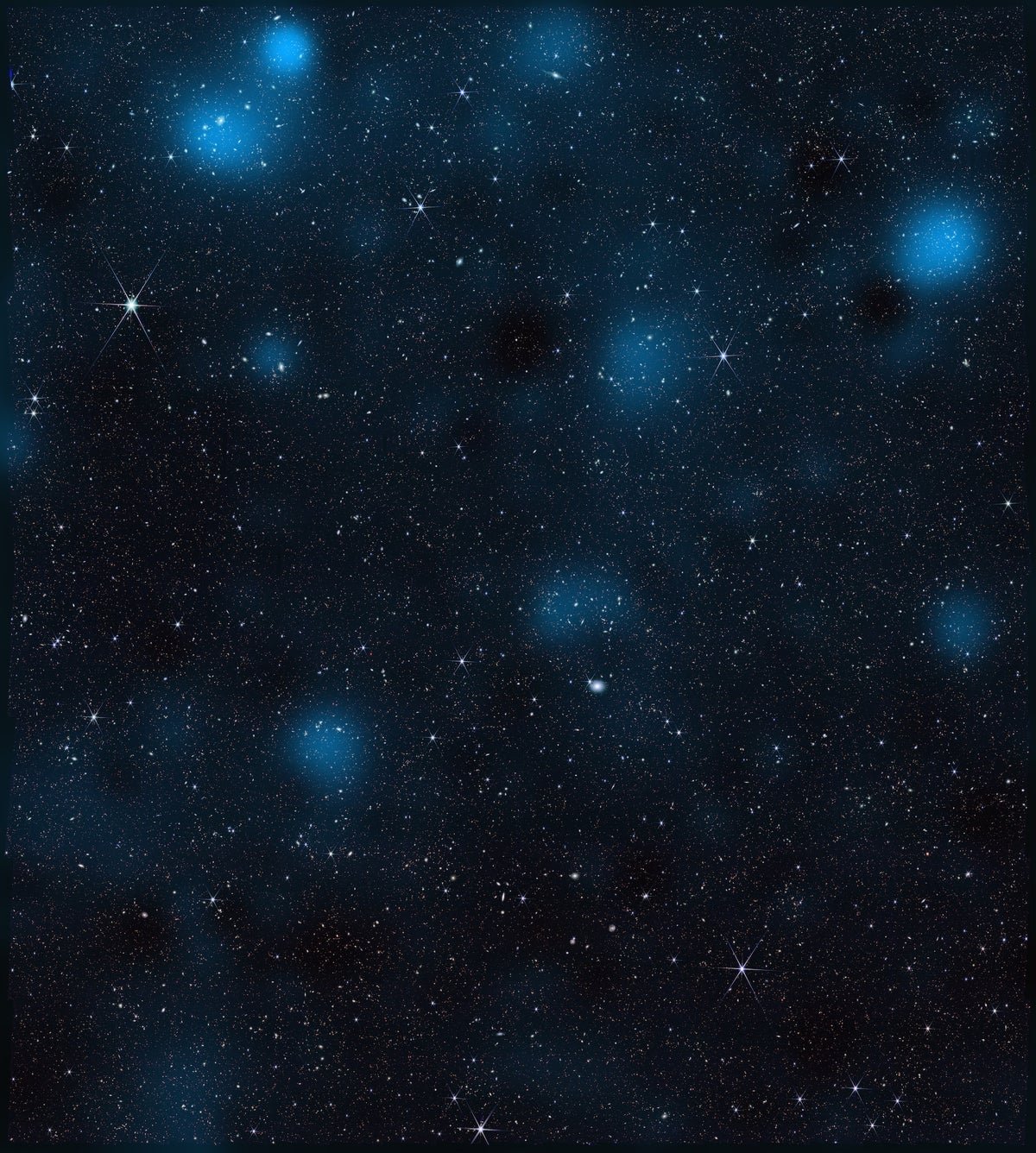
Containing nearly 800,000 galaxies, this image from NASA’s James Webb Space Telescope (JWST) is overlaid with a map of dark matter, represented in blue. Researchers used JWST data to find the invisible substance via its gravitational influence on regular matter.
NASA/STScI/J. DePasquale/A. Pagan
It’s an open secret in astronomy that, practically wherever the James Webb Space Telescope (JWST) looks in the sky, a vast, clump-filled mist fills its view. But luckily for everyone marveling at JWST’s crisp snapshots of faraway galaxies, this dense haze is totally invisible.
That lightless, see-through murk is dark matter. Think of dark matter as scaffolding for all the luminous, normal stuff out there—with the former outweighing the latter five times over—like a gravitational glue that holds everything else together. But scientists have no idea what this “glue” is made of and have yet to detect it directly; they have only inferred its presence through subtle but unmistakable clues. For something so integral to all we see, it’s astonishingly hidden from our cosmic view.
Now astronomers have traced dark matter’s ghostly contours in the foreground of one of JWST’s deep-sky images. They’ve turned a survey of the Cosmic Evolution Survey (COSMOS) field—one of the sky’s best-studied patches—into the most finely detailed dark matter map in existence. With it, they hope to learn more about how galaxies depend on its presence. A study reporting the results appears today in Nature Astronomy.
On supporting science journalism
If you’re enjoying this article, consider supporting our award-winning journalism by subscribing. By purchasing a subscription you are helping to ensure the future of impactful stories about the discoveries and ideas shaping our world today.
“We can see the influence of gravity on galaxy formation,” says Diana Scognamiglio, a postdoctoral fellow at NASA’s Jet Propulsion Laboratory, who co-led the study. “It’s a way to trace, really, the backbone of the universe.”
Gaze upon any JWST image of some faraway galaxy. What you really see is where each ray of light hit JWST’s optics during observations. The image essentially traces each ray back to its source within a targeted galaxy.
But that ray’s journey from the galaxy to JWST isn’t really a straight line. On its voyage through intergalactic space, that light traverses countless clumps of dark matter. Each clump slightly warps the spacetime around it, altering the light ray’s path much like a glass lens.
That warping distorts the image in the same way that wearing someone else’s glasses blurs your sight. For JWST’s images, this effect is imperceptible to the eye, which is why it’s called “weak gravitational lensing.” But the images encode all the dark matter between the far-off object and the telescope.
No one knew how to decode this warping, however, until around the start of the third millennium. “People were saying that there’s absolutely no way you can measure a 1 percent distortion with everything else going on,” says Catherine Heymans, a professor of astrophysics at the University of Edinburgh and Scotland’s astronomer royal. Heymans and her peers proved them wrong, launching the field of “weak lensing” that has since shed more light on dark matter.
Heymans helped build the first dark matter map of the COSMOS field using JWST’s predecessor, the Hubble Space Telescope. “It was a really pioneering work,” Scognamiglio says.
Two decades later Scognamiglio’s team of cosmic cartographers has updated that map using the heaps more galaxies JWST’s images contain. “It’s super exciting just because of the sheer number of galaxies and that they can use,” says Zoltan Haiman, an astrophysicist at Columbia University. The new map spans an area on the sky only twice as big as the full moon—a quarter of the original’s size—but it’s far more detailed, pinpointing blobs of dark matter that are too small for Hubble to discern.
And JWST’s larger, more sensitive optics can collect light from farther out in the universe—and thus further back in cosmic time. So it can see weak lensing caused by dark matter clumps from 10 billion or 11 billion years ago, when the universe was most prodigiously forming stars and galaxies. Studying these clumps—which likely host clusters of adolescent galaxies—is a rare chance to learn more about what dark matter’s role was in that epoch, called “cosmic noon,” and how the universe has evolved ever since. Next the team wants to infer the various distances of the structures that the researchers have glimpsed and to use them to make the map more dynamic and three-dimensional.
For now, the map as is puts one of the universe’s most elusive sculptors starkly in view. “Before we only had dark matter simulations, and I always wanted to be able to see it,” Heyman says. “What I love about weak lensing is: it allows us to see the invisible.”
In the coming years, astronomers’ dark matter maps will be massively extended—though with less fine-grained detail. Weak lensing is part of the stated mission of newer space telescopes such as the European Space Agency’s Euclid, already in orbit, and NASA’s Nancy Grace Roman Space Telescope, scheduled for launch this year. Ground-based projects such as the Dark Energy Survey, which released a new trove of data last week, and the Vera C. Rubin Observatory also use weak lensing to study the universe’s expansion.
A generation after the trailblazing Hubble dark matter map, Scognamiglio is proud to help extend its legacy. “I like this continuity,” she says. “I hope that, 20 years from now, my student will be able to make an even better map.”
It’s Time to Stand Up for Science
If you enjoyed this article, I’d like to ask for your support. Scientific American has served as an advocate for science and industry for 180 years, and right now may be the most critical moment in that two-century history.
I’ve been a Scientific American subscriber since I was 12 years old, and it helped shape the way I look at the world. SciAm always educates and delights me, and inspires a sense of awe for our vast, beautiful universe. I hope it does that for you, too.
If you subscribe to Scientific American, you help ensure that our coverage is centered on meaningful research and discovery; that we have the resources to report on the decisions that threaten labs across the U.S.; and that we support both budding and working scientists at a time when the value of science itself too often goes unrecognized.
In return, you get essential news, captivating podcasts, brilliant infographics, can’t-miss newsletters, must-watch videos, challenging games, and the science world’s best writing and reporting. You can even gift someone a subscription.
There has never been a more important time for us to stand up and show why science matters. I hope you’ll support us in that mission.
