

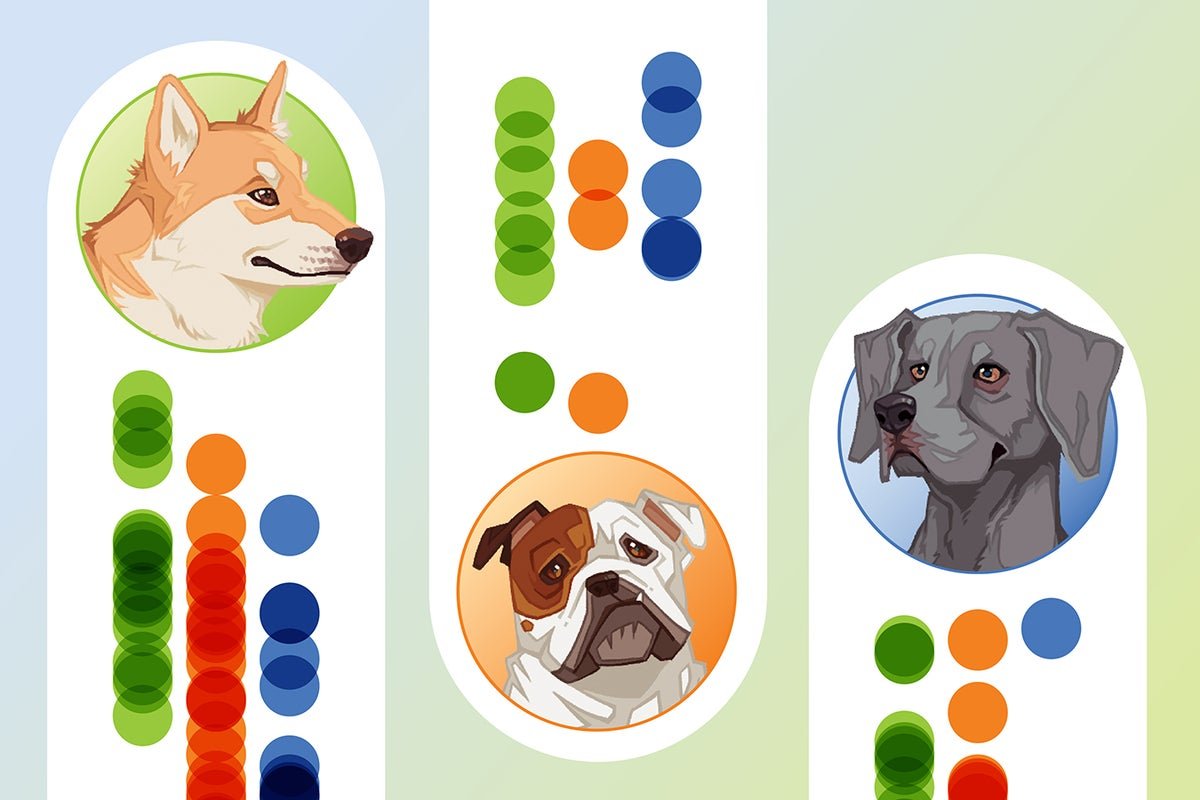
Dogs can have wildly different personalities, which often vary by breed and size. Although individual temperament matters most, larger trends can help predict which pooch will be meek and mild and which is most likely to bite the postal worker.
The Dog Aging Project, a long-term study on canine aging, has collected data on dog behavior from more than 50,000 owners, distilling the results into scores for traits such as trainability, excitability and aggression. Owners of mixed-breed dogs reported higher average scores for fear and aggression than owners of single-breed dogs, for instance. And compared with larger dogs, smaller dogs tended to score higher for fear, aggression and excitability and lower for trainability. Understanding these patterns is key to improving the compatibility of people and their pets. “Dogs are entirely dependent on their owner,” says veterinarian Audrey Ruple of the Virginia-Maryland College of Veterinary Medicine, a collaborator on the Dog Aging Project. A mismatch can be “devastating,” but a good match can ensure dogs receive the care and affection they need.
On supporting science journalism
If you’re enjoying this article, consider supporting our award-winning journalism by subscribing. By purchasing a subscription you are helping to ensure the future of impactful stories about the discoveries and ideas shaping our world today.
SMALL DOG SYNDROME
Dog breeds classified as toy or small have higher owner-rated scores on aggression and fear, as well as lower trainability scores. Large and giant dog breeds, in contrast, are on average the most trainable and the least aggressive and anxious. “I suspect it has to do with the way small dogs are treated as compared with large dogs,” Ruple suggests. Good behavior in a big dog is often judged as more of a necessity, whereas people may let little dogs off the hook.
OLD DOGS, NEW TRICKS
Dogs rated as more trainable tend to learn new skills more readily. They often obey “sit” or “stay” commands immediately, and they aren’t as easily distracted by interesting sights, sounds or smells. Some breeds are known for being easily taught, and mixed-breed dogs tend to get rated as less trainable than purebreds. That pattern, however, might reflect the early life experiences of mixed-breed dogs, who often are adopted from shelters or rescues and have experienced trauma, Ruple says. A purebred dog raised by a reputable breeder, however, will be primed to be comfortable around people and eager to learn. collectively find solutions to these problems as long as the federal government remains committed to providing funding for this research,” Wilson notes.
It’s Time to Stand Up for Science
If you enjoyed this article, I’d like to ask for your support. Scientific American has served as an advocate for science and industry for 180 years, and right now may be the most critical moment in that two-century history.
I’ve been a Scientific American subscriber since I was 12 years old, and it helped shape the way I look at the world. SciAm always educates and delights me, and inspires a sense of awe for our vast, beautiful universe. I hope it does that for you, too.
If you subscribe to Scientific American, you help ensure that our coverage is centered on meaningful research and discovery; that we have the resources to report on the decisions that threaten labs across the U.S.; and that we support both budding and working scientists at a time when the value of science itself too often goes unrecognized.
In return, you get essential news, captivating podcasts, brilliant infographics, can’t-miss newsletters, must-watch videos, challenging games, and the science world’s best writing and reporting. You can even gift someone a subscription.
There has never been a more important time for us to stand up and show why science matters. I hope you’ll support us in that mission.
