
Close Menu

    Subscribe to Updates

    Get the latest creative news from FooBar about art, design and business.

    What's Hot

    I love vultures, mosquitoes and, yes, even wasps. This is why you should too | Jo Wimpenny

    From childhood to midlife and beyond: how to handle anxiety at every age | Life and style

    Spaceflight supercharges viruses’ ability to infect bacteria

    Facebook X (Twitter) Instagram
    Facebook X (Twitter) YouTube LinkedIn
    Naija Global News |
    Sunday, March 15
    • Business
    • Health
    • Politics
    • Science
    • Sports
    • Education
    • Social Issues
    • Technology
    • More
      • Crime & Justice
      • Environment
      • Entertainment
    Naija Global News |
    You are at:Home»Science»Chinese nuclear fusion reactor pushes plasma past crucial limit: what happens next
    Science

    Chinese nuclear fusion reactor pushes plasma past crucial limit: what happens next

    onlyplanz_80y6mtBy onlyplanz_80y6mtJanuary 9, 2026003 Mins Read
    Share Facebook Twitter Pinterest LinkedIn Tumblr Email
    Chinese nuclear fusion reactor pushes plasma past crucial limit: what happens next

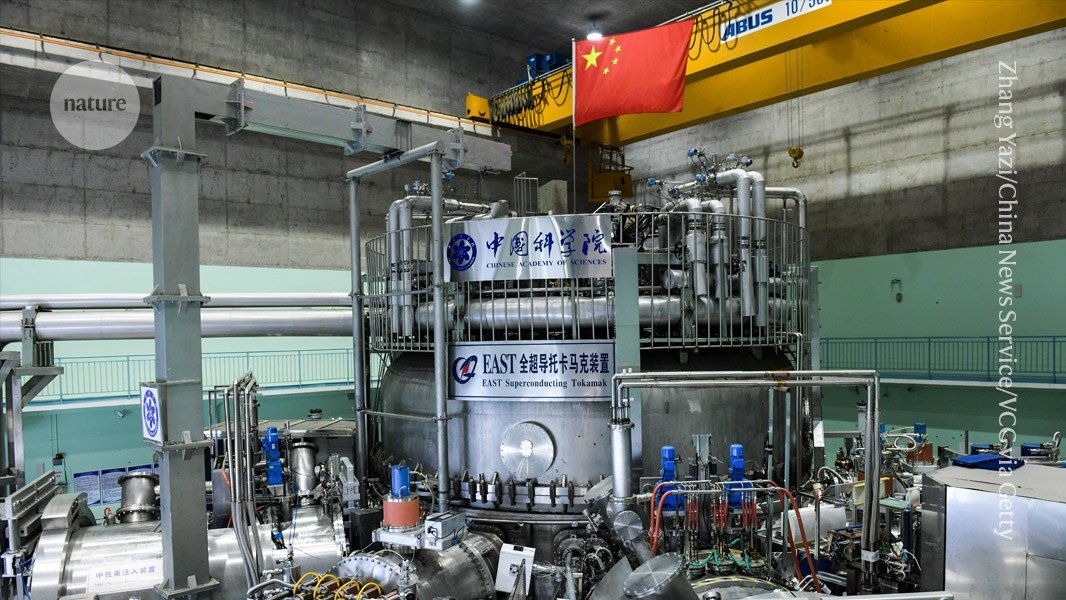
    The Experimental Advanced Superconducting Tokamak is a nuclear-fusion research reactor in Hefei, China.Credit: Zhang Yazi/China News Service/VCG via Getty

    Share
    Facebook Twitter LinkedIn Pinterest Email

    The Experimental Advanced Superconducting Tokamak is a nuclear-fusion research reactor in Hefei, China.Credit: Zhang Yazi/China News Service/VCG via Getty

    Researchers working on China’s ‘artificial sun’ have reported breaking a long-accepted threshold that has limited the operation of nuclear-fusion reactors for decades.

    China’s Experimental Advanced Superconducting Tokamak (EAST) is a nuclear-fusion research reactor in Hefei. Researchers hope that it will one day produce clean, nearly limitless energy by replicating the fusion processes that power the Sun.

    In fusion reactors, light-weight atoms are compressed under extreme pressure and heat to form heavier atoms. This process releases energy, but it must be optimized carefully so that the reactor produces more energy than it consumes.

    One of the most promising reactor designs, the tokamak, confines plasma inside a doughnut-shaped chamber using magnetic fields. The plasma is then heated. To sustain fusion reactions, the plasma must reach an extremely high density — meaning many particles must be packed into a small volume.

    But researchers thought that plasma could not exceed a certain density without becoming unstable. This upper limit — known as the Greenwald limit — has been a major obstacle for fusion research, particularly for tokamak-type devices.

    In a paper published on 1 January in Science Advances1, scientists working on China’s EAST device reported pushing plasma densities beyond this limit, achieving densities 30% to 65% higher than those normally reached by EAST.

    “These results are very promising and should be explored in other tokamak devices,” says Jeronimo Olaya, a fusion plasma physicist at the French Alternative Energies and Atomic Energy Commission in Saint-Paul-lez-Durance.

    Fewer impurities

    In 2021, study co-author Dominique Escande, a plasma physicist at the Aix-Marseille University in France, and colleagues first proposed2 that the Greenwald limit could be surpassed by adjusting the conditions so that the plasma and the inner wall of the reactor are in a stable, mutually reinforcing state.

    The EAST team used high power microwaves to raise the temperature of the initial fuel used to generate the plasma in a more efficient way than those used in conventional methods. This reduced the number of metal atoms that were knocked off the tokamak’s inner walls and mixed into the plasma. Fewer impurities mean less unwanted radiation, helping the plasma to remain stable even as its density increases.

    The researchers also injected a high amount of neutral gas into the chamber. This provided more fuel for the plasma to reach high densities later in the experiment, while simultaneously cooling the region near the walls and further reducing the production of impurities.

    Chinese crucial fusion Limit Nuclear plasma pushes Reactor
    Share. Facebook Twitter Pinterest LinkedIn Tumblr Email
    Previous ArticlePrincess of Wales says nature ‘helped me heal’ in 44th birthday video | Catherine, Princess of Wales
    Next Article Another State Requires Social Media Warning Labels
    onlyplanz_80y6mt
    • Website

    Related Posts

    Spaceflight supercharges viruses’ ability to infect bacteria

    March 15, 2026

    Can scientists really resurrect the dodo? Inside the company that says they can | US news

    March 15, 2026

    Vaccine-carrying mosquitoes could inoculate bats against rabies

    March 14, 2026
    Add A Comment
    Leave A Reply Cancel Reply

    Top Posts

    Watch Lady Gaga’s Perform ‘Vanish Into You’ on ‘Colbert’

    September 9, 20251 Views

    Advertisers flock to Fox seeking an ‘audience of one’ — Donald Trump

    July 13, 20251 Views

    A Setback for Maine’s Free Community College Program

    June 19, 20251 Views
    Stay In Touch
    • Facebook
    • YouTube
    • TikTok
    • WhatsApp
    • Twitter
    • Instagram
    Latest Reviews

    At Chile’s Vera Rubin Observatory, Earth’s Largest Camera Surveys the Sky

    By onlyplanz_80y6mtJune 19, 2025

    SpaceX Starship Explodes Before Test Fire

    By onlyplanz_80y6mtJune 19, 2025

    How the L.A. Port got hit by Trump’s Tariffs

    By onlyplanz_80y6mtJune 19, 2025

    Subscribe to Updates

    Get the latest tech news from FooBar about tech, design and biz.

    Most Popular

    Watch Lady Gaga’s Perform ‘Vanish Into You’ on ‘Colbert’

    September 9, 20251 Views

    Advertisers flock to Fox seeking an ‘audience of one’ — Donald Trump

    July 13, 20251 Views

    A Setback for Maine’s Free Community College Program

    June 19, 20251 Views
    Our Picks

    I love vultures, mosquitoes and, yes, even wasps. This is why you should too | Jo Wimpenny

    From childhood to midlife and beyond: how to handle anxiety at every age | Life and style

    Spaceflight supercharges viruses’ ability to infect bacteria

    Recent Posts
    • I love vultures, mosquitoes and, yes, even wasps. This is why you should too | Jo Wimpenny
    • From childhood to midlife and beyond: how to handle anxiety at every age | Life and style
    • Spaceflight supercharges viruses’ ability to infect bacteria
    • Can scientists really resurrect the dodo? Inside the company that says they can | US news
    • CNN’s Frederik Pleitgen on being the only western journalist in Iran: ‘It’s obviously a big responsibility’ | US-Israel war on Iran
    © 2026 naijaglobalnews. Designed by Pro.
    • About Us
    • Disclaimer
    • Get In Touch
    • Privacy Policy
    • Terms and Conditions

    Type above and press Enter to search. Press Esc to cancel.