

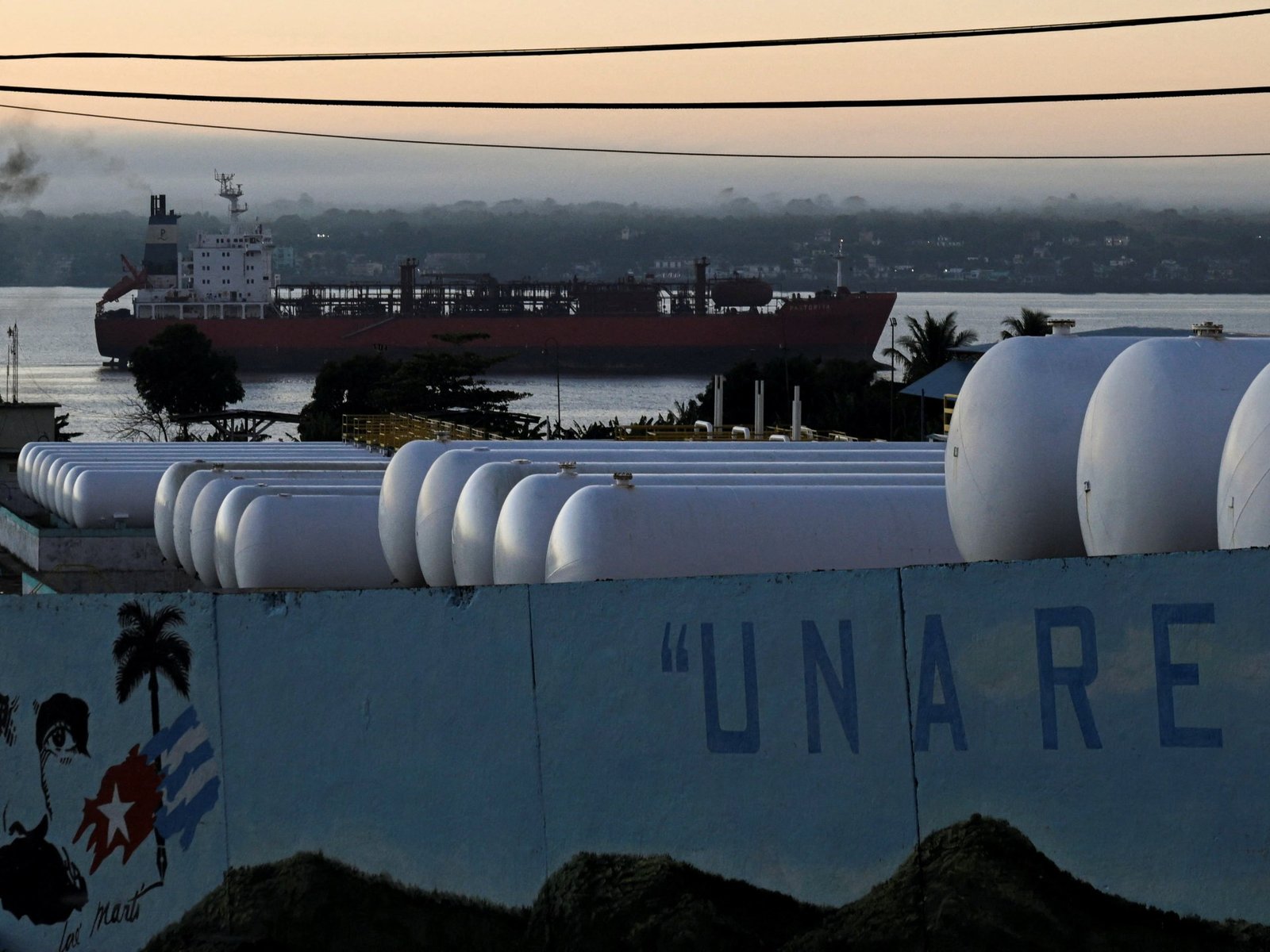
The United States government has said it aims to control Venezuelan oil sales indefinitely.
“We need to have that leverage and that control of those oil sales to drive the changes that simply must happen in Venezuela,” Energy Secretary Chris Wright said on Wednesday.
Recommended Stories
list of 4 itemsend of list
His comments come days after US forces abducted Venezuelan leader Nicolas Maduro on Saturday. Since then, the administration of US President Donald Trump has announced a deal under which Venezuela would turn over 30 million to 50 million barrels of sanctioned oil to the US to sell.
That comes against a backdrop of demands that Venezuelan government officials open up access to US oil companies or risk further military action.
On Friday, executives from several major oil companies, including ExxonMobil, ConocoPhillips, and Chevron, are slated to meet with the president to discuss potential investments in Venezuela.
Can the US control Venezuelan oil sales indefinitely?
“The US federal government can absolutely intervene, make demands, capture what it wants, and redirect those barrels accordingly. I don’t know of anything that would meaningfully interfere with the federal government if that’s what it decided to do,” Jeff Krimmel, founder of Krimmel Strategy Group, a Houston, Texas-based energy consulting firm, told Al Jazeera.
There are, however, geopolitical hurdles. The US has less leverage than it did more than two decades ago when the US military and its allies entered Iraq, another oil-rich country. Today, other superpowers could stand in the way in ways they did not in 2003.
“When we went into Iraq, we were living in a unipolar moment as the world’s only great power. That era is over. China is now a great power, and most experts consider it a peer competitor. That means it has ways to hurt the US economy and to push back militarily, including through proxy conflicts, if it chooses to oppose such actions,” Anthony Orlando, professor of finance and law at California State Polytechnic University, Pomona, told Al Jazeera.
China is the largest purchaser of Venezuelan crude, although it only imports about 4 percent of its oil from the South American nation.
“It’s a question of whether they want to draw a line in the sand with the United States and say, ‘You can’t do this, because if we allow it, you’ll keep pushing further,’” Orlando said.
“If you’re a minor power like Venezuela, not China or Russia, you’re a country vulnerable to US intervention. That creates an incentive to align more closely with China or Russia to prevent it from happening, and that’s not a good outcome for the United States,” Orlando continued.
In the days since Maduro’s abduction, members of the Trump administration have also renewed calls to take over Greenland.
How does this compare with Iraq?
The US intervention in Venezuela has been compared to its involvement in Iraq, which began under the administration of former President George W Bush in 2003. At the time, Iraq had the second-largest oil reserves in the world, with 112 billion barrels.
However, production was limited. Prior to the invasion, Iraq produced 1.5 million barrels per day (bpd), rising to 4.5 million bpd by 2018.
While the Iraqi government retained ownership of oil, US companies were often given no-bid contracts to operate there, including ExxonMobil and BP, and the majority of sales went to Asian and European markets.
In 2021, Iraq’s then-President Barham Salih claimed that an estimated $150bn in money stolen through corrupt deals had been “smuggled out of Iraq” since the 2003 US-led invasion.
Unlike during the Bush administration and its aims for Iraq’s oil, the Trump administration has been explicit about the role of oil in its attack on Venezuela.
“The difference between Iraq and this is that [Bush] didn’t keep the oil. We’re going to keep the oil,” Trump said in a conversation with MS Now anchor Joe Scarborough.
Comparatively, in 2002, prior to the US invasion, then-Secretary of Defense Donald Rumsfeld asserted that the operation to take control of post-war reconstruction had “literally nothing to do with oil”.
“When the Bush administration went into Iraq, they claimed it wasn’t about that, even though there was substantial evidence it was a factor. This time it’s more explicit, so it’s clear it will impact oil markets. [But] one lesson from the Iraq war is that it’s easier said than done,” Orlando, the professor, told Al Jazeera.
Will this benefit oil companies?
Analysts argue that investments in Venezuela might not actually benefit oil companies due to rising economic uncertainty, the need for major infrastructure improvements, and the fact that large companies like ExxonMobil and Chevron already have capital programmes planned for the remainder of the decade.
“Either [the companies] will have to take on more debt or issue more equity to raise the capital needed, or they’ll have to divert capital expenditures from other regions into Venezuela. In either scenario, I expect substantial shareholder pushback,” Krimmel, the energy consultant, said.
Increased production will also require infrastructure improvements. Venezuelan oil is dense, which makes it more difficult and expensive to extract compared to oil from Iraq or the US.
Venezuelan oil is often blended with lighter grades from the US. It is comparable in density to Canadian oil, which, despite tensions between Ottawa and Washington, comes from a US ally with more modern extraction infrastructure.
“I don’t think Canada’s going to be too happy about all this,” Orlando said.
However, Chevron, the only US company currently operating in Venezuela, is seeking authorisation from Washington to expand its licence to operate in the country after the US placed restrictions on it last year, the Reuters news agency reported on Thursday, citing unnamed sources.
The US role in energy, particularly oil and gas, has surged in recent years amid the rise of fracking technology. The US is now the largest producer of oil in the world. But recent cuts to alternative energy programmes and increasing energy demands from the artificial intelligence industry have led Republicans to double down on expanding the oil and gas sector.
“There is an oil supply surplus. Even if we were in a supply deficit right now, military action in Venezuela wouldn’t unlock incremental barrels quickly. So even if you were trying to solve a short-term supply deficit, which, to be clear, we do not have, Venezuela wouldn’t be an answer because it would take too long and be too expensive to ramp production up,” Krimmel added.
While Venezuela holds the world’s largest oil reserves, the OPEC member represents only 1 percent of global oil output.
Currently, Chevron is the only US company operating in Venezuela. ExxonMobil and ConocoPhillips operated in Venezuela before Hugo Chavez nationalised the oil sector in 2007, leading to a downturn in production over years of disinvestment and poorly run facilities. In the 1990s, Venezuela produced as much as 3.5 million bpd. That has since fallen due to limited investment, with production averaging 1.1 million bpd last year.
“Venezuela’s infrastructure has deteriorated under both the Chavez and Maduro regimes. While they are extracting oil, returning to production levels from 10 or 20 years ago would require significant investment,” Orlando said.
