

January 7, 2026
3 min read
Add Us On GoogleAdd SciAm
Could This Fossil Be the Key Linking Humans, Neandertals and Denisovans?
Fossils of a human ancestor from 773,000 years ago may be near the base of the Homo sapiens lineage, representing a common ancestor of modern humans, Neandertals and Denisovans
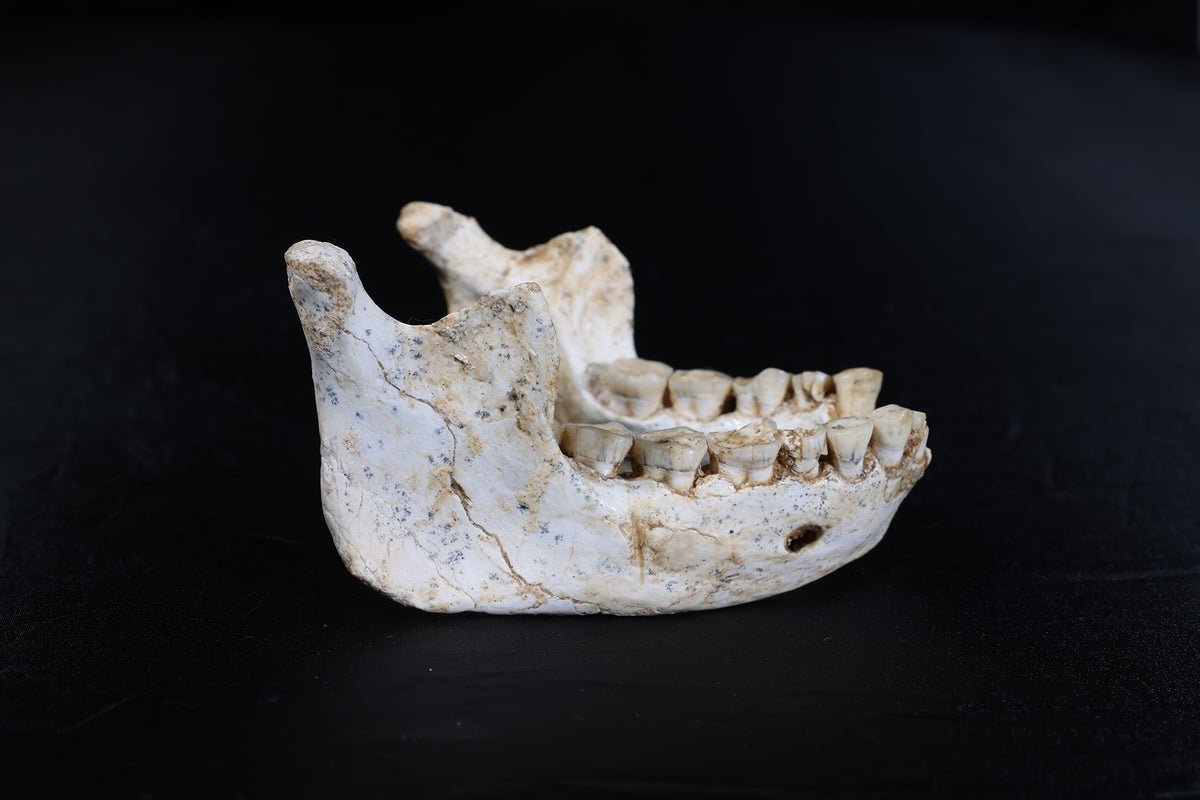
A mandible from the newly discovered ancient human ancestor.
Hamza Mehimdate, Programme Préhistoire de Casablanca
A trio of jawbones, a leg bone, and a handful of vertebrae and teeth found in Morocco may represent one of the last common ancestors of Neandertals, Denisovans and modern humans.
New research published today in Nature dates the bones—chipped out from a cave called Grotte à Hominidés and nearby it over decades—to about 773,000 years ago, during the era of the last common ancestor of Homo sapiens, Homo neanderthalensis and Denisovans (a group of humans that ranged across Asia and that does not have an agreed-upon species name).
“We can say that the shared ancestry between these three species is perhaps in Grotte à Hominidés in Casablanca,” says study co-author Abderrahim Mohib, a prehistorian at the National Institute of Archaeology and Heritage Sciences in Rabat, Morocco.
On supporting science journalism
If you’re enjoying this article, consider supporting our award-winning journalism by subscribing. By purchasing a subscription you are helping to ensure the future of impactful stories about the discoveries and ideas shaping our world today.
The cave is part of a quarry, where the first mandible was discovered in 1969. Another adult mandible and a string of vertebrae turned up in 2008, and part of a child’s mandible was unearthed in 2009. The hominin bones and animal remains make up an assemblage of fossils that appear to come from the den of a carnivore, perhaps a hyena. Among them, a hominin femur that was excavated from the cave bears teeth marks.
Mandibles from North Africa, illustrating variation among fossil hominins and modern humans. The fossils shown are Tighennif 3 from Algeria (upper left), ThI-GH-10717 from Thomas Quarry in Morocco (upper right), and Jebel Irhoud 11 from Morocco (lower left), compared with a mandible from a recent modern human (lower right). All specimens are shown at the same scale, allowing direct comparison of their size and shape.
Researchers weren’t able to make much of this steady drip of hominin fossils until they figured out how old they were. The key to pinning that down was a method called magnetostratigraphy, says Serena Perini, one of the study authors and a postdoctoral researcher at the University of Milan. This method depends on the fact that Earth’s magnetic field flip-flops every few hundred thousand years. The polarity change can be detected in iron-rich minerals. There was a reversal 773,000 years ago, which allowed the researchers to pinpoint when the sediments surrounding the hominin fossils were laid down.
As to who the hominin bones belonged to, tiny anatomical features on them point to an in-between species—one with some traits that were reminiscent of older African hominin species such as Homo erectus and others that were similar to those seen in later African fossils and specimens from Eurasia, Mohib says. This suggests that the Moroccan fossils represent something of an in-between species. They’re similar in age to a Neandertal-like species from Spain called Homo antecessor that had previously been suggested as a possible common ancestor of modern humans, Neandertals and Denisovans. But the traits of the Grotte à Hominidés fossils are more of a mix of new and old.
“They display a combination of primitive and more advanced traits, indicating human populations close to this phase of divergence,” Mohib says. “They thus confirm the deep antiquity of our species’ African roots and highlight North Africa’s key role in the major stages of human evolution.”
These ancestors may have looked quite different from any of these three human lineages, says Antonio Rosas González, a paleoanthropologist at the National Museum of Natural Sciences in Spain, who was not involved in the research but wrote an editorial accompanying its publication. Traits such as a large, spherical skull and a prominent chin had not yet evolved, he says. “The Moroccan fossils document the beginning of a long evolutionary process.”
It’s Time to Stand Up for Science
If you enjoyed this article, I’d like to ask for your support. Scientific American has served as an advocate for science and industry for 180 years, and right now may be the most critical moment in that two-century history.
I’ve been a Scientific American subscriber since I was 12 years old, and it helped shape the way I look at the world. SciAm always educates and delights me, and inspires a sense of awe for our vast, beautiful universe. I hope it does that for you, too.
If you subscribe to Scientific American, you help ensure that our coverage is centered on meaningful research and discovery; that we have the resources to report on the decisions that threaten labs across the U.S.; and that we support both budding and working scientists at a time when the value of science itself too often goes unrecognized.
In return, you get essential news, captivating podcasts, brilliant infographics, can’t-miss newsletters, must-watch videos, challenging games, and the science world’s best writing and reporting. You can even gift someone a subscription.
There has never been a more important time for us to stand up and show why science matters. I hope you’ll support us in that mission.
