

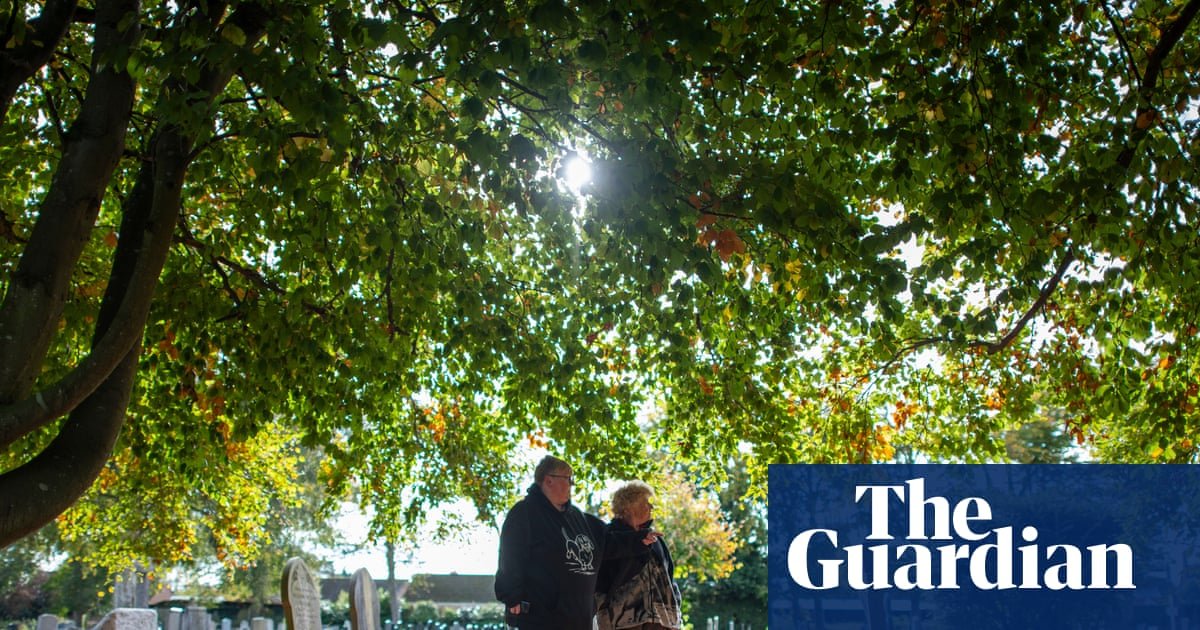
The autumn sunlight is filtering through quietly falling leaves as Louise Cocker stands in front of the gravestone of James Henry Payne and takes a quick photograph. Payne died at the age of 73 in October 1917 and was buried in the Norfolk town of North Walsham, along with his wife Eleanor and son James Edward, who was killed in the Battle of Vimy Ridge in April 1917. “Not lost”, reads the simple slab, “but gone before”.
This is far from the first Norfolk gravestone Cocker, 53, has photographed – in fact, over 24 years, she has captured almost half a million of them, driving around the county on her weekends and days off from her job in the local Lidl supermarket. As a result, she has produced a remarkable dataset of 615,000 names – many graves contain more than one person – which experts consider one of the most comprehensive photographic records of gravestones and memorials in England.
“I’m just passionate about it, I really am,” says Cocker. “I know it sounds crazy.” The appeal lies partly in the peace of spending time in graveyards, she says, where she will gently clear overgrown memorials, often accompanied by her mother, Angela Parke, or husband Neil. But also: “I just like helping people. You can make somebody’s day when you help them find their ancestor that they’re looking for. It’s a really nice feeling.”
To some, Cocker’s hobby may be idiosyncratic, but she is just one of a number of amateur historians whose private passions are “the hidden engine room” of Britain’s boom in genealogical research. According to Mary McKee, UK archives manager of the family history website Findmypast, which facilitates access to Cocker’s database among many others, “the foundation of our entire industry is independent genealogists”.
“If you start getting into genealogy, you think about the birth, marriage and death records, and then the civil or the census records and so on,” says McKee – information that is collected by the state and often held at the National Archives or British Library. “But what comes after that? How do you tell the fuller story?”
That is often when the private obsessions of individuals come into play. In addition to sharing official data such as censuses and military records, and working with about 200 libraries and archives, Findmypast also licenses datasets collected by about 40 dogged amateurs such as Cocker, who are passionate about their own, often highly specific area of history.
Cliff Webb, a former insurance broker now based in Hampshire, is one of them. As a young man working in the City of London he developed an interest in family history, which was regarded as eccentric but could be useful professionally, he says. “There were plenty of people who could talk about football to clients, but people who could show them where [US president] John Quincy Adams was married [in the London church of All Hallows by the Tower] were few and far between.” Over decades, he has compiled a wealth of datasets, including an index of hundreds of thousands of apprentices and their employers dating back to 1442 and a detailed directory of court cases heard in Surrey between the 14th and 19th centuries.
Webb is now focused on wills that were recorded in London church courts in the Elizabethan period, and hopes to compile an index of up to 300,000 “before I die or go completely gaga”. Why? “I think wills are the closest we can get to how the ordinary people felt at the time,” he says. “It’s real humanity – people falling out and reconciling. All human life is there.”
For the retired academic Mark Peel, it was a passion to record “the stories of people who would otherwise be silent” that fuelled his decades-long work, in his free time, compiling a new dataset of civilian casualties of the second world war in Britain. Painstaking efforts were made at the time to record the identities of people killed in bombing raids, he says. By combining the names recorded by the Commonwealth War Graves Commission with contemporary street maps, burial registers and other sources, his data offers much more texture and detail about those who died.
“People did the most amazing things in the most harrowing circumstances to make sure that people weren’t forgotten and just lost,” says Peel, who began his work while working in his native Australia and now lives in Leicestershire. “And that was part of it for me too. I want these people to be there in the record, with something very tangible. Here are their names, here are their relationships. Here is where they died.
“I think that each of these people has a story, and each of them is owed a remembering, and not because they were heroes. They weren’t. They were caught up in something appalling, and we need to remember that it was appalling.”
