

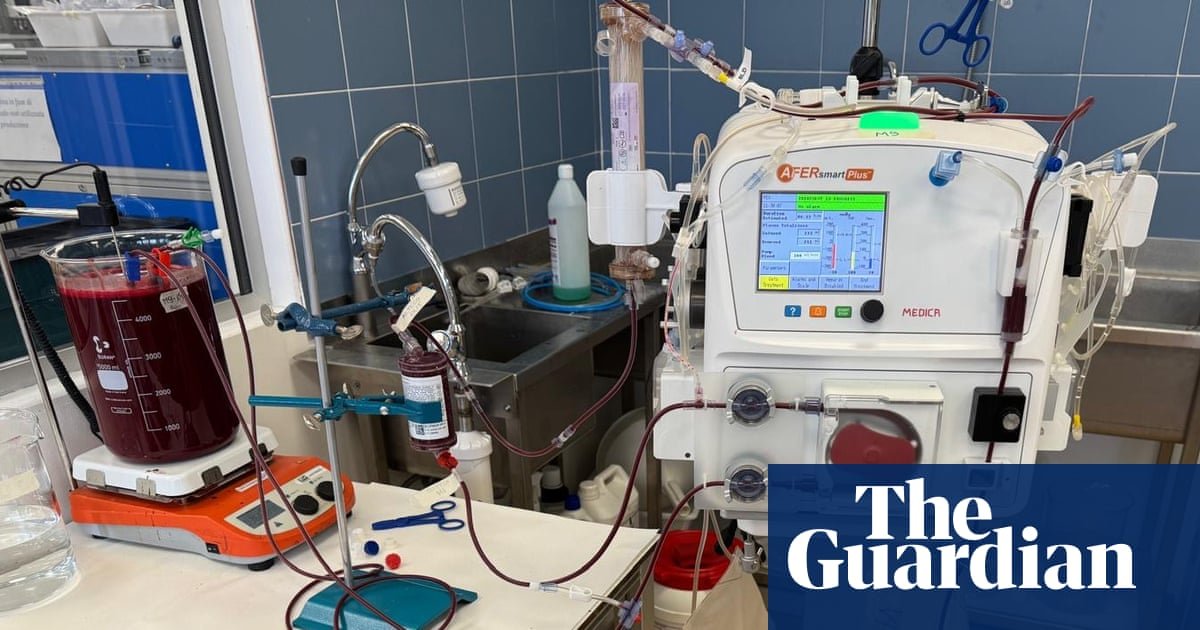
The NHS is to trial a potentially life-saving new treatment for a deadly liver disease that causes the body’s vital organs to fail.
Thirteen major hospitals will use a device that cleans patients’ blood that has become corrupted by toxins as a result of them developing acute-on-chronic liver failure (ACLF).
ACLF is a severe and hard-to-treat form of liver disease linked to obesity, alcohol and hepatitis, in which patients suddenly deteriorate and have to be admitted to intensive care. Three out of four people affected are only diagnosed when it has already become life-threatening.
Seven out of 10 people with the disease die within 28 days and only a handful of those affected are eligible for a liver transplant, which is the only existing way to reverse ACLF.
Seventy-two seriously ill patients will take part in the randomised controlled trial of a machine called Dialive, starting early next year. Doctors involved say that it “offers new hope” and could reduce the condition’s high death rate.
If it proves successful, it could become the first form of liver dialysis in global medicine. Dialive seeks to aid recovery by removing dysfunctional albumin – a protein produced by the liver – and replacing it with clean, functional albumin.
The “intensive care liver support system” works in a similar way to what happens during haemodialysis, a long-established treatment for people whose kidneys have stopped working properly.
dialysis graphic
Patients are hooked up to the Dialive device while it removes harmful substances from their blood, which helps their liver and other organs to recover and increases their chances of survival.
Those in the trial will already be suffering from two or more organ failures. They will have sessions of treatment on their first, second and third days and then up to four more within the first 10 days.
“Our goal is to demonstrate that we can resolve life-threatening ACLF more often and faster than standard care, and thereby impact both patients’ time in hospital and chances of survival,” said Rajiv Jalan, a senior liver specialist and co-principal investigator of the trial who founded Yaqrit, the medical innovation company that developed the device.
“These are gravely ill patients with multi-organ failure and high risk of death, so there is a desperate need for effective treatments not only here but all around the world.
“Dialive cleans the blood of toxins that accumulate in the body because the liver is not working and therefore prevents further damage and allows the liver to regenerate”, added Jalan, who is a professor of hepatology at University College London (UCL).
Rajiv Jalan is the scientific director of European Foundation for the Study of Chronic Liver Failure.
Yaqrit is a UCL spinout company that specialises in developing new drugs and devices to treat severe liver disease, which is rising worldwide as a result of soaring obesity, heavy drinking and hepatitis infection.
An estimated 2 million people in the UK have some form of liver disease, and rates have quadrupled over the past 50 years. About 60,000 of them have cirrhosis – severe inflammation and scarring – of the liver that puts them at risk of dying. Liver disease kills more than 12,000 people a year.
The government-funded National Institute for Health and Care Research (NIHR) is funding the £2.2m trial after a previous, smaller-scale study in 2023 into its safety and effectiveness found that Dialive showed promise for treating ACLF.
Ten of the 15 patients who had the treatment saw their ACLF reversed compared with just five of the 15 who had only standard treatment. Dialive patients also recovered faster than the others.
Dr Rohit Saha, a consultant at the Royal Free hospital in London and another trial co-principal investigator, said: “Many [patients with ACLF] die because their bodies become trapped in a destructive cycle of inflammation that current treatments can’t reverse.
“Dialive … offers new hope, with the potential to put this condition into remission and, for the first time in decades, give us a new path forward for our sickest liver patients.”
King’s College and University College London hospitals in the capital and the Queen Elizabeth hospital in Birmingham will be the first three of the 13 teaching hospitals to recruit patients.
“Thousands of people are admitted to NHS hospitals every year with ACLF and there are three possible outcomes: transplant, death or recovery.
Dr Mansoor Bangash, a consultant at the Queen Elizabeth and fellow principal investigator, said: “If we can support more patients to recover, with new devices like Dialive, while simultaneously tackling underlying infections, then we can improve survival rates, stabilise their health and ensure they are in the best possible condition for a transplant-free future.”
The NIHR said that it was covering the costs of the trial because, if it works, the device may mean patients with severe liver disease no longer need to have a liver transplant.
Prof Mike Lewis, its scientific director for innovation, said: “Acute-on-chronic liver failure is a dangerous – and often deadly – condition. The only available treatment for it is a transplant, which isn’t always possible or an organ available.
“If this NIHR-funded trial of Dialive is successful, it will bring dramatic benefits for patients, providing a treatment for ACLF that will save lives and reduce hospital stay. This is taxpayer-funded research at its best, making treatments on the NHS available when they are needed.”
