

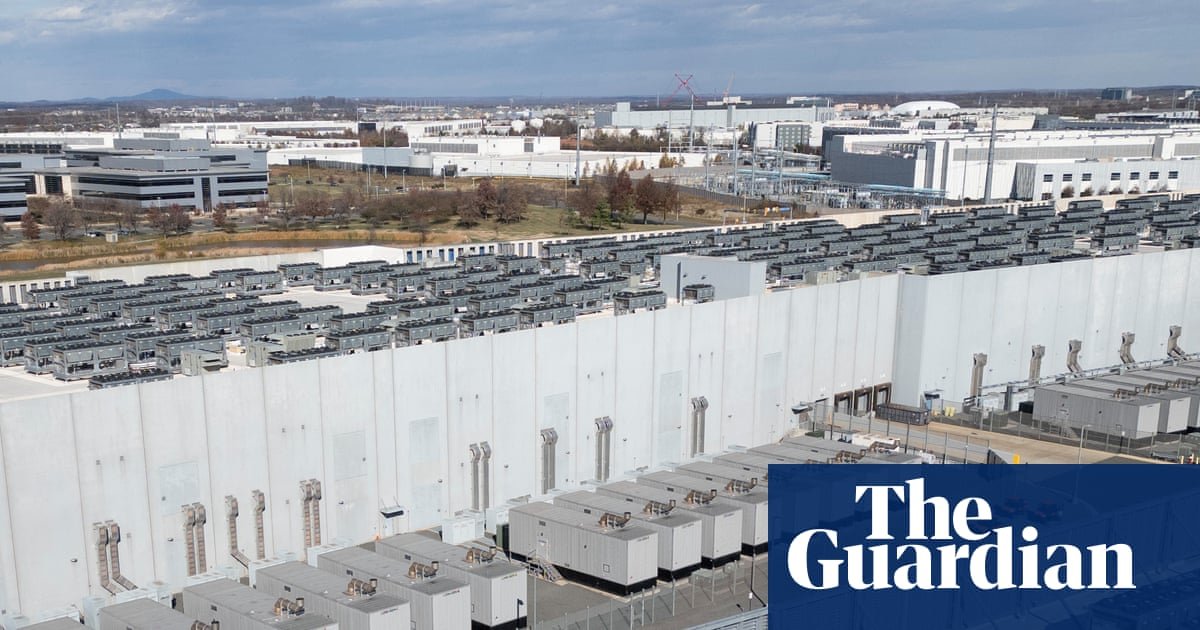
The UK’s largest proposed datacentre is understating the scale of its planned water use, according to an analysis.
The first phase of construction for the hyperscale campus in Cambois in Northumberland has been given the go-ahead by the local council. The US operator QTS, which is developing the site, has promoted its “water-free” cooling system as proof of its sustainability.
But research published this week calls that claim into question. A study of the power and water footprints of AI production by the data scientist Alex de Vries-Gao highlights the underestimated scale of indirect, or embedded, water consumption caused by datacentre operations.
QTS estimates the two initial data halls will consume 2.3m litres of water annually, according to documents it submitted to Northumberland county council. Yet applying De Vries-Gao’s methodology to the electricity generation required for the site’s AI servers produces a figure more than 50 times higher, at 124m litres a year, according to analysis by Watershed Investigations and the Guardian.
When all the 10 planned halls are operational, the Cambois campus could indirectly consume about 621m litres annually – equivalent to the average yearly use of more than 11,000 people.
The company uses a closed-loop system, which typically reuses the same water repeatedly for cooling, but uses more energy to chill the machines. QTS says there will be no pressure on water supply for people in the north-east fromits direct datacentre operations.
In a statement, QTS said: “Our power is typically carbon neutral and comes from a range of sources including wind, hydro, nuclear, tidal, etc. QTS does not control the quantity of any water utilised in the power generation process.”
But according to De Vries-Gao, datacentre operators must acknowledge the water footprint linked to their massive energy demands, in the same way that power-intensive industries are held accountable for the carbon emissions generated by their electricity consumption.
De Vries-Gao said: “The datacentre operator will be responsible for creating the power demand which leads to the consumption of this water. For the same reason, the greenhouse gas protocol already mandates disclosure of indirect emissions related to electricity consumption.”
Another potentially understated problem is the air pollution from the datacentre from increased power generation and potential greater use of diesel generators than stated.
In the US, researchers and environmental groups have sounded the alarm about worsening air quality as a result of growing emissions of fine particulate matter and nitrogen oxides (NOx) from the power plants and backup generators datacentres rely on. Increased emissions are a result of surging power demand to produce AI systems, according to a recent study. According to Shaolei Ren of the University of California, one of the study’s authors, the evidence connecting datacentre growth to harmful health outcomes from air pollution is already “very strong”.
“What is missing is awareness and precise quantitative accounting. The critical gap is that we still do not know, in a transparent and systematic way, how much criteria air pollution data centres actually contribute at the local and regional levels,” Ren said.
Common pollutants include ozone, fine particulate matter, carbon monoxide, sulfur dioxide, nitrogen dioxide and lead, which damage human health and the wider environment.
This pollution is not only the result of electricity generation from the grid. A proportion often comes from highly-polluting diesel generators, installed to ensure the nearly constant “uptime” demanded by the datacentre and AI industry.
Once complete, the Cambois campus will rely on nearly 600 diesel generators for “backup” power – up to 58 per data hall. QTS estimates that regular testing of the system would mean running each generator for five hours a year.
The generators have been designated as a backup power system to be used in emergencies if the grid fails. But in Virginia’s “datacentre alley”, a hub where QTS has a datacentre, regulators are considering expanding diesel generator use for planned outages, while environmentalists have warned of pressure to permit generators during grid stress.
Julie Bolthouse from the Piedmont Environmental Council, a conservation organisation, said: “They are incrementally increasing under what circumstances they can run and de facto how frequently and how long they can run the thousands of generators we have permitted here in Virginia. Once the generators are in place it is only a matter of time before they use them.”
The potential impact of this scenario playing out in Cambois could have negative effects on the local community’s health. Cambois primary school’s playground has been identified by QTS as directly affected by emissions from the generators.
In a statement, QTS said: “Generators can occasionally be utilised on a temporary basis to bridge power needs while permanent connections are finalised, but the primary use of generators is for emergency backup purposes.
“Diesel generators are not the main source of power for our datacentres. Generators are tested once a month for a short period of time for routine maintenance. Each data centre has a publicly available emissions limit and our normal operations are designed to stay well within those requirements. In the highly unlikely event of a complete grid outage in the UK, backup generators would run only for the duration of such grid outage and at reduced power. Regarding Virginia, QTS has zero control over our competitors.”
