

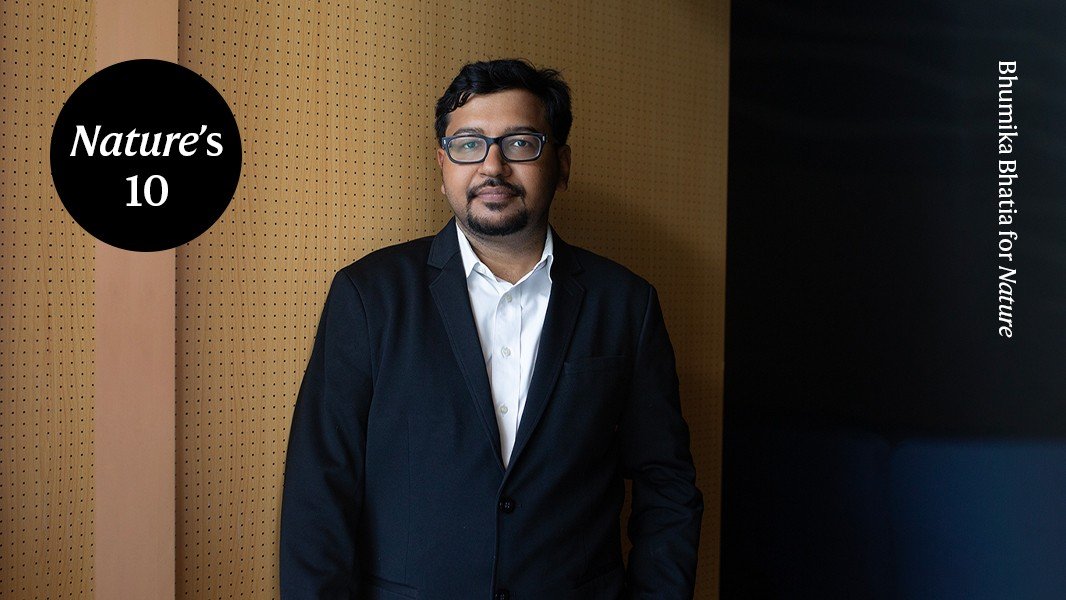
Achal Agrawal had just finished giving a lecture when an enthusiastic undergraduate student approached him with an idea for a research project. Agrawal was delighted, until the student described how he had previously used software to paraphrase published work.
Agrawal explained that doing so was considered plagiarism — a serious violation of research integrity — but the student insisted that it was not, because the work passed the university’s plagiarism checks. “I was shocked,” recalls Agrawal, now a freelance data scientist in Raipur, India.
The interaction, in late 2022, made Agrawal realize how ingrained such misconduct had become — and it cemented his resolve to do something about the issue. He left his university job a month later and has since dedicated his time to raising awareness about research-integrity breaches in India. This unpaid work has placed him at the centre of the nation’s conversation about academic incentives.
This year, Agrawal’s efforts, as well as those of others, contributed to a landmark policy change in how higher-education institutions in India are ranked. In August, the Indian government announced that the National Institutional Ranking Framework (NIRF), which assesses universities yearly and influences their eligibility for some grant schemes, will penalize institutions if a considerable number of papers published by their researchers has been retracted. The move — a first for such a ranking system — aims to combat unethical practices. Some institutions have already had marks deducted from their current scores, and penalties are expected to be more stringent next year. “I was really happy that day,” Agrawal says.
Previous rankings rewarded high publication counts no matter the quality. “He is on a mission to demonstrate that the wrong metrics are being targeted,” says Matt Spick, a biomedical scientist at the University of Surrey in Guildford, UK.
Agrawal earned his PhD in applied mathematics in 2016 at the University of Paris-Saclay in Orsay, France. In 2018, he returned to India, where he worked at various universities. There, he saw how publication targets affected research ethics and education. He recalls his colleagues abandoning their teaching responsibilities to chase publications.
After resigning from his university post in 2022, he launched India Research Watch (IRW), an online group of researchers and students who highlight integrity issues, including plagiarism and other types of publication misconduct. He also began posting analyses of retractions by researchers at Indian institutions on social-networking site LinkedIn, and wrote for the media about the alarming rise in research misconduct in the country.
For months, Agrawal felt like he was shouting into the void. But over time, his commentaries gained attention, and IRW’s LinkedIn account now has more than 77,000 followers. The platform also offers a portal for whistle-blowers to report research-integrity breaches anonymously. Agrawal now receives around ten tips a day.
Last year, Agrawal and his colleagues added a dashboard to visualize countries’ retraction numbers using data from the Retraction Watch Database. India ranked third, after China and the United States. Most of the country’s retractions cited concerns related to research integrity.
Moumita Koley, a research-policy analyst at the Indian Institute of Science in Bengaluru, says that the IRW has stirred up discussions on research integrity among the nation’s academics, and especially in early-career researchers. Koley first learnt about Agrawal’s work on LinkedIn and has since co-authored several publications with him. “It’s quite impressive,” she says, praising Agrawal’s data-driven approach.
In 2024, she and Agrawal showed that private institutions were climbing up India’s NIRF rankings by massively increasing their publication output and citation counts (A. Agrawal and M. Koley Preprint at Zenodo https://doi.org/qbr3; 2024). But these gains in output, they suggest, might be happening without adequate checks by universities of the papers’ quality and integrity.
