

December 5, 2025
5 min read
Add Us On GoogleAdd SciAm
CDC Vaccine Panel Scraps Guidance for Universal Hepatitis B Shots at Birth
New guidance from the CDC’s vaccine advisory panel would do away with a decades-old universal birth dose recommendation for hepatitis B that helped cut infections by 99 percent in the U.S.
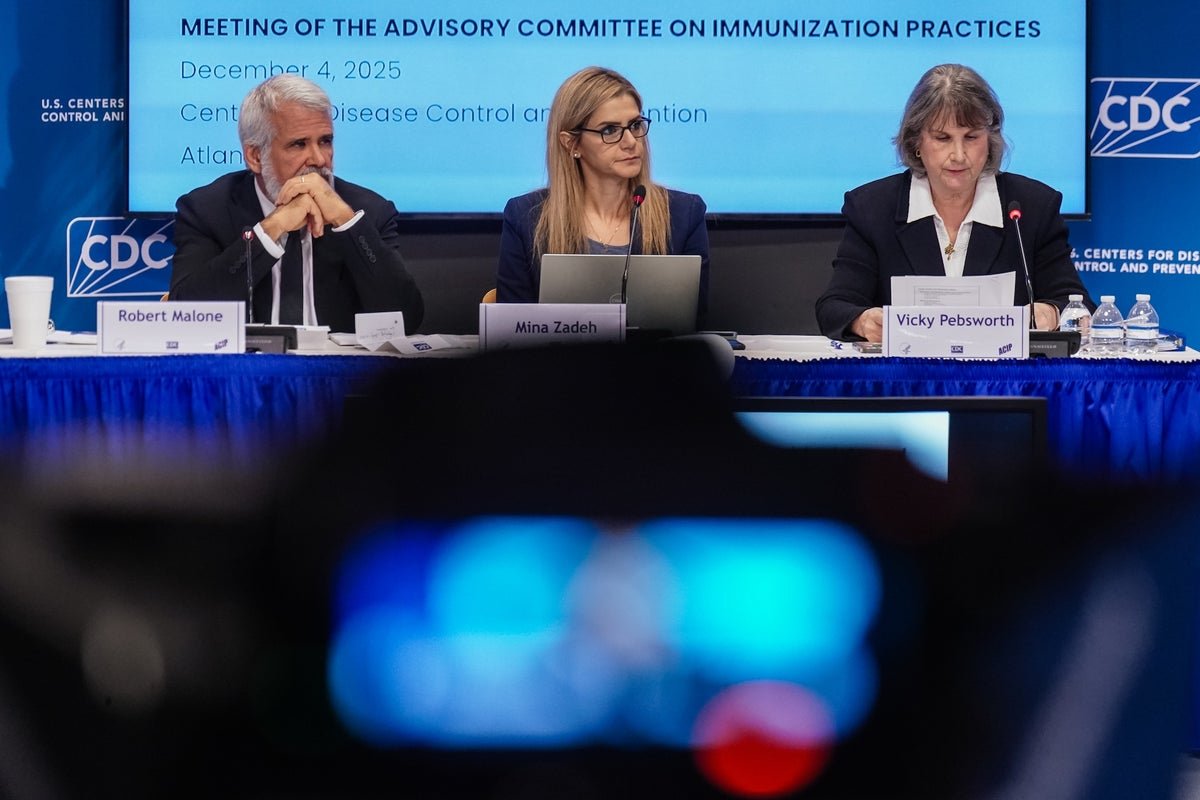
The Centers for Disease Control and Prevention’s Advisory Committee on Immunization Practices at its December 4 meeting.
Elijah Nouvelage/Getty Images
On Friday an influential vaccine advisory panel voted to change the recommendations for the hepatitis B vaccine for newborns. Under the new guidance from the panel, which the Centers for Disease Control and Prevention almost always adopts, parents would need to consult with a health care provider about when to give a baby their first dose of the vaccine—so long as the person who gave birth to the baby tested negative for the disease. That would scrap current CDC policy that all babies receive the hepatitis B vaccine hours after birth. The vote passed with eight in favor and three against.
The new Advisory Committee on Immunization Practices (ACIP) guidance recommends that the three-dose vaccine regimen begin at no earlier than two months of age for those infants. ACIP members also passed a second vote to recommend that parents discuss subsequent doses with a health care provider based on blood tests of the newborn’s immunity levels (protective antibody titers).
“I will just say: we have heard that do no harm is a moral imperative. We are doing harm by changing this wording. And I vote no,” said ACIP member Cody Meissner, a pediatric infectious disease epidemiologist, during the first of three votes presented at today’s meeting.
The CDC didn’t immediately respond to requests for comment from Scientific American.
On supporting science journalism
If you’re enjoying this article, consider supporting our award-winning journalism by subscribing. By purchasing a subscription you are helping to ensure the future of impactful stories about the discoveries and ideas shaping our world today.
Public health experts have expressed concern about the lack of data to support the proposed timing of vaccination and have cautioned that delaying the initial dose would increase vulnerability to hepatitis B infection.
That two-month period “is time that a child is at risk for a vaccine-preventable disease,” says Helen Chu, a physician and immunologist at the University of Washington and a former ACIP member.
The decision comes after several meetings filled with heated debate and admitted confusion among members on what they were voting on. The panel had tabled the vote twice, first at a September meeting and again on Thursday. Deliberations ignited a “public outcry,” Chu says. Many public health experts and medical societies are “pretty clear that they do not want to eliminate the birth dose,” she says.
At the meetings, several ACIP members argued that newborns whose birthing parent tested negative for the virus are “low risk” for the disease—and that deciding to vaccinate should be an individual right. Currently, states require people receive certain vaccines in order to attend public school or participate in certain jobs. Some members also raised concerns over adverse effects and limited data on vaccine safety, despite dozens of studies and CDC reviews that have demonstrated that the hepatitis B vaccine is safe and highly effective at preventing infections in infants.
Today’s vote moves away from a vaccine policy established in 1991 that has dramatically reduced hepatitis B rates in children, according to a review of 400 studies published earlier this week.
“The vaccine has essentially virtually eliminated childhood hepatitis B from the United States, and so it is really devastating to think about losing that,” says Yvonne Maldonado, a pediatrician at the Stanford University School of Medicine and a former ACIP member.
ACIP’s decisions directly affect vaccine access. Vaccines for kids are covered either through private health insurance or Vaccines for Children (VFC)—a federal program that approximately half of the children in the U.S. are eligible for. Private and public insurers, including VFC, fully cover vaccines ACIP recommends under shared clinical decision-making. But public health experts have expressed concern that ACIP’s discussion and new shared decision-making recommendation will still ultimately weaken people’s ability to receive the vaccine.
“When you remove the strength of that recommendation, pregnant women may or may not be offered that vaccine,” said Rochelle Walensky, former director of the CDC and now a senior fellow at Harvard University, in a press call on Thursday. “They may or may not have a discussion about how important it is for their newborn to be vaccinated. And that may fall off the radar in terms of the access.”
Hepatitis B is a very contagious viral disease that damages the liver. Chronic cases can lead to liver disease or liver cancer. The virus spreads through bodily fluids, including blood and semen. The disease has been stigmatized because people associate it with unprotected sex and injection drug use, but the virus can also be transmitted during pregnancy and through childbirth and close contact of bodily fluids after birth.
“In my career, I have seen children with hepatitis B. I’ve seen children die of liver failure, which is a horrible death. I would never wish this on anybody,” Maldonado says.
About 18,000 infants and children were infected with hepatitis B annually before the vaccine was recommended to all newborns in the U.S., according to the Children’s Hospital of Philadelphia. The guidance called for three vaccine doses: the first has been given to infants at birth, the second has been given at one to two months old and the third has been given between six and 18 months. The birth dose helps prevent infection in the first weeks to months of life, Maldonado says. And the regimen has been effective: cases from 1990 to 2019 dropped by 99 percent.
Delaying the first dose to the second month of age for infants born to pregnant parents who test negative for the virus or whose infection status is unknown could cause 1,437 more childhood infections over the course of one year, which could lead to 304 liver cancer cases and 482 hepatitis B-related deaths, a recent preprint paper suggests.
Public health experts note that the updated recommendation’s success is contingent on effective screening for hepatitis B in pregnant people. The CDC recommends that all pregnant people be tested for hepatitis B, preferably in the first trimester. But that testing can fail because hepatitis B can be “a silent infection,” Maldonado says.
Only 84 to 88 percent of pregnant people get screened for the virus in the U.S.; more than 80 percent of people are unaware that they’re infected. False negatives can occur if the test is performed incorrectly or if a person was very recently infected. And other caregivers, such as family members and daycare workers, who might not be screened could also carry the virus, Maldonado says.
“The simplest, safest, most effective way to protect all of the babies in this country is to give them that birth dose, along with the subsequent two doses, which is going to keep them protected for virtually their entire young adult life,” she adds.
Editor’s Note: This is a developing story and may be updated.
