

If the moon were to suddenly turn to cheese, the movie pitches would be insufferable. Astronauts would be irritated, grad students would be demoralized and news articles would overflow with terrible puns. The great jaws of the Internet would get hold of the details, churning out doomsday scenarios, memes and conspiracies. And that’s even before the moon cheese would start to compress, creating geysers of material and a dangerously unstable lunar landscape.
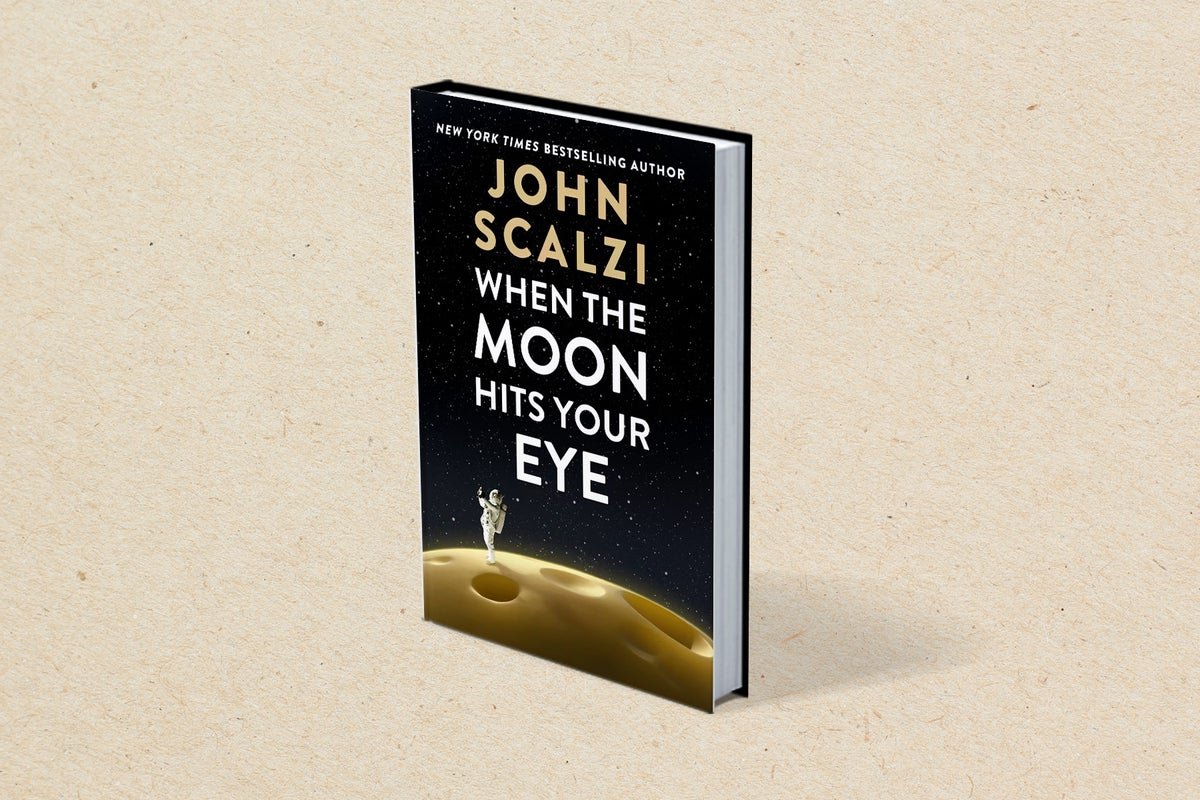
In When The Moon Hits Your Eye, voted one of Scientific American’s best fiction picks of 2025, author John Scalzi plots out the physical side of this scenario alongside the societal and interpersonal ramifications of such an unexpected (if delicious) transformation. The story follows myriad perspectives—including those of scientists, government officials, billionaires with something to prove, online forum commenters, journalists, and many others—as people try to grapple with the moon’s abrupt transformation and stubborn insistence on remaining cheesy. We caught up with Scalzi to discuss the planetary science of cheese, the sticky scourge of misinformation and the way a worldwide scramble to understand the unexplained can reveal the process of science. (Plus: Would he eat the cheese?)
[An edited transcript of the interview follows.]
On supporting science journalism
If you’re enjoying this article, consider supporting our award-winning journalism by subscribing. By purchasing a subscription you are helping to ensure the future of impactful stories about the discoveries and ideas shaping our world today.
So the moon is made of cheese. How did you come to write this?
I have settled into a really interesting niche with the contemporary science fiction I write, which is take a really absurd idea and then try to apply real life to it.
We have, since we were children, heard the phrase “the moon is made of cheese,” or “green cheese.” And so my brain was like, “Okay, what would happen to everyone if the moon was made of cheese?” Because it is kind of a universal thing: The moon is in the sky for everyone. Everyone would have to deal with it, and it would be that disconnect of, “I am trying to get through my day in the real world with real problems. And also, the moon has turned to cheese. Everything that I thought I knew about the universe has just been chucked out the window. What sort of just God or universe would turn the moon to cheese? And for what purpose? And what does this mean for me?” So each chapter is its own protagonist, each chapter has a new point of view, and everyone is dealing with the moon.
I had actually been thinking about [this] for a long time. I had originally come up with the idea in 2015, and then when I was just about to sit down to write it, Neal Stephenson came out with Seveneves—
Also an iconic book about sudden, dramatic changes to the moon and their far-reaching consequences for Earth and society as we know it.
And I was like, well played, Neal Stephenson. I’m not going to put out my cheese moon book in the wake of Seveneves. But that actually turned out to be advantageous because I had more time to think about the actual consequences of the moon turning to cheese. So weirdly this has been a multiyear project, from thinking about it to actually writing about it. And I do think that like cheese, it benefits from having been aged.
How much research did you do?
I did some research. If you are replacing basalt with a dairy product, what are the consequences of that? How much does the moon expand? What happens when it starts compressing?
Strangely enough, there are articles online about this because people have had this idea before; they just haven’t written novels about it. So that was extremely helpful. I did talk to some actual scientist friends about some stuff, and I was very clear—look, I’m not going to be exceptionally rigorous about this, but I do also want to make sure that physics does what physics is supposed to do. [My friends] just looked at me like, “You’re an idiot, but here’s what you’re going to have to think about.”
One of the things that was really important was that I didn’t get too specific. If you get too specific in science fiction, you will inevitably uncover the gaps in your own knowledge base. For example, and I made it a running joke, the kind of cheese is never told. [If I were to say] “Oh yeah, it’s Gruyère,” or something like that, somebody would be like “I actually did the math of what would happen with a Gruyère moon, and you were completely wrong!”
What was the most unexpected consequence of a cheese moon you found?
Sooner or later you would have an atmosphere, and you would have oceans.
You can’t just have a cheese moon up there not being subject to physics…. If it’s going to stay in its orbit, it’s going to have to do the whole suite of physics. It’s going to compress. You’re going to have geysers of steam. You’re going to have eruptions where huge chunks of cheese are going to fly off, and eventually, over the series of years or decades, you would inevitably have oceans, and those oceans would stay for centuries or even millennia.
The albedo [brightness] of the moon would be significantly higher. There would be no more deep night skies whenever the moon was in the sky; it would just be like dusk. All of that stuff was fascinating to me, and I think putting it in the book adds that sort of weird verisimilitude to it that as a writer you are playing fair with your audience. You are saying yes, this is an absurd concept, but I’m going to actually do the math so you will be carried along and see the logical consequences.
Would you eat the moon cheese?
In my universe, absolutely, I would eat the moon cheese. If I was given the opportunity, I would 100 percent do it.
Great. Just to have that on the record that you would in fact eat the moon cheese.
Just to have it on the record, yes. This is very important stuff.
Did you enjoy writing so many different perspectives for the book?
For me, part of the joy of doing this thing was having not just the individuals respond to it, but [including] things like the news articles or the Reddit posts or the Slack rooms where people are talking about this. I’m a former journalist; I used to work at the Fresno Bee newspaper in the 1990s. This would absolutely be a great story for everyone. The first several days would be, “Oh my God, the moon has turned to cheese!” But then you would get the lifestyle pieces, and you would get the sports pieces…. Just imagining that sort of stuff was fascinating to me.
And sometimes that coverage and discussion veers into misinformation or active disinformation.
It doesn’t matter if the moon is turning to cheese or if there’s an election or if there’s a natural disaster—there are immediately going to be actors that spread disinformation. And the reason they spread disinformation is sometimes purely for their own ends, like if someone’s trying to scam you, or they’re trying to weigh in and manipulate political opinion. When you have a historical event, at the time there is a general consensus about it because everybody has experienced that world-changing event. The shared consensus is harder to maintain in any circumstance the further you get out from an event—and especially now because the Internet makes it so easy to spread disinformation. The old saying that “the lie has traveled a mile before the truth has even put on its shoes” is absolutely true. When the truth comes out, that rumor has already taken root and any corrective is basically a defensive fight.
The scientists trying to explain an utterly baffling phenomenon are key viewpoint characters in the book. What do you hope readers take away about the way science is done?
I do hope that people get the sense that the scientists in the book are actually excited after that initial shock and disbelief.
People forget that science is not a philosophy or a religion. Science isn’t any of that. Science is a system. It is a systematized way of discovering and documenting and verifying and getting, through repeated experimentation and testing, as close to the truth as you can. When something like this happens, after the initial moment of disbelief for scientists, they’re going to be like, “Yes! This is what we are here for!” And I think that that is going to be exciting for them. Now the flipside of that is that a fantastical situation is also going to spin up rumor and misunderstanding and apocalyptic thinking and people moving toward irrationality—because in many ways, this is something that is irrational.
That is something that scientists have to deal with all the time, both in the real world and in other fiction. What the scientists are doing in the book is what the scientists do in real life. They roll up their sleeves and say, let’s find out what we’re working with and what’s really going on.
How has the response been to this weird, cheesy book?
It was a real joy as a writer that I got to do so many different perspectives and so many different techniques and so many different ways of showing how a big cheese moon would influence the world. I got to do comedy. I got to do romance. I got to make people laugh. I got to make people cry—there were a couple of chapters where people sent me e-mails that are like, “I was reading this and I was really enjoying this and then you made me cry, and then you made me cry again. I hate you I hate you I hate you. When’s the next book?” And that’s exactly what I want to do. I want to give people what they expect out of a book made out of moon cheese, but then I also want to give them the moments that they don’t expect.
It was a fun book to write, and I hope it was also a fun book to read.
Have there been any other books that bring bizarre science fiction into the everyday that you’ve enjoyed lately?
There are a lot of books now that mix humor and absurdity. For a while there, it was really difficult to find. So you have Dungeon Crawler Carl [by Matt Dinniman]. You have Cat Valente’s Space Opera books, where she basically posits Eurovision but for the galaxy. There was the book Assistant to the Villain [by Hannah Nicole Maehrer].
There are other books that take a concept that changes the world and everyone has to deal with it in a regular sort of way. For example, Mary Robinette Kowal’s Lady Astronaut series has an asteroid hit just outside of Washington, D.C., in the Atlantic Ocean, and as a consequence of that, the space program evolves incredibly differently and includes women in it from the very start. Not just alternate histories but different ways of looking at the world are everywhere in contemporary science fiction and fantasy, and they’re a lot of fun for people to explore.
