

Astronomy can be a difficult topic for newcomers. Like any scientific field, it has its own jargon and buzzwords—and terms with meanings that can be not only odd but downright counterintuitive.
The most obvious one is astronomers’ use of the word metal to mean any element heavier than helium. Lithium? Metal. Oxygen? Metal. Carbon? That’s a metal, too, as far as astronomy is concerned.
Using a single term to cover these heavier-than-helium elements makes some sense because the universe is overwhelmingly made up of the lighter stuff, so lumping everything else into one group makes the math easier. I wish our astronomical forebears had picked a better term, but here we are.
On supporting science journalism
If you’re enjoying this article, consider supporting our award-winning journalism by subscribing. By purchasing a subscription you are helping to ensure the future of impactful stories about the discoveries and ideas shaping our world today.
There are many more examples. The words that really irritate me are not only confusing but also obsolete. These are terms we should dump in favor of others that better reflect our more modern understanding. A great example of this is Population I, II and III stars—these really refer, in order, to stars with more metals in them, stars with fewer metals and stars that were the very first in the universe, which is ridiculously confounding.
But to our credit, astronomers do sometimes drop terms when they become outdated. It can just take a long time.
For example, I remember reading articles in older books about “spiral nebulas” when I was much younger. Nebula is a fairly generic term; it’s Latin for “fog” and means any sort of diffuse deep-space object we see in the sky. Some, such as the great Orion Nebula, have little overall shape, while others, such as the Ring Nebula, are highly structured. We now know these are all immense clouds of gas and dust, and while they have a broad range of very different structures and origins, grouping them together as cosmic fuzzies is helpful in understanding them because they do have many characteristics in common.
But what about spiral nebulas?
“Spiral nebula” is a centuries-old term rich in science history. While stars appear (usually) as sharp points through a telescope, nebulas are extended and sometimes indistinct. A couple of centuries ago, when telescopes got big enough to resolve more structural details in nebulas, some were seen to have a pinwheel shape, with one or more spiral arms winding around a somewhat brighter core.
One of the best examples of such a strange body was M51, the 51st object in the catalog of the great French comet hunter Charles Messier, who made a list of fluffy, irksome objects he found that he thought could be mistaken for the comets he held precious and scoured the heavens for. (The irony: today that list comprises most of the brightest and most beautiful deep-space objects in the sky.) When English astronomer William Parsons, the third Earl of Rosse, observed M51 in 1845 using his 1.83-meter reflecting telescope, an instrument so large at the time that it was called the “Leviathan of Parsonstown,” he saw that it had spiral arms, and further observations confirmed this. It became known as the Whirlpool Nebula, the first of many spiral nebulas to be characterized as such.
Astronomers posited that the nebulas were nascent planetary systems (which we now know do sport spirals of a different sort) or stars that were colliding and flinging away material, among other things. Hypotheses abounded. Most were fanciful; none completely explained what was seen. But that started to change in the early 20th century.
At this time the commonly accepted idea was that the Milky Way was the entirety of the observable universe. Everything we saw in the sky was inside the Milky Way, so that perforce included the spiral nebulas. Many, perhaps most, astronomers thought these were in fact nebulas in the classic sense, clouds of gas inside our Milky Way.
But by the 1920s, doubts about this interpretation were on the rise. Astronomer Heber Curtis noted that the Andromeda Nebula—one of the most famous of these spiral nebulas, easily seen by the naked eye in dark skies—hosted several novae. These were stars that suddenly got much brighter than usual, then faded over many weeks. Novae were not well understood at the time but had often been seen in the Milky Way. The ones in Andromeda were much fainter than normal, though, implying that it was at a vast distance. Andromeda also had dark lanes similar to those in the Milky Way throughout its spiral structure. And observations indicated that Andromeda had a large Doppler shift, which meant it was moving very rapidly relative to the Milky Way, a peculiar property for such an object.
This led to the Great Debate, an actual formal debate on whether these nebulas were inside the Milky Way (an idea championed by astronomer Harlow Shapley) or, as Curtis argued, “galaxies” in their own right. The term galaxy itself traces back at least 600 years, well before anyone had any inkling of more than one, and is derived from the Greek galaxias, meaning “milky,” which is, of course, a reference to our own Milky Way.
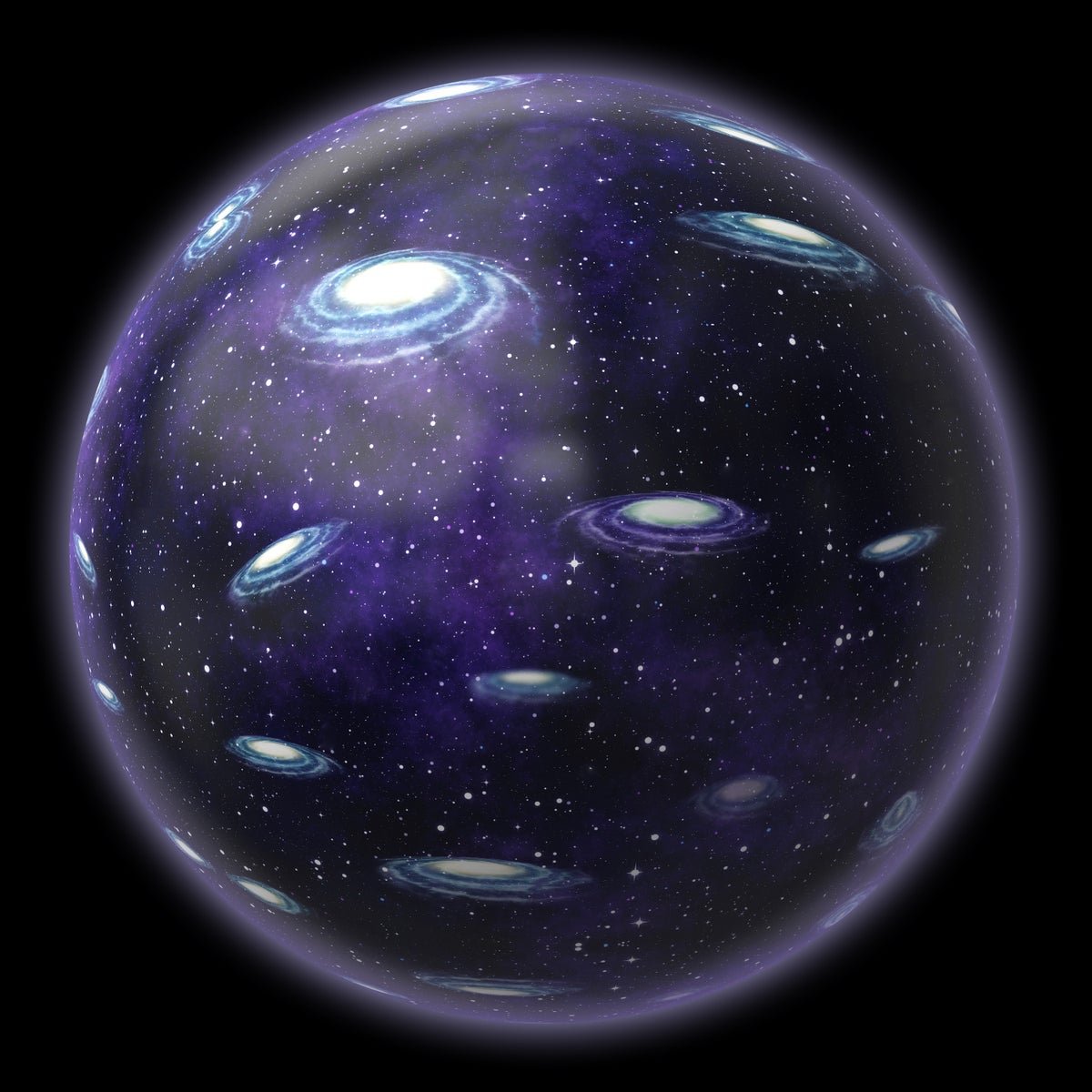
It was only a few years later that a team led by Edwin Hubble showed that the spiral nebulas were in fact at great distances, millions of light-years removed from us, and were in fact galaxies. Soon most astronomers had changed their minds about the true scale of the universe, which was far larger than they had thought. Eventually galaxy became the generic handle for all such objects, no longer reserved for the Milky Way alone.
That brings us back to the term nebula. I distinctly remember that, when I was a kid, I heard astronomers still refer to the “Andromeda Nebula,” which I now find rather funny. This term was obsolete a half-century before, so any astronomer who used it back then probably did so out of habit.
This led to a wonderful discovery as I researched this column. Looking at old issues of Scientific American, I stumbled upon an article called “The Dynamics of the Andromeda Nebula,” written by famed astronomer Vera Rubin (the namesake of the recently activated Vera C. Rubin Observatory). Note her terminology; she wrote the article in 1973! That vindicates my memory of seeing the term used when I was younger. I’ll add that Rubin was born in 1928, years after the Great Debate. Astronomers at the time still called them nebulas—astronomer Henry Norris Russell called the Milky Way a spiral nebula in a SciAm article in 1929—so just as I had, Rubin probably grew up hearing the term used, and it became habit.
I don’t know exactly when the old term finally fell out of use, but it couldn’t have been much later. While I did see it here and there when I first started reading about astronomy as a tyke, galaxy was far more common.
Words matter. What we call something shapes our understanding, our framing of how we see it. A nebula now means something quite different to a modern astronomer than a galaxy, as well it should!
It’s worth thinking about how our terminology guides our thinking, and it’s very much worth relitigating some terms when they cause more confusion than clarity—or keep us holding on to outdated notions better left in the history books.
