

Jason Gulley spent four weeks trekking through the Everest region to report and photograph this article, which was supported by the Pulitzer Center. Raymond Zhong reported from London. Bora Erden, in New York, visualized in 3-D the flood’s path into the village.
Nov. 14, 2025
The ice of the Himalayas is wasting away. Glacier-draped slopes are going bare. The ground atop the mountain range, which sprawls across five Asian countries, is slumping and sliding as the ice beneath it — ice that held the land together — disappears. Meltwater is puddling in the valleys below, forming deep lakes.
As humans warm the planet, so much ice has been erased from around Mount Everest that the elevation at base camp in Nepal, which sits on a melting glacier, has dropped more than 220 feet since the 1980s.
But this loss is not unfolding gradually.
Often it begins slowly, imperceptibly — and then it happens all at once, with catastrophic consequences for the people below. That was how it went on a warm August day last year.
By the time the water raged through, it was as if a swath of the village had never existed. The medical clinic, gone. The school, destroyed. Two dozen homes and trekking lodges, plus fields and fields of potatoes — wiped out.
As the flood charged through Thame, the headmaster of the village school fled to higher ground and captured this video.
Om Prasad Bhattarai
Months later, a scientist named Scott Watson was walking the flood’s path in reverse, up the steep valleys, up past mud-encrusted books in the ruined school, up to the unknown lake that had suddenly made itself very known.
All across the fast-warming Himalayas, melting glaciers are creating thousands of high-altitude lakes — and, in effect, thousands of new opportunities for avalanches and earthquakes to cause destruction. When falling rocks or snow land on a frozen glacier, nothing much happens. But as the ice melts and forms a lake, those same falling objects can set off a flood that menaces villages, tourist lodges, hydropower plants and anything else in its path.
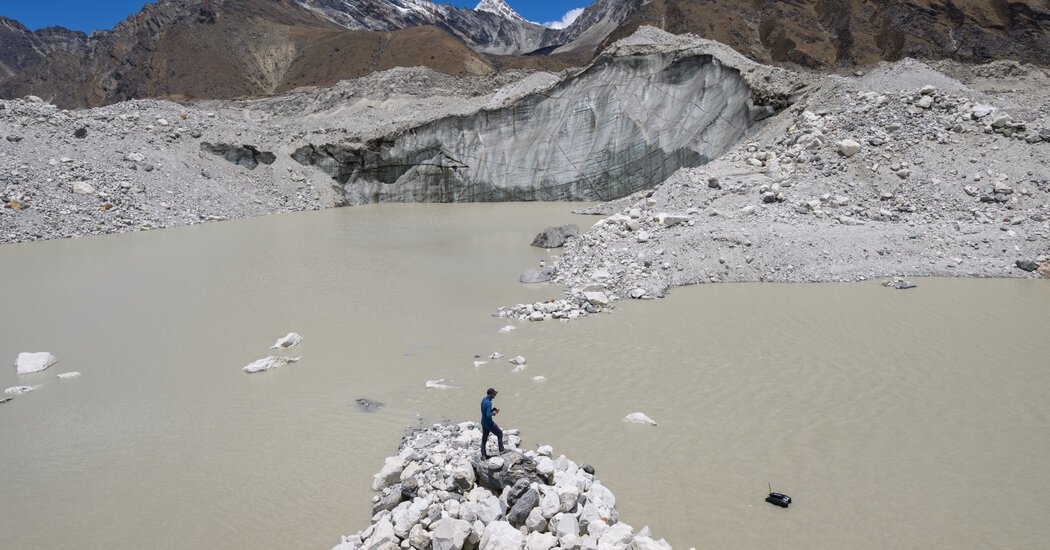
Dr. Watson, a glaciologist at the University of Leeds, and his team trekked through Thame as part of a three-week expedition in the Everest region to measure as many glacial lakes as they could using sonar and drones.
Sitting on these lakes in their inflatable kayak, the scientists found them anything but placid. The ice cliffs were leaking noisy streams of fresh meltwater. Rocks and debris were tumbling in. Behind heavy clouds, unseen landslides rumbled all around, like rolling thunder.
Scott Watson paddling a kayak fitted with a portable sonar system to map the depths of the glacial lake known as Dig Tsho.
A Dark Shape in the Valley
The death of a glacier is widely understood to be a tragedy, a loss reversible only on geological time scales, mourned like the death of a species. But before a glacier is gone — while it is still in the process of dying — it represents not just a loss, but a threat.
The problem is the meltwater. As a glacier shrinks, it sheds water that gathers in the earthen bowl where the ice once sat, forming a lake. But the dirt and rock around this bowl are loose, crumbly. And so maybe one day there is a landslide. Maybe a chunk of the glacier’s remaining ice breaks off and plummets into the water.
What happens next? Picture doing a cannonball into an aboveground swimming pool, said Daniel Shugar, an expert on glacial floods at the University of Calgary. Except you don’t just make a giant splash; you blow out an entire wall of the pool. “It would drain within seconds,” Dr. Shugar said.
Water plunges down the valley, picking up speed but also sand, silt, gravel and boulders. It becomes a slurry so thick that it knocks down buildings.
This is the way some of the largest floods in Earth’s history, ancient deluges that reshaped entire landscapes, took place. More recent floods have taken their own staggering toll: In northern India in 2023, a chunk of partially frozen earth half a mile long collapsed into a lake, creating a 65-foot tsunami that barreled down the mountains, killing dozens of people and destroying a hydropower dam.
Potato fields in the village of Thame, which suffered heavy damage in last year’s glacial lake flood.
But it isn’t just their capacity for devastation that makes these floods so terrifying. It’s how hard it is to predict where, when and how they will happen.
The lakes that flooded Thame (pronounced TAH-may) last year were small, not on anybody’s list of the lakes most likely to cause a disaster.
That day, the 32 students in the village’s school were getting ready for lunch when the headmaster, Om Prasad Bhattarai, saw a dark shape charging down the valley. It was bristling, immense — as if a new, much larger river were swallowing up the old river from behind. Mr. Bhattarai told the children to drop everything and run.
They made it to higher ground in time to watch the water slam into the building where they’d been preparing to eat rice and lentil stew.
The flood carved a long, curving gash through Thame that was 40 feet deep. Buildings kept collapsing into it for days after.
Milan Magar, a health assistant at Thame’s clinic, had hiked to a nearby town that day to restock some medicine. After the flood, he took his usual route back, but at some point there was no more trail. He kept going, hoping to salvage something from the clinic. But soon he saw there was no more clinic, either. “There was nothing left,” he said.
For days after, the schoolchildren told Mr. Bhattarai they were seeing the flood in their dreams.
The Tibet Guest House, a trekking lodge in Thame, was destroyed in the August 2024 flood; Om Prasad Bhattarai, headmaster of the school in Thame; damage to the school from the flood; and children attending classes in a temporary classroom in the village’s community center.
Proliferating Threats
When you think of a glacier, you probably imagine an expanse of white: stately, solid, pristine. Dr. Watson and his team crossed the face of Nepal’s longest glacier, the Ngozumpa, and found it to be a river of dirt, boulders and milky-gray water.
Ice is still there, beneath the debris that crumbles off the mountains. But as it melts, more and more of the glacier’s surface is liquid: puddles that you could step across at first, then ponds, then lakes. Now, the lakes are joining up, transforming the landscape into a maze of ribbonlike waterways.
Dr. Watson stood at the edge of one lake and steered a robot across its surface. A program on his phone showed the water’s depth.
“Fifty meters, the deepest I’ve seen,” he said. Then, five minutes later: “I think we’re up to 67 meters,” or around 220 feet.
In recent decades, satellites have allowed scientists to watch glacial lakes expand and proliferate in ever-increasing detail. There were 19,300 of these lakes across the Himalayas as of 2020, nearly 1,700 more than in 1990, by one recent estimate. Their total area grew 10 percent.
Thousands of glacial lakes now dot the Himalayas
Sources: Survey of glacial lakes by Taigang Zhang, Weicai Wang and Baosheng An; roads and country borders from OpenStreetMaps; satellite image by Landsat and Copernicus.
But to learn how deep the lakes are and how dangerous they could be, researchers still need measurements in the field.
Dr. Watson set out in May with a guide, three porters and two fellow researchers, Lauren Rawlins and Rajendra Kumar Shrestha. Among their 175 pounds of gear were the robot, the kayak, two sonar transducers, a GPS base station and a laser rangefinder. Plus, some modest luxuries: chocolate bars, Pepsi and Kendal mint cakes, the longtime confection of choice for British mountaineers.
About a decade ago, while working on his doctorate, Dr. Watson measured glacial ponds in Nepal that were nearly 150 feet from the surface to the ice on which they sat. “I thought that was deep,” he said.
On this trip, he measured several that were deeper. Dig Tsho is a giant lake that shed much of its water in a catastrophic flood in 1985. (The village hit hardest? None other than Thame.) But the lake has since refilled, and this year Dr. Watson measured its maximum depth as 240 feet.
Dr. Watson setting up satellite-based surveying equipment near the Ngozumpa glacier; Dr. Watson leaping across a stream in the Khumbu region; piloting a robot boat on a meltwater lake atop the Ngozumpa Glacier; Dr. Rawlins catching a drone after an aerial survey near Imja Lake.
It’s no mystery why the lakes have grown so deep. As the sun rose at the Ngozumpa glacier, the bare faces of the ice began melting visibly, first in trickles, then in streams.
The ice released rocks that rained down and landed in the lakes with loud kerplunks. Most of these rocks were the size of golf balls. But entombed in the ice behind them were boulders the size of desks, waiting to be freed.
Over three weeks in the region, Dr. Watson and his team trekked 130 miles and surveyed 26 lakes. Dr. Watson hopes the data will help officials and communities better comprehend the risks they face.
But understanding lake growth tells scientists only where floods might begin. It doesn’t tell them how much damage those floods could cause once they’re underway.
To make sense of that, Kristen Cook, a geomorphologist at Université Grenoble Alpes in France, examines 3-D models of valleys before and after floods. The differences in topography indicate how much solid material — sand, gravel, boulders — the water picked up as it moved, adding to its deadly momentum.
When Dr. Cook first ran the numbers on the 2023 flood in India, she thought her math was wrong. “I was like, This can’t be right,” she said.
She and her colleagues’ calculations showed that the volume of sediment that the flood carried down the valley was five times the volume of lake water that originally overflowed. In other words, the roaring torrent had a consistency somewhere between murky water and wet concrete.
The spillway of Imja Lake, which was built in 2016 and lowered the lake’s level by 11 feet. The lake is still eating into the glaciers that feed it, causing it to grow longer. It is nearly two miles long, 2,000 feet wide and hundreds of feet deep.
‘We Don’t Feel Peace’
Nobody died in the Thame flood. It occurred in the daytime; villagers saw and heard the water coming. This, everyone agrees, was an extraordinary stroke of luck.
People near Nepal’s border with China weren’t so fortunate on an early morning in July, when a glacial lake in Tibet overflowed and killed at least 11 people. That lake had been a collection of ponds a few months earlier. It coalesced and grew to cover 150 acres before something caused it to burst.
“Nobody knew these lakes were forming,” said Sonam Futi Sherpa, an earth scientist at the University of Utah. That’s a challenge not only for downstream communities, but for scientists, too: Satellites can have trouble detecting small lakes in high mountains, where the clouds are thick and the peaks cast big shadows, Dr. Sherpa said.
One way to reduce flood hazards is by making lakes somewhat smaller. A recent $36 million grant to Nepal from the United Nations’ Green Climate Fund will go toward building drainage channels at four “high-risk” lakes.
It’s a technique Nepal has used at two other lakes, Tsho Rolpa and Imja. The channel at Imja was built in 2016 and lowered the water level by 11 feet. But melting glaciers are still feeding the lake, causing it to grow longer, said Tenzing Chogyal Sherpa, a glacier scientist at the International Center for Integrated Mountain Development. Already, Imja is nearly two miles long, 2,000 feet wide and hundreds of feet deep.
And smaller lakes nearby still pose threats. Nawang Doma Sherpa, 65, and her husband recently moved to Chukhung, a village two miles downstream of Imja, to raise yaks. (Many Sherpa people use the name of their ethnic group as their last name.)
A yak grazing near the village of Chukhung; Nawang Doma Sherpa; yaks in Chukhung on a snowy June day; Mingma Rita Sherpa in Kathmandu, Nepal.
One summer night last year, the two were in bed when they heard the rumble of rushing water.
Terrified, Ms. Sherpa shined a flashlight out the window. A neighbor was outside, watching floodwaters surge past their house. She couldn’t sleep again until the terrible noise subsided.
“In summertime, we don’t feel peace,” Ms. Sherpa said.
People in Thame can relate. Mingma Rita Sherpa was born there. He was a student when the village first flooded in 1985, killing 12 people. Later, he became one of the first employees at Thame’s hydropower plant. He was at work last year when the water tore through again, sweeping away his home, the lodge he owned and the land on which they stood.
Mr. Sherpa is now staying with his brother-in-law in Nepal’s capital, Kathmandu, far from the ice and the peaks. He has no plans to return.
