

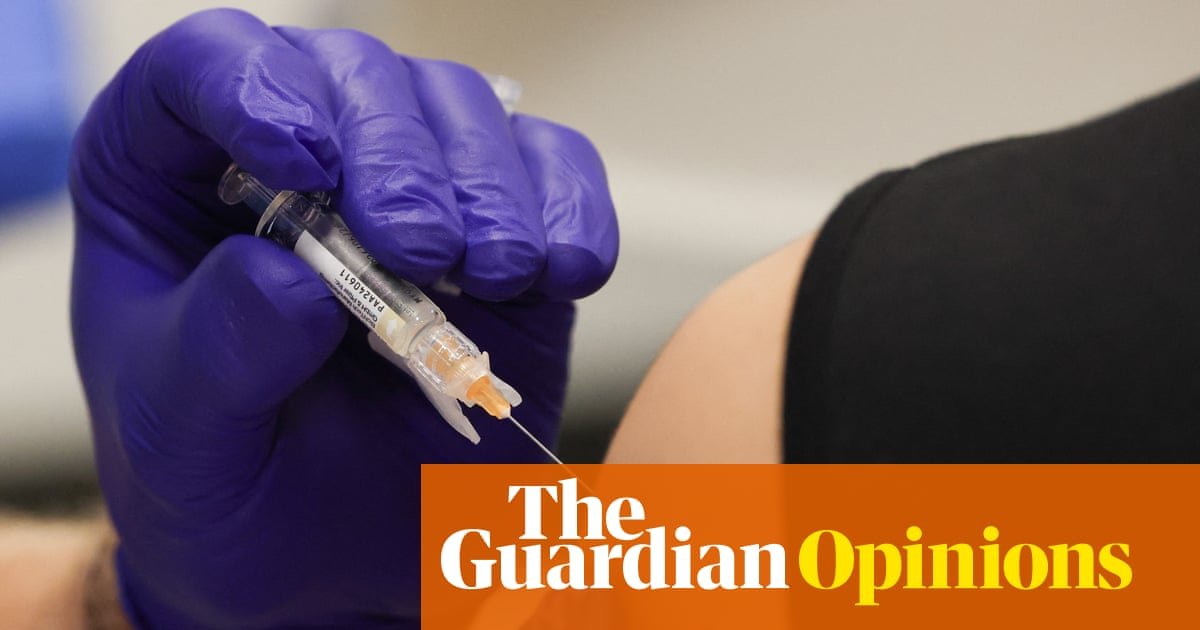
I’m often asked whether we’re better prepared for the next pandemic. It’s a mixed answer, but the bright spot is scientific progress on vaccines. The Covid vaccines were produced faster than any previous effort, and are credited with saving millions of lives from 2021 onwards. The mRNA vaccines – Pfizer/BioNTech and Moderna – were designed within days of the Sars-CoV-2 genome being published in January 2020, and went into safety trials over the following months before finally being approved in the UK at the end of 2020.
But could they have additional benefits? According to a recent study published in Nature, mRNA vaccines seem to trigger a powerful immune response that increases the median survival time by about 75% for certain cancer patients. These findings – which are being further developed – could indicate the power of repurposing vaccines and medicines that have already passed trials for safety and are available at reasonable cost.
How could Covid vaccines play a part in cancer treatment? Cancer develops when normal cells in the body grow and divide without control. Usually, cell division is strictly controlled, but when certain mutations happen – sometimes caused by tobacco, or radiation, inherited genetic factors or environmental exposure – the body is no longer able to stop uncontrolled cell growth. These cells (often referred to as malignant) build up to form a tumour – an abnormal growth. To keep growing, these cells create new blood vessels to feed themselves and start to spread around the body – called metastasis.
Our immune system is excellent at recognising invaders in our body – think of viruses or bacteria – but given that cancerous cells are part of our body, they prove hard for our immune system to distinguish from healthy cells. In treating cancer, doctors have several options. Surgery or radiotherapy is usually the start, to simply remove or target localised cancerous cells. If they have spread throughout the body, then chemotherapy is necessary: basically “nuking” the body to kill cancer cells. Chemotherapy drugs target cells that divide quickly to stop tumours growing, but this means they also kill off healthy cells in hair follicles, the stomach lining and bone marrow. It’s a blunt and barbaric intervention.
Immunotherapy is a more targeted approach: its aim is to prime the immune system to attack only cancerous cells. Most of the research efforts here have focused on developing targeted vaccines and drugs for specific cancers, which means a long and expensive process of testing for safety, efficacy and dosage. But what appears to happen with mRNA vaccines is something different: it looks as if they activate the immune system in general, and this helps the body fight cancerous cells.
Researchers in the US looked at the medical records of patients with stage 3 and stage 4 lung cancer treated between 2015 and 2022 at the University of Texas MD Anderson Cancer Center. Of those, 180 patients had received a Covid mRNA vaccine – either Pfizer or Moderna – within 100 days of starting immunotherapy treatment. In this observational study, the researchers compared them with 704 patients who had the same drugs but did not have the Covid jab.
After controlling for age, disease severity and other confounding factors, the results were striking: vaccinated patients lived a median of 37.3 months compared with 20.6 months in the unvaccinated group. Three years after starting treatment, 55.7% of vaccinated patients were alive compared with 30.8% of those who weren’t. A similar pattern was found when looking at a second group of patients with metastatic melanoma (a skin cancer that has spread around the body). The same benefit was found regardless of whether it was Pfizer or Moderna, but not in non-mRNA Covid vaccines.
The gains are significant and far beyond the norm for most cancer drugs. A study reviewing the clinical impact of 124 new cancer drugs approved by the US FDA between 2003 and 2021 found that, on average, new drugs increased median overall survival only by 2.8 months.
To delve deeper into these findings, scientists studied the impact of mRNA vaccines in mice. They found that pairing an mRNA vaccine with immunotherapy helped activate the immune system and turn previously hidden (“cold”) tumours into recognisable ones.
What could explain this? The researchers suggest that mRNA vaccines act as a flare, activating immune cells throughout the body. This doesn’t directly target cancer, but primes the immune system to be more alert and responsive.
If these findings are confirmed in other studies, this could revolutionise how cancer is treated. As Dr Elias Sayour, an oncologist and a co-author of the study, said: “We could design an even better non-specific vaccine to mobilise and reset the immune response, in a way that could essentially be a universal, off-the-shelf cancer vaccine for all patients.” Because Covid mRNA vaccines have already been tested for safety in millions of people, researchers see potential in repurposing them as a low-risk, inexpensive way to boost the immune system alongside traditional cancer treatments.
skip past newsletter promotion
Sign up to Matters of Opinion
Guardian columnists and writers on what they’ve been debating, thinking about, reading, and more
Privacy Notice: Newsletters may contain information about charities, online ads, and content funded by outside parties. If you do not have an account, we will create a guest account for you on theguardian.com to send you this newsletter. You can complete full registration at any time. For more information about how we use your data see our Privacy Policy. We use Google reCaptcha to protect our website and the Google Privacy Policy and Terms of Service apply.
after newsletter promotion
But there are caveats. The findings come from an observational study – that is, looking back at medical records of patients, rather than one designed from the ground up to test this effect – meaning it can show association, not causation. Randomised control trials (or RCTs) are needed to confirm whether it is indeed the vaccine making the difference. Animal studies are also needed to further examine the exact biological mechanism beyond just general immune system activation.
But just imagine having more precise and effective cancer treatments without the heavy toll and side-effects of chemotherapy. I remember my father suffering through round after round of chemo and wondering if the cure was worse than the disease. The Nature study is a reminder that science often advances in surprising ways. The mRNA Covid vaccines may not only have saved lives during the pandemic – they might also save lives from cancer too.
Fit Forever: Wellness for midlife and beyond. On Wednesday 28 January 2026, join Annie Kelly, Devi Sridhar, Joel Snape and Mariella Frostrup, as they discuss how to enjoy longer and healthier lives, with expert advice and practical tips. Book tickets here or at guardian.live
