

This is an edition of The Atlantic Daily, a newsletter that guides you through the biggest stories of the day, helps you discover new ideas, and recommends the best in culture. Sign up for it here.
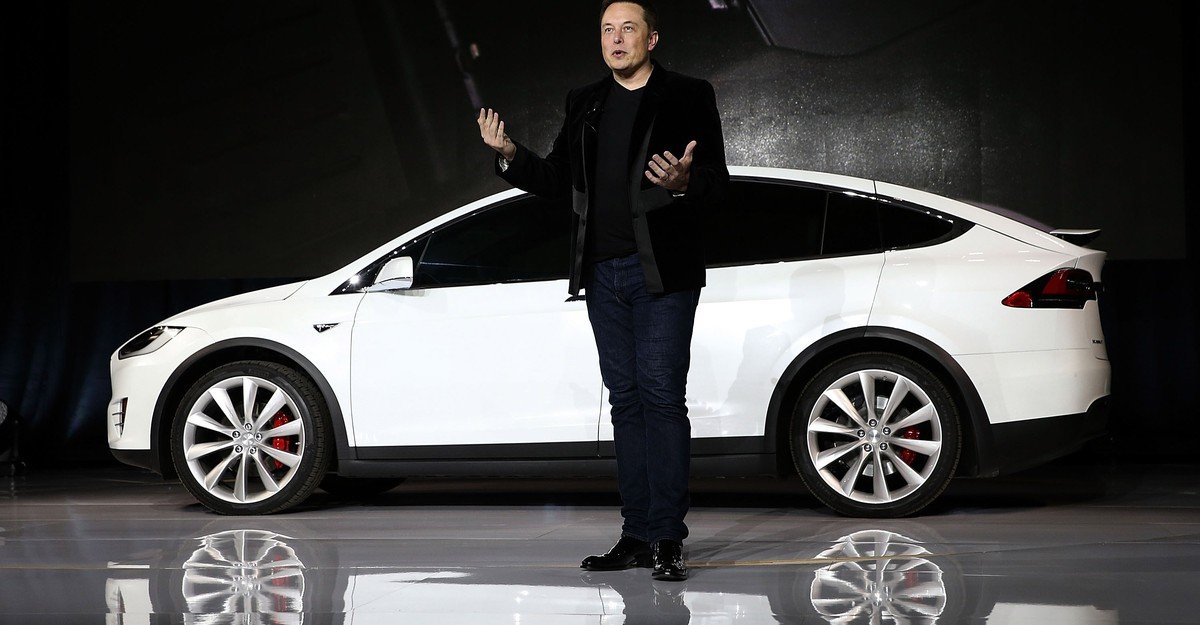
Elon Musk wants to be anointed the world’s first trillionaire—but he swears it’s not about the money.
Over the past few weeks, the Tesla CEO has been demanding greater power over the electric-vehicle manufacturer that he has led for almost two decades. Specifically, he is asking for another 12 percent of the company—a stake currently worth roughly $190 billion. If shareholders vote for it, and if Musk meets the board’s goals for drastically increasing the company’s value, the total value of his personal stake will shoot up to $1 trillion. At Tesla’s annual meeting on Thursday, shareholders will finish voting on whether to give him both more money and more control over the company’s governance—or to give him neither.
The compensation package is partly a reflection of Tesla’s changing priorities. The company’s “Master Plan IV,” released in September, “makes no mention of any new electric cars in the works,” Patrick George recently wrote in The Atlantic. “It is instead a technocratic fever dream, predicting a future in which humanoid robots made by Tesla free us from mundane tasks and create a utopia of ‘sustainable abundance.’” Tesla’s board has said that the compensation package will help motivate Musk to pursue these innovations; in the company’s third-quarter earnings call last month, robots—not money—were at the heart of Musk’s argument for more shares. “If I go ahead and build this enormous robot army, can I just be ousted at some point in the future?” he asked.
As the world’s richest man and the CEO of several companies, Musk exerts an enormous amount of influence over many people’s lives, but Tesla’s structure does include some checks on that power. Tesla is, on paper, overseen by those who actually own the company—which isn’t always the case at other public companies. Mark Zuckerberg, for example, owns about 13 percent of Meta, but as of last year, he controls 61 percent of the total voting power, thanks to a special class of stock that grants him outsize sway over corporate governance. This system is not a democratic representation of all shareholders’ views, but it is nevertheless popular among today’s tech companies. Snap Inc. (the parent company of Snapchat) is perhaps the most extreme example; its two co-founders control more than 99 percent of the vote.
The fact that a vote against Tesla’s pay package is even technically possible is a reflection of a not-so-monopolized voting structure. Companies often have valid reasons for deciding to centralize so much control in the hands of a few individuals (dissenters can make it hard for boardrooms to move quickly on decisions, and outside interests can dilute a founder’s vision, to name two). But that centralization can also lead to something of a shareholder monarchy. Although Tesla is already consolidated around Musk, he still doesn’t own a majority of the company. If shareholders were to reject his pay package, they’d be reminding the board that, for now, they still have ultimate say over how the company is run.
Analysts generally believe that the compensation package will be accepted, because top Tesla shareholders have been content to follow Musk’s lead in the past. The company’s structure should ideally enable a multiplicity of dissenting voices—but more often, shareholders are simply willing to go with the board’s recommendations. This time, however, there has been early and forceful pushback. Some shareholders, including Norges Bank Investment Management, the bank behind the world’s largest sovereign wealth fund, have come out against the plan on the grounds that $1 trillion is simply too much money for a single CEO. Prominent public figures have weighed in too: “We’re in big trouble,” Pope Leo XIV said of Musk’s possibly becoming a trillionaire.
But in the world of corporate governance, there are forces far more influential than the pope. Among them are the proxy advisory firms ISS and Glass Lewis, which do market research and advise fund providers such as BlackRock and Vanguard on how to vote their shares. The people invested in BlackRock’s and Vanguard’s funds aren’t all corporate bigwigs; some of them are ordinary people, with pensions and IRA accounts. Most of them won’t vote at Tesla’s shareholder meeting, but BlackRock and Vanguard certainly will. ISS and Glass Lewis have recommended voting against Musk’s pay package, as they’ve done repeatedly in recent years—Musk responded by calling the companies “corporate terrorists” during last month’s earnings call—although what BlackRock and Vanguard will decide is still unclear.
Tesla leadership has been mounting a steady campaign to undermine any dissent; a slick website, VoteTesla.com, lays out why voters should approve the pay package. But now the board appears to be scrambling. The chair, Robyn Denholm, who usually eschews public appearances, has been on something of a media tour over the past few weeks, defending the plan. For the board, this vote is existential. As early as last year, Musk was heavily implying that he would leave the company if he couldn’t have that 25 percent stake. If he exits, Tesla’s stock will almost certainly tank.
Tesla’s board of nine, which includes Musk’s brother, seems to trust him completely. (After rejecting a previously proposed pay package, a Delaware court said that certain board members were not independent, citing concerns about undisclosed “connections between the members of the Compensation Committee and Musk”; Tesla is appealing the decision.) Whether shareholders outside Musk’s inner circle still maintain that trust is a question that will be answered later this week. Musk said in the earnings call that he wants just enough voting control to retain a “strong influence.” The conflict over his pay package is a reminder that influence shouldn’t be taken for granted.
Related:
Here are three new stories from The Atlantic:
Today’s News
- Elections are being held today in the first major contests of President Donald Trump’s second term, including New York’s race for mayor, elections for governor in New Jersey and Virginia, and a redistricting ballot measure in California.
- Parts of the United States’ airspace could be closed if staffing shortages, including a dearth of air traffic controllers, who are working unpaid, persist amid the government shutdown, Transportation Secretary Sean Duffy said.
- Trump threatened in a social-media post to withhold SNAP payments—which would affect roughly 42 million low-income Americans until the government shutdown ends—despite a federal court order requiring the aid to continue. Hours later, White House Press Secretary Karoline Leavitt stated that the White House will be “fully complying” with the court by providing partial SNAP payments this month.
Evening Read
Charles Ommanney / Getty
There Was One Dick Cheney All Along
By David Frum
In Vice President Dick Cheney’s later years, former detractors sometimes expressed puzzlement about his political trajectory. The onetime designated villain of the Iraq War had somehow mutated into a hero of the anti-Trump constitutional resistance. Had he changed? Or had they misjudged him?
People do change. Perspectives can shift. But oftentimes the secret to later-life decisions is encoded in early experiences.
Read the full article.
More From The Atlantic
Culture Break
Listen. The Atlantic is launching a new weekly podcast, Galaxy Brain, hosted by staff writer Charlie Warzel, who is paying attention to where we pay attention.
Read. Michael Gorra explores how the critic Malcolm Cowley made American literature into its own great tradition.
Play our daily crossword.
Rafaela Jinich contributed to this newsletter.
When you buy a book using a link in this newsletter, we receive a commission. Thank you for supporting The Atlantic.
