

November 3, 2025
4 min read
Catch the Taurid Meteor Shower—And Learn Why Scientists Are Watching It Closely
Debris from Comet Encke creates two annual meteor showers, but it might also pose a small risk to Earth. Scientists are investigating
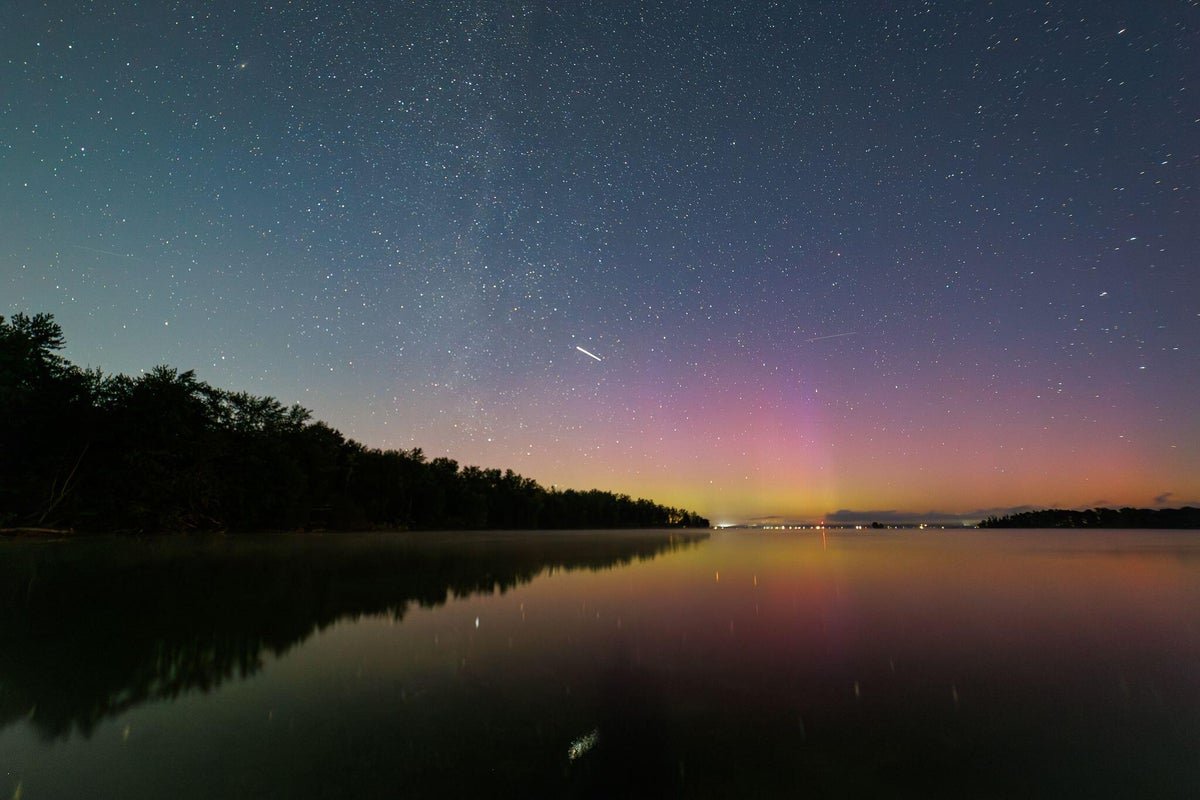
A meteor from the Southern Taurid meteor shower streaks towards the aurora borealis in Central New York State on Sept. 29, 2025.
Alex Hamer/ZUMA Press Wire via Alamy
An autumn meteor shower yearly responsible for “Halloween fireballs” may pose a small impact threat to Earth. But scientists have the sky under surveillance. Here’s what to know.
What is the Taurid meteor shower?
The Taurid meteor shower blooms when Earth flies through debris left behind by Comet 2P/Encke. Encke has among the shortest orbital periods of all comets identified by scientists to date, completing one loop around the sun every 3.3 years. As the object zips around the warmest part of that loop near the sun, its ice turns to gas, which causes the comet to shed dust and other material.
On supporting science journalism
If you’re enjoying this article, consider supporting our award-winning journalism by subscribing. By purchasing a subscription you are helping to ensure the future of impactful stories about the discoveries and ideas shaping our world today.
“I like to think of it sort of like the character Pigpen [from Peanuts]—he’s always got dust and stuff following him,” says Mark Boslough, a physicist at the University of New Mexico. “It’s left a big trail,” he says of Comet Encke.
And twice every year Earth’s orbit carries us through that trail: every June the daylit side of our planet flies into what’s dubbed the Beta Taurids, and every October and November the night side flies into the Southern and Northern Taurids.
The Southern Taurids have already begun; this year they will peak around November 5 and continue through about November 12. Inconveniently for skywatchers, the full moon will also occur on November 5, with its brightness potentially outshining meteors. The Taurids tend to be less dazzling overall than other meteor showers but are notable predominantly for their more numerous fireballs.
If you want to try catching a Taurid, go to a dark place and get comfy—veteran skywatchers recommend staying out at least 30 minutes to allow your eyes to adjust to the dark and sitting or lying down so you don’t have to crane your neck. Then find the constellation Taurus, from which the meteor shower appears to radiate, giving it its name. But don’t exclusively look at Taurus—nearby constellations may also show meteor activity.
The Northern Taurid meteor shower has also already begun, but it won’t peak until November 9 and will continue through around December 2. (For skywatchers, the Northern Taurids appear to radiate from a point slightly higher in the sky than the Southern Taurids.)
Scientists currently believe that the Northern Taurids are not the product of Comet Encke directly but instead of an asteroid called 2004 TG10. Both the asteroid and comet, as well as several other asteroids, scientists posit, formed 5,000 or 6,000 years ago when a much larger object fragmented.
A hidden threat to Earth?
That hypothesized fragmentation is even more interesting than the near-twin meteor showers suggest.
Among the other products of the breakdown, scientists believe, is the massive object that exploded in the skies over Siberia in June 1908 in what has been dubbed the Tunguska Event—a massive aerial explosion that killed three people and likely would have been much deadlier had it occurred anywhere near denser populations.
Tunguska is the sort of event that has inspired scientists to create the field of planetary defense to find and study—and, if need be, try to deflect—asteroids and comets that might be on an impact course with Earth. And some of these scientists—including Boslough—worry that other debris created by that fragmentation thousands of years ago could pose a risk to Earth.
That wouldn’t quite be the same material that produces the Southern Taurid meteor shower, however. The Southern Taurids come from Comet Encke itself, and some of them may be in a debris cluster called a resonant swarm. Some wonky orbital math suggests that Jupiter’s gravitational influence could have condensed rubble from the breakup into such a grouping.
Right now, that’s just a theory—scientists don’t have any observations suggesting such a debris cloud exists. The hypothetical swarm wouldn’t have made a close approach to Earth since June 1975, Boslough says, but the careful surveys of near-Earth space designed to detect any potential threatening objects began only in the 1990s.
In new research, Boslough and his co-authors calculate that the hypothetical swarm would make its next particularly close approaches in November 2032 and in June 2036. If the swarm really does exist, those might mark times when Earth faces a slightly higher risk of an impact, the scientists warn.
It bears repeating: Scientists aren’t even positive yet that this swarm of rubble exists, much less that it poses a threat to Earth. Boslough and his colleagues aren’t trying to panic people, just calling for observations, both during those years and in June 2026 and 2029.
By then, scientists may have a shiny new tool to investigate the swarm. NASA is currently building a specialized space telescope called Near-Earth Object Surveyor. Currently targeting launch in late 2027, the mission will use infrared light to detect objects that can reflect little to no visible light.
“I think it’s improbable that there are going to be significant large objects in this swarm,” Boslough says. “But from a risk assessment perspective, well, we’d better check.”
It’s Time to Stand Up for Science
If you enjoyed this article, I’d like to ask for your support. Scientific American has served as an advocate for science and industry for 180 years, and right now may be the most critical moment in that two-century history.
I’ve been a Scientific American subscriber since I was 12 years old, and it helped shape the way I look at the world. SciAm always educates and delights me, and inspires a sense of awe for our vast, beautiful universe. I hope it does that for you, too.
If you subscribe to Scientific American, you help ensure that our coverage is centered on meaningful research and discovery; that we have the resources to report on the decisions that threaten labs across the U.S.; and that we support both budding and working scientists at a time when the value of science itself too often goes unrecognized.
In return, you get essential news, captivating podcasts, brilliant infographics, can’t-miss newsletters, must-watch videos, challenging games, and the science world’s best writing and reporting. You can even gift someone a subscription.
There has never been a more important time for us to stand up and show why science matters. I hope you’ll support us in that mission.
