

MI5 chief Ken McCallum confirms Russia did interfere in Brexit referendum – but says it had little impact
Dan Sabbagh
Dan Sabbagh is the Guardian’s defence and security editor.
MI5 chief Ken McCallum said today that Moscow did attempt to interfere in the 2016 Brexit referendum with anti-EU coverage on RT and Sputnik media and via troll social media accounts. But there was a big difference between “what may have been attempted and what actually resulted”, he added.
The head of the Security Service said that he agreed strongly with what the prime minister had said on Sunday and Monday, when he raised the issue of attempted Russian interference a decade ago – though Burnham then backed off when he was challenged by the Conservatives as to whether this meant he regarded the Brexit vote as illegitimate.
McCallum did not put any new evidence into the public domain but cited already known concerns about Russian broadcasters who “came in pretty strongly around the time of the referendum” in favour of Brexit. He also said that “there was a second line of interference attempted through [internet] trolls”.
However, he argued there was no evidence to suggest the result of the Brexit vote had been swayed as a result of the effort, which is generally believed to have been marginal, and said that it would be to Russia’s benefit if the issue was talked about further.
He explained:
double quotation markIt is up to us how far we allow our adversaries to divide us.
I’m a little bit worried that if we all stay in this debate for another few days, the Russian trolls who didn’t appear to do all that much at various points over the years, they’ll be delighted they are front page news once again despite the comparative unimpressedness of what they do at all points along the journey.
I am a little bit anxious that we don’t play into our adversaries’ hands by making these trolls look 10ft tall.
UPDATE: McCallum said:
double quotation markThere is a really important difference between interference attempted and outcome swayed … It’s quite important to focus on the difference between what may have been attempted and what actually resulted.
It is a matter of public record including in select committee reports published in 2019 – the DCMS [digital, culture, media and sport] committee did a bit and the intelligence and security committee did a bit also – that in 2016, before you even get to any secret intelligence … it is openly on the record that Russia Today and Sputnik and other Russian media organisations came in pretty strongly around the referendum.
And it is also a matter of open source record that there was a certain amount of interference attempted through trolls and bots and so forth.
I agree strongly with what the prime minister said yesterday, we did see a hack and leak thing inside the 2019 general election campaign.
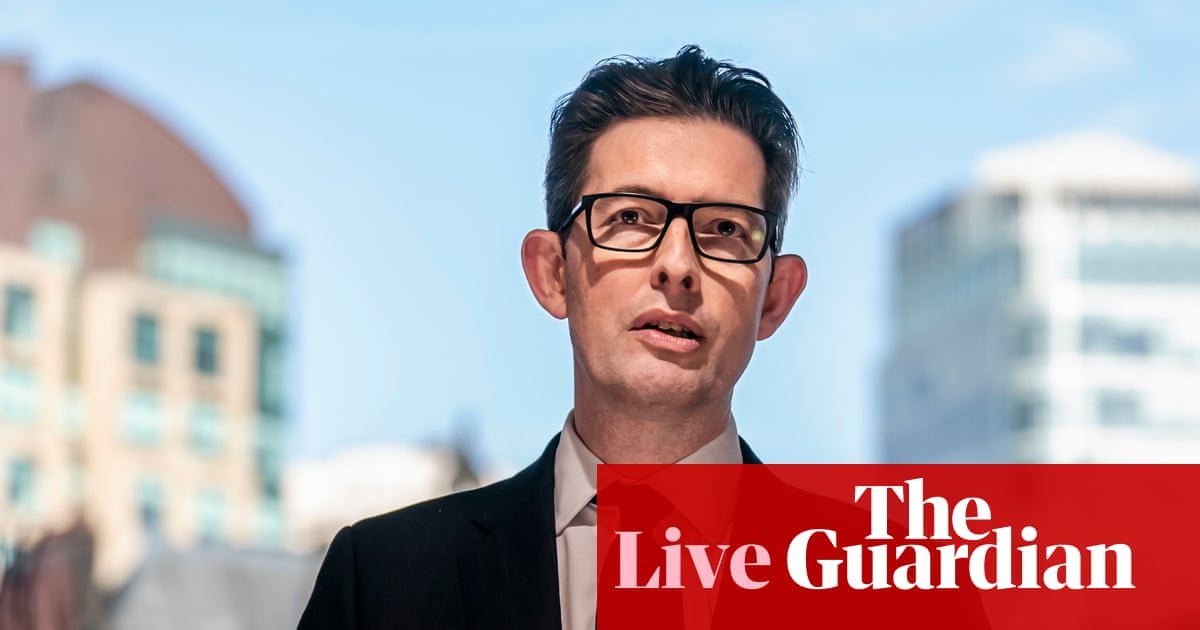
Ken McCallum giving a speech today. Photograph: Jonathan Brady/Pool PA/APShare
Updated at 11.17 EDT
Key events
Afternoon summary
Ken McCallum has said that Moscow did attempt to interfere in the 2016 Brexit referendum with anti-EU coverage on RT and Sputnik media and via troll social media accounts. But there was a big difference between “what may have been attempted and what actually resulted”, he added. (See 1.15pm.)
For a full list of all the stories covered on the blog today, do scroll through the list of key event headlines near the top of the blog.
Kemi Badenoch meeting salon owners at The Vanilla Room in Hornchurch, Essex, today. Photograph: Will Colebourne/PAShare
Streeting says, if Sinn Féin opposing new Troubles bill as ‘veterans’ charter’, he’s ‘delighted’
Wes Streeting, the defence secretary, is still giving evidence to the defence committee. Asked about the Northern Ireland Troubles bill, he said that the new amendments being tabled (see 2.34pm) considerably improved it from the point of view of the armed forces. He went on:
double quotation markAnd so we are in a much stronger place, to the extent that I think Sinn Féin have condemned these amendments and the bill as a veterans’ charter, which as far as I’m concerned is the highest plaudit possible, and I’m absolutely delighted that that’s where we’ve got to.
We have worked intensively with the Northern Ireland secretary [Chris Bryant] and his team to get this bill to a much better place, that deals with what I think is my personal moral obligation to people who’ve served.
Share
Ed Davey under pressure to defend his leadership at meeting with his MPs
Liberal Democrat MPs are holding a private meeting later where they are expected to thrash out disagreements about Ed Davey’s leadership. For months there has been persistent, low-level grumbling about Davey’s supposedly ineffectual leadership. This is a long way off the sort of firing squad revolt the Tory 1922 Committee used to specialise in. So far only two relatively junior frontbenchers have resigned.
But it must be a bit serious because at the Times they have activated a loyalty spreadsheet. This is from Aubrey Allegretti on the state of play.
double quotation markLib Dem leadership showdown:
– 4-hours has been carved out in MPs’ diaries for their meeting at 5pm today, to accommodate requests from more than 40 people to speak (and breaks in proceedings for votes). Roz Savage, as chair of the parliamentary party, will chair the meeting.
– So far, I’ve counted 21 MPs who’ve explicitly – or at least appeared – to back Ed Davey. That leaves a *lot* still undeclared. The rebels need 18 (or 25% of MPs) to force a no-confidence vote.
– Davey’s critics are digging in – and hoping his performance tonight swings sceptics in their favour. They say even if he survives tonight, it’s a matter of “when, not if” he goes.
– Davey’s allies accuse the rebels of “trying to create chaos at a pivotal moment, with the timing of the next general election up in the air”. He has spoken to some MPs to encourage them to speak in support of him tonight.
– Some MPs privately think Davey should go, but are divided over who should replace him – further splintering the rebels.
But my colleague Peter Walker reckons Davey is safe for now.
double quotation markFrom what I hear there is almost no chance of Ed Davey facing any kind of no confidence vote at tonight’s meeting of the Lib Dem parliamentary party. Some MPs are dissatisfied with him, even if it’s hard to gauge how many. But there seems a willingness to listen to what he has to say
double quotation markTwo other reasons why anything dramatic feels unlikely:
• There is no consensus among the malcontents – or anyone else – about who they might want to replace Davey.
• The Lib Dems aren’t generally very good at this sort of thing.
Share
Streeting tells MPs committing to spending 3% of GDP on defence without plan to fund it would risk Truss-type backlash
The government could trigger a Liz Truss mini-budget-type economic incident if it committed to spend 3% of GDP on defence by 2030 without saying where the money will come from, Wes Streeting has suggested.
Streeting used the argument as he gave evidence to the Commons defence committee, where he as pressed to confirm that the government will raise defence spending to 3% of GDP by 2030.
The defence investment plan (Dip) currently sets out a path to spending 2.7% of GDP on defence by the 2027-28 financial year. John Healey resigned as defence secretary when Keir Starmer refused to commit to 3% by 2030. Healey is now chancellor, but he has not yet explained how he will raise defence spending to the 3% level he treated as a resignation issue.
Streeting told the committee he never expected Healey to set out a pathway to 3% at the budget later this month and that plan was always due in the spending review, now reportedly expected next autumn.
And he defended the chancellor’s decision not to rush. He said:
double quotation markWe have had very bitter recent experience of a former prime minister making unfunded commitments to spend more, tax less, and borrow more all simultaneously, and it led to enormous loss of confidence, people’s mortgages going up, and a level of fundamental loss of confidence in Britain among investors, and this country is still recovering from that.
But Streeting also said that he was “confident that we will get there”, arguing that this confidence was justified “from the choices that Labour’s already made in government through to how strongly, as a matter of principle, the chancellor felt about this”.
Wes Streeting at the Commons defence committee. Photograph: House of Commons/UK Parliament/PAShare
Updated at 12.23 EDT
Pat McFadden accuses Tories of hypocrisy over pensions triple lock, saying many of them accept current version unsustainable
Pat McFadden, the work and pensions secretary, has claimed he has a file “as thick as my morning porridge” with quotes from Tories arguing against the pensions triple lock.
He made the claim in a Commons statement explaining the plan announced by Andy Burnham at Labour conference to replace the current triple lock with an adjusted version that will be less generous.
The Conservatives opposed the move when it was announced and, in the Commons, McFadden’s Tory shadow, Helen Whately, claimed this policy was a “U-turn in waiting” and that it would be abandoned by Burnham because of its unpopularity.
But McFadden told Whately that plenty of her colleagues were in favour of the Labour policy. He told her:
double quotation markThe shadow foreign secretary [Tom Tugendhat] has called it simply not affordable and described it as a Ponzi scheme. The shadow justice secretary [Nick Timothy] actually wrote the 2017 manifesto that pledged to replace it with a double lock.
But my favourite is Lord Gove, who told LBC that if Andy Burnham changed the triple lock, he would, and I quote, “declare that I will be campaigning at the next general election exclusively for Stella Creasy in Walthamstow”. So I look forward to seeing him at the end of the Victoria line at the next election. with a red rosette on.
McFadden said these were not isolated examples.
double quotation markI have a file as thick as my morning porridge full of quotes from the Tories saying that the triple lock is unsustainable and will have to be changed. They say it in private, they say it before they join the frontbench, and they say it after they leave it.
McFadden also said that, if the Tories remained committed to restoring the triple lock in its current form, they would have to explain at the next election how they would fund that. (Labour plans to legislate before the next election to change the triple lock uprating mechanism from 2030.)
Although the Tories oppose what Labour is planning, at the Tory conference last week Kemi Badenoch refused to commit to restoring the current triple lock if Labour has got rid of it before she takes office.
Share
Updated at 10.39 EDT
Foreign Office minister tells MPs nearly 240 Iranian people and entities now subject to sanctions over hostile acts
Stephen Doughty, the Foreign Office minister, told MPs earlier that the UK has now sanctioned nearly 240 individuals and entities in relation to threats to the country posed by Iran.
A further two Iranian officers from the Islamic Revolutionary Guard Corps (IRGC) were sanctioned yesterday, he said.
In response to an urgent question, Doughty also confirmed that 34 other foreign ministers have joined Ed Miliband, the foreign secretary, in issuing a joint statement condemning “in the strongest terms Iran’s use of violent attacks, including the acts of lethal plotting, arson, sabotage, cyber-attacks, and other hybrid activities against us and our partners”.
And Doughty said that yesterday he had summoned the Iranian ambassador to the Foreign Office to tell him, “candidly and forcibly” that Iran’s activities were unacceptable.
Doughty said:
double quotation markWe have sanctioned nearly 240 individuals and entities in relation to Iran whose actions threaten our people and security and will continue to keep all those tools under review and will not hesitate to take further action where appropriate.
Share
Updated at 09.55 EDT
Veterans to get more protection under significant amendments to Northern Ireland Troubles bill, ministers claim
Later in the Commons, MPs are expected to pass a motion allowing them more time to consider the Northern Ireland Troubles bill before it has to be passed. The bill was introduced in the last session of parliament, which means it is subject to the carry-over procedure.
The bill replaces legislation passed by the last Tory government which in effect gave immunity to terrorists and members of the armed forces accused of crimes during the Troubles, provided they gave evidence to a Legacy Commission trying to establish the truth about unsolved Troubles-era murders. The Conservative law was hugely unpopular in Northern Ireland, and the Labour alternative – which is similar – has also been widely criticised.
In an article in the Times today, Chris Byrant, the Northern Ireland secretary, and Wes Streeting, the defence secretary, highlight amendments being made to the bill which they argue will reduce the risk of retired soldiers being subject to vexatious investigations. Under one change, in future the attorney general would have to approve any serious, Troubles-related prosecution.
They say:
double quotation markBy setting up a fair, workable system to deliver as many answers as possible, we will help communities to heal so that we can finally turn the page on one of the darkest periods in our recent history.
More than a quarter of the families seeking answers from the Legacy Commission are veterans’ families. Nearly one in five are the families of police officers. No one should be in any doubt how important this is.
And describing the way the legislation has been changed, they say:
double quotation markOver the last few months, we have listened to veterans, victims’ groups, including those representing service families, and the wider defence community to hear their concerns. We are responding by making sure the Troubles bill properly protects all those troops who served with honour.
Under the previous government’s scheme, terrorists would have enjoyed the same immunity as veterans – something so abhorrent it should never have been considered in the first place. And so we will not only repeal it, we will make clear – in black and white – that there is no equivalence between paramilitaries, who waged campaigns of violence, murder and destruction, and the lawful actions of our armed forces sent to stop them.
For too long, our servicemen and women have had to fear the knock at the door, the call from an unknown number or the ping of an email notification, as they bear the brunt of incidents being reinvestigated years or decades after the events in question. The bill spells out that there can be no duplication of previous investigative processes unless it is essential, and that witnesses cannot be contacted unless it has been clearly demonstrated that there is compelling new evidence. Nor will veterans be forced to traipse to Northern Ireland to attend hearings. And any decision to prosecute a serious Troubles-related crime will now require the consent of the attorney general.
Share
Reoffending ‘off the charts’ because of prisoner early release scheme, Tories claim
The Tories have claimed reoffending is “off the charts” due to the prisoner early release scheme.
In an urgent question in the Commons, Nick Timothy, the shadow justice secretary, said the majority of prisoners were not being tagged before release, despite assurances from the government that the tagging system would be the “toughest in history”.
He said:
double quotation markThe justice secretary [Alex Norris] told the country that proper safeguards would be put in place with a presumption that all released prisoners would be tagged.
He called it the toughest tagging regime in history, but that was nonsense.
I have some advice for him and his ministers – it is better to work out how to implement your policy before it starts, not after. We know a majority of prisoners are not being tagged before release, and we know reoffending is off the charts already.
Jake Richards, a justice minister, said that Timothy should be showing more contrition because prisoners were having to be released early as a result of the Tories leaving a system where the prisons were full.
Share
Kemi Badenoch has welcomed a poll giving the Tories a three-point bounce since their conference, and putting them just one point behind Labour.
In its write-up of its latest regular, weekly poll, YouGov says:
double quotation markOur latest figures show Labour on 24% of the vote, down three points on last week’s poll, while the Conservatives are up three points to 23%, their highest level since we restarted our voting intention tracker in January 2025. Reform UK take a 21% share in this week’s poll, their joint-lowest on our tracker this parliament.
YouGov poll Photograph: YouGov
Speaking to reporters today, Badenoch suggested the fall in Reform UK’s ratings showed the public had been taking a “long look” at Nigel Farage’s party and “don’t like what they see.”
Asked whether she was confident her party could continue to rise in popularity, or whether it was just a temporary, post-conference blip, Badenoch told the Press Association:
double quotation markI am confident that the momentum will continue, because people are seeing the Conservative party has changed under my leadership and there’s much more to come, this is just the beginning.
We left office two years ago, it was a historic defeat for the Conservative party. We made a lot of mistakes.
I have been showing the public that I understand what went wrong; apologised and acknowledged those mistakes. But we are the only party with common sense and a plan to unite the country.
Asked what she thought the poll suggested about Reform UK, she said:
double quotation markI think the public have been taking a long look at Reform and they don’t like what they see. What I need to show them is that if they don’t want a Labour Government there is only one credible alternative.
And this is from Luke Tryl, the More in Common pollster, on the significance of the YouGov poll figures.
double quotation markFew interesting things here of which the most important thing I’d say is the level of volatility should be a further warning of risks a snap election. Lab’s conference bounce disappears in a week. Second conferences still matter at least short term. Third battle for the right is now wide open.
Kemi Badenoch on a visit to the Vanilla Room, a hair saloon, in Hornchurch, Essex. Photograph: Will Colebourne/PAShare
How MI5 chief’s comments undermine Tory claim Burnham was spreading ‘conspiracy theories’ about Brexit referendum
The statement from Ken McCallum confirming Russian interference in the Brexit referendum is a bit awkward for Katie Lam, the shadow communities secretary. On Sunday she wrote an open letter to Angela Rayner, the communities secretary, about Andy Burnham saying Russia did interfere in the 2016 vote. Lam said in her letter these claims were “unproven” and in a post on social media she said: “The prime minister is spreading conspiracy theories about the Brexit referendum.”
(You can argue that the claim Russia decided the outcome of the referendum is a conspiracy theory, but this is not something Burnham did say in his Rest is Politics interview, or ever has said.)
Share
Rightwing extremists increasingly likely to consider terrorist attacks, MI5 chief says
Ken McCallum, the head of MI5, has also said that extremists holding anti-immigration opinions are becoming increasingly likely to consider carrying out terrorist attacks against immigration centres and asylum hotels in the UK. Dan Sabbagh has the story.
Share
MI5 chief Ken McCallum confirms Russia did interfere in Brexit referendum – but says it had little impact
Dan Sabbagh
Dan Sabbagh is the Guardian’s defence and security editor.
MI5 chief Ken McCallum said today that Moscow did attempt to interfere in the 2016 Brexit referendum with anti-EU coverage on RT and Sputnik media and via troll social media accounts. But there was a big difference between “what may have been attempted and what actually resulted”, he added.
The head of the Security Service said that he agreed strongly with what the prime minister had said on Sunday and Monday, when he raised the issue of attempted Russian interference a decade ago – though Burnham then backed off when he was challenged by the Conservatives as to whether this meant he regarded the Brexit vote as illegitimate.
McCallum did not put any new evidence into the public domain but cited already known concerns about Russian broadcasters who “came in pretty strongly around the time of the referendum” in favour of Brexit. He also said that “there was a second line of interference attempted through [internet] trolls”.
However, he argued there was no evidence to suggest the result of the Brexit vote had been swayed as a result of the effort, which is generally believed to have been marginal, and said that it would be to Russia’s benefit if the issue was talked about further.
He explained:
double quotation markIt is up to us how far we allow our adversaries to divide us.
I’m a little bit worried that if we all stay in this debate for another few days, the Russian trolls who didn’t appear to do all that much at various points over the years, they’ll be delighted they are front page news once again despite the comparative unimpressedness of what they do at all points along the journey.
I am a little bit anxious that we don’t play into our adversaries’ hands by making these trolls look 10ft tall.
UPDATE: McCallum said:
double quotation markThere is a really important difference between interference attempted and outcome swayed … It’s quite important to focus on the difference between what may have been attempted and what actually resulted.
It is a matter of public record including in select committee reports published in 2019 – the DCMS [digital, culture, media and sport] committee did a bit and the intelligence and security committee did a bit also – that in 2016, before you even get to any secret intelligence … it is openly on the record that Russia Today and Sputnik and other Russian media organisations came in pretty strongly around the referendum.
And it is also a matter of open source record that there was a certain amount of interference attempted through trolls and bots and so forth.
I agree strongly with what the prime minister said yesterday, we did see a hack and leak thing inside the 2019 general election campaign.
Ken McCallum giving a speech today. Photograph: Jonathan Brady/Pool PA/APShare
Updated at 11.17 EDT
