

October 30, 2025
3 min read
Chimps Can Weigh Evidence and Update Their Beliefs Like Humans Do
Are we the only rational thinkers? New research on our primate cousins suggests otherwise
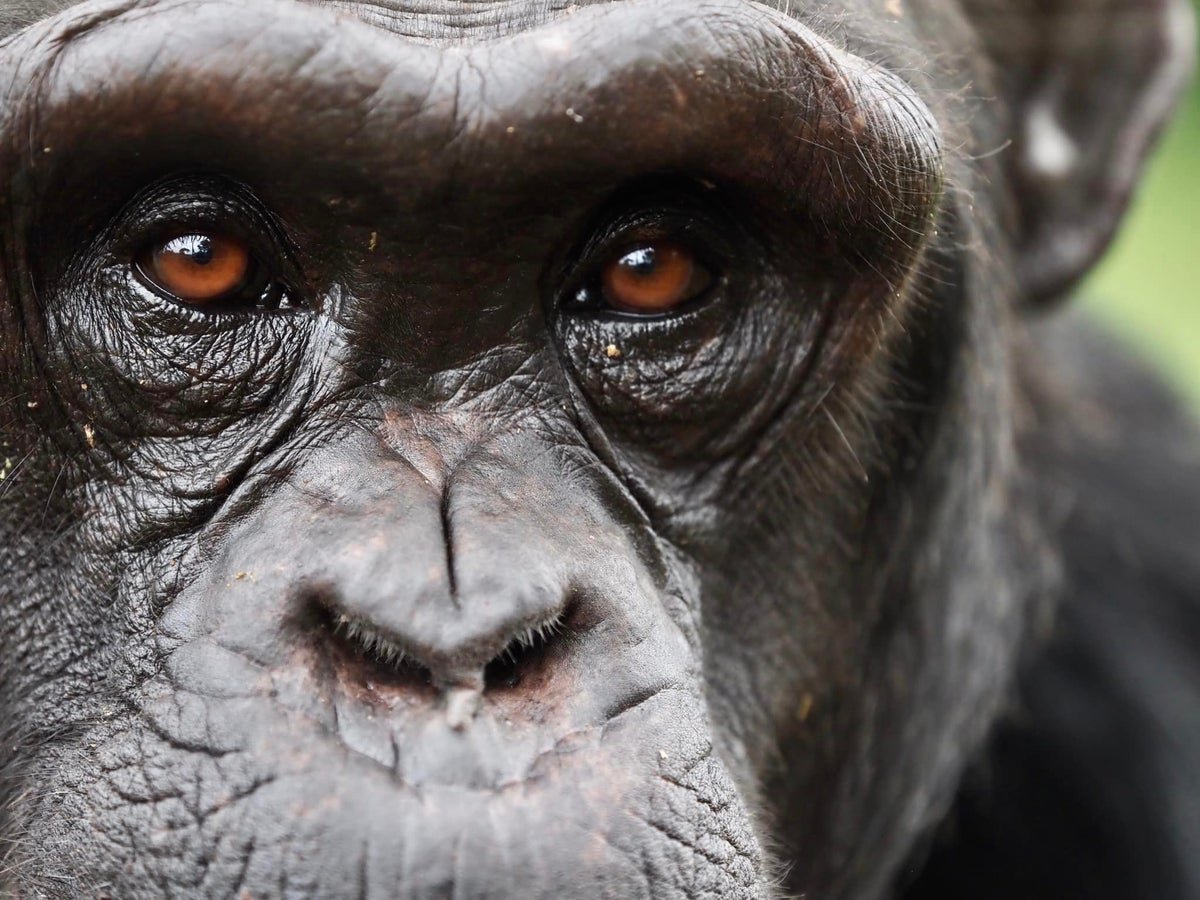
Chimpanzees show the capacity to revise their beliefs when presented with new evidence.
Innocent Ampeire/Ngamba Island Chimpanzee Sanctuary
You generally have reasons, good or bad, for your beliefs. You can reflect on those reasons: “Why do I think there’s a serial killer in the attic? It’s because the floor creaked.” And, paragon of rationality that you are, you can also adjust your beliefs when additional evidence demands it: “Having scoured the attic, baseball bat in hand, I must conclude that it’s just an old, creaky house.”
This cognitive skill is known as belief revision. It’s long been considered a hallmark of human rationality that distinguishes us from other animals. It relies on a reflective awareness of our own thought processes—thinking about thinking, or metacognition—that other species don’t obviously possess. But a new study, published today in the journal Science, shows that our closest evolutionary relatives also reason in surprisingly sophisticated ways.
In a series of experiments, researchers tested chimpanzees at the Ngamba Island Chimpanzee Sanctuary in Uganda to see how the animals juggled different sources of evidence. Each experiment revolved around food hidden in one of several boxes: The chimps would pick the box they thought was most promising based on an initial clue. Then they’d get another clue that sometimes conflicted with the first. Given the chance to update their decision, they almost always chose the box predicted by a rational-choice model and only changed their mind when the new information was stronger than what they already knew. “The chimps knocked it out of the park,” says Brian Hare, an evolutionary anthropologist at Duke University, who was not involved in the study. “It’s obvious this is so easy for them.”
On supporting science journalism
If you’re enjoying this article, consider supporting our award-winning journalism by subscribing. By purchasing a subscription you are helping to ensure the future of impactful stories about the discoveries and ideas shaping our world today.
Most impressively, the animals even accounted for clues that undermined earlier evidence. If they heard something bouncing around inside box 1, they would assume, at first, that it was an apple—but then the experimenter would pull out a stone. Realizing they had been misled, the chimps would immediately opt for box 2, even though it appeared uninspiring a moment before. This was “the cherry on top,” says study co-author Jan Engelmann, a comparative psychologist at the University of California, Berkeley. “None of us thought they could do it because it’s just so complex.”
Of course, lots of animals obey reason without reflecting on it; an amoeba is acting rationally, in some sense, when it follows chemical signals toward food. This “unreflective responsiveness to evidence,” as it’s been called, is a mere shadow of human rationality. But Engelmann argues that chimpanzees’ ability to scrutinize evidence and gauge the certainty of their own knowledge comes much closer to the real thing. “It’s very hard to explain the chimps’ behavior without appealing to some notion of reflection,” he says.
Christopher Krupenye, who studies animal cognition at Johns Hopkins University and was not involved in the study, agrees. He’s agnostic about the content of that reflection—without language, it’s unclear how animals could mentally represent the propositions that make up human beliefs (“I hear rattling, so there’s probably an apple in the box”). It’s possible the chimps think primarily in pictures. Regardless, Krupenye says, “all of this suggests they’re not just driven by simple, emotional responses. They have rather complex awareness.”
Clearly, however, there’s still more to human rationality. According to study co-author Hanna Schleihauf, a comparative psychologist at Utrecht University in the Netherlands, the crucial ingredient may be social interaction—we’re able to sharpen our beliefs through discussion. “This is really what makes humans so special,” she says. “We give and ask for reasons.” Indeed, some cognitive scientists think our reasoning skills evolved so that we could argue with one another.
This study reminds us that those skills evolved from somewhere—namely, from cognitive abilities that were already present in the common ancestor we share with chimpanzees and bonobos. More than 150 years ago, Charles Darwin predicted that our extraordinary mental powers would turn out to be extensions of capacities found throughout the animal kingdom. If chimpanzees are truly capable of reflection, the gap between us and our primate cousins narrows a bit further. As Hare puts it, there’s no need to search the stars for intelligence akin to our own. “We already know we’re not alone,” he says. “There are beings here, considering the world in a way that we think of as being rational.”
It’s Time to Stand Up for Science
If you enjoyed this article, I’d like to ask for your support. Scientific American has served as an advocate for science and industry for 180 years, and right now may be the most critical moment in that two-century history.
I’ve been a Scientific American subscriber since I was 12 years old, and it helped shape the way I look at the world. SciAm always educates and delights me, and inspires a sense of awe for our vast, beautiful universe. I hope it does that for you, too.
If you subscribe to Scientific American, you help ensure that our coverage is centered on meaningful research and discovery; that we have the resources to report on the decisions that threaten labs across the U.S.; and that we support both budding and working scientists at a time when the value of science itself too often goes unrecognized.
In return, you get essential news, captivating podcasts, brilliant infographics, can’t-miss newsletters, must-watch videos, challenging games, and the science world’s best writing and reporting. You can even gift someone a subscription.
There has never been a more important time for us to stand up and show why science matters. I hope you’ll support us in that mission.
