

For a long time, ecology tended to ignore people. It mostly focused on beautiful places far from large-scale human development: deep rainforest or pristine grassland. Then, in the late 1990s, in the desert city of Phoenix, Arizona, scientists shifted their gaze closer to home.
A team of ecologists went out into their own neighbourhood to map the distribution of urban plants in one of the first studies of its kind. Equipped with tape measures and clipboards, they documented trees and shrubs, sometimes getting on all fours to crawl through bushes under the curious watch of local people.
“We had a lot of fun. Little kids loved our measuring wheel,” says Prof Ann Kinzig, from Arizona State University. “It made me look at cities differently.”
Existing ecological theories did not explain the distribution of plants in cities. In wild areas, plants are typically arranged by influences such as geography and weather: the rockiness of the soil, level of rainfall, exposure to light and shade.
The scientists wondered whether a new theory was needed. “And the answer was, we did,” Kinzig says.
Phoenix city, where a 2003 study first documented the ‘luxury effect’ on wildlife diversity. Photograph: Alamy
The urban data kept telling them the same thing: the most significant impact on the distribution of plants was not elevation, proximity to water bodies, being close to rural areas or soil type. It was the wealth of people living nearby. In 2003, her team published the first paper on the “luxury effect”.
The phenomenon describes how wealthy parts of cities have more wildlife, and more wildlife diversity – a finding that can have profound implications for human health and wellbeing. In Phoenix, the researchers wondered if heat was the culprit. It is a desert environment where water is scarce and temperatures can be punishing.
When wealth in an area of Phoenix went up, people generally planted more vegetation and kept it watered. A $10,000 (£7,500) increase in the median household income of the study site in Phoenix resulted in a 0.3C (0.54F) decrease in mean surface temperature.
A chameleon in Phoenix, where household income was found to be one of the best predictors of lizard diversity. Photograph: Getty/500px
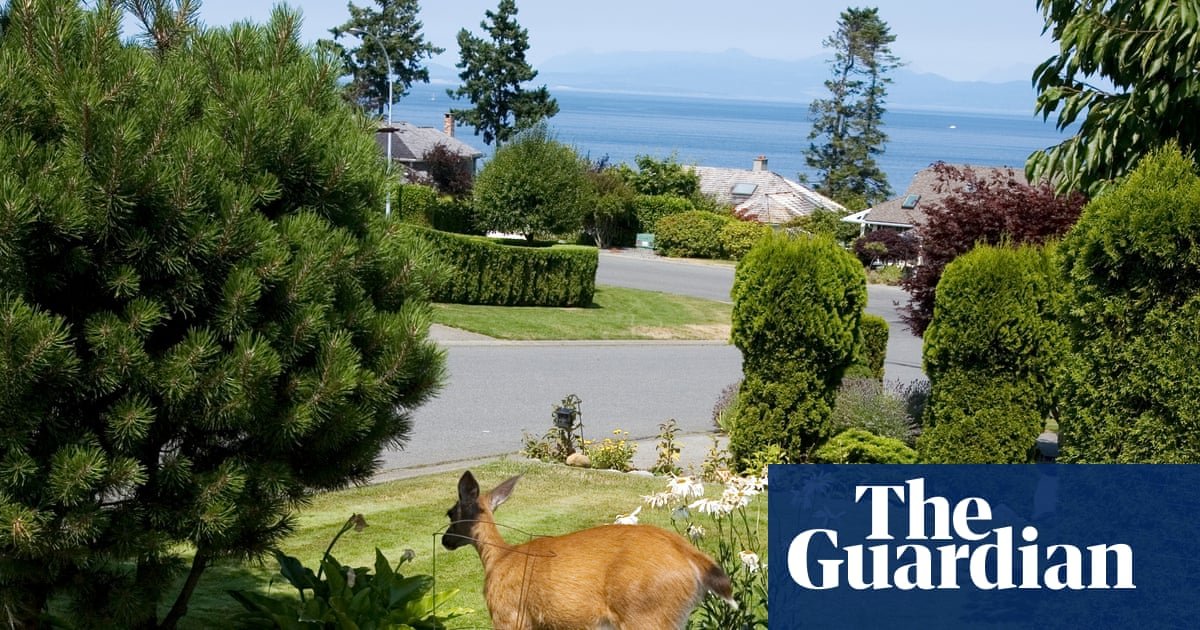
But since the initial studies in Phoenix, researchers found the luxury effect in other cities with different species, and where heat was less crucial. Black-tailed deer in British Colombia hung out in wealthier parts of town with more gardens, golf courses and parklands, according to a 2023 study.
The luxury effect has been found in plants in North America, Burundi, China and Australia. It has also been documented in birds in North America, Europe and New Zealand. Birds depend on plant species or food and shelter, so it’s possible that they are following the plants to luxury neighbourhoods. Even some bats gravitate towards wealthier areas of town. As far back as ancient Egypt, the places where labourers lived hosted different insect species compared with wealthier areas.
“I was surprised – not that human agency might shape biodiversity patterns in unexpected ways, but that the luxury effect holds so well,” says Kinzig. “In other words, you would … expect different types of people to create landscapes that support different types of other species, but you would not necessarily expect the rich would almost always experience higher biodiversity.” (Fewer studies on the luxury effect have been done in tropical regions – one study from Burundi found a positive relationship between plant diversity and wealth, but another study in Puerto Rico found no correlation, possibly because there is a smaller income gap between neighbourhoods.)
When people have the time and resources … they seem to like more diverse vegetationJeff Ackley, biologist
In urban environments, “humans control everything”, says Jeff Ackley, a US government regulatory biologist, who discovered the luxury effect on “rich lizards” of Phoenix, finding that household income was one of the best predictors of nearby lizard diversity. “When people have the time and resources to do it, they can control what their back yards look like. And for the most part, people seem to like more diverse vegetation.”
But the luxury effect is not confined to gardens – it appears to be happening indoors too. Wealthier homes have more insects and spiders living inside, according to a study from the US.
Researchers randomly sampled 50 homes in Raleigh, North Carolina, across the income spectrum. Wealthier homes had on average 100 types of arthropods, twice the number than in less wealthy homes, according to the study, which accounted for the size of home.
Contact with biodiverse environments and animals has been connected to positive health effects in humans. Photograph: John Callery/Getty Images/iStockphoto
The results were counterintuitive, because people typically think of wealthier people having cleaner homes, highlighting “how much we have yet to learn about indoor ecology”, researchers wrote.
No study has looked at how the millions of species of microbes that live in cities might be influenced by the luxury effect, but research shows poorer people typically have more inflammatory and immune diseases, which could be linked to lack of exposure to microbial life. Contact with biodiverse environments, soil and animals has been connected to a host of positive health effects.
“Almost all diseases of the immune system are on the rise,” says Dr James Kinross, a consultant surgeon at Imperial College London and author of Dark Matter: The New Science of the Microbiome. “There’s something about the way that we build and construct our urban systems that detaches us from nature, and therefore detaches us from these kind of microscopic ecosystems that we need to maintain our health.”
Biodiversity loss is recognised as a pressing global issue, but has typically referred to extinctions and species decline in the wider environment around us, rather than what is taking place in the human body. A growing collection of research, however, shows that they are intertwined. Last year, a paper coined the notion of “nature deficiency”, referring to how nature loss in the human body influenced health.
To reverse those health inequalities, scientists point back to the outside world, where preserving and expanding biodiversity can move the dial. A study in Finland showed that teenagers living with biodiverse gardens, for example, had reduced allergy and autoimmune problems.
“The luxury effect represents not just an interesting ecological pattern,” a group of researchers reviewing the phenomenon wrote. “[It is] also yet another layer in the social and structural injustices present in cities.”
Find more age of extinction coverage here, and follow the biodiversity reporters Phoebe Weston and Patrick Greenfield in the Guardian app for more nature coverage
