

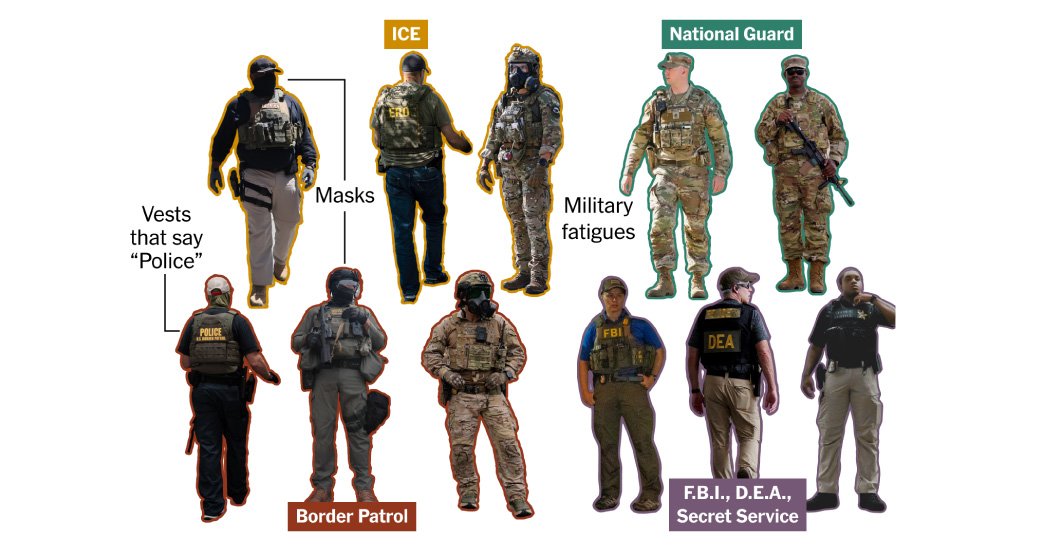
With the Border Patrol marching through Chicago and the National Guard patrolling Memphis, the variety of federal forces deployed to support President Trump’s mass deportation campaign and anticrime efforts continues to expand.
Often, it can be difficult for the public to tell them apart, or to understand what powers each agency has. Here is a guide to how these forces are operating, including alongside local law enforcement.
Who they are
Immigration and Customs Enforcement is the primary immigration law enforcement agency in the country, and its officers wear a variety of uniforms and identifiers.
August — Washington, D.C.
August — Washington, D.C.
Photos by John Moore/Getty Images (top); Kevin Dietsch/Getty Images (middle); Tasos Katopodis/Getty Images (bottom)
ICE is made up of two main branches. The officers of Enforcement and Removal Operations typically handle arrests and deportations. In the past, Homeland Security Investigations focused on transnational crimes, but Mr. Trump has called on its officers to make other arrests in the field.
Confusion over immigration officers’ relationship to other law enforcement is not new. In 2020, community organizations in California sued ICE, claiming officers misrepresented themselves as the police during immigration operations. The lawsuit was settled in August and mandated that officers clearly identify themselves as ICE on their clothing.
Elsewhere, ICE officers may operate in plain clothes with no or minimal identification but are supposed to identify themselves during arrests.
One case involving a Turkish doctoral student sparked outrage when footage surfaced of plainclothes agents confronting her on the street outside Boston in March.
March — Somerville, Mass.
Footage via WCVB Channel 5 Boston
Still other ICE officers may appear in full military-style fatigues, like the agency’s Special Response Teams, who are trained for high-risk operations. Since the anti-ICE summer protests in Los Angeles, they have also been guarding ICE facilities and making some street arrests.
Photo by Spencer Platt/Getty Images
Customs and Border Protection is charged with law enforcement at the border, but Mr. Trump has deployed its agents nationwide to arrest immigrants. Within 100 miles of the border, they have greater authority than local law enforcement to conduct certain searches.
Like ICE officers, their uniforms vary.
October — Portland, Ore.
Photos by Todd Heisler/The New York Times (top); Spencer Platt/Getty Images (bottom)
After protests mounted over his immigration crackdown, Mr. Trump sent National Guard troops to Chicago, Los Angeles and Portland, Ore., citing a need to protect immigration agents and federal property. He also has called upon the National Guard to work alongside the local police in Memphis and Washington, D.C.
Photo by Robyn Beck/Agence France-Presse — Getty Images
Local officials in most of these cities, which are led by Democrats, have strongly objected to the deployments, saying Mr. Trump is misusing the Guard, a part-time military force that most often is called upon during natural disasters, wars or civil unrest.
What they are doing
Where the president’s deportation and crime-prevention campaigns intersect, the lines have blurred, and all types of law enforcement share overlapping roles.
While immigration enforcement is the purview of ICE and Border Patrol, other agencies within the Department of Homeland Security and in the Justice Department have increasingly taken on this work.
September — Chelsea, Mass.
Photos by D.E.A, via Reuters (top); Brian Snyder/Reuters (bottom)
ICE often conducts raids on residences, and the agency has revived workplace raids, a practice largely suspended under the previous administration. Officers more often now stop people on the street, sometimes detaining U.S. citizens. ICE and Border Patrol agents also make arrests at courthouse immigration hearings, a practice legal groups say violates due process protections.
In many places, the local police work directly with Homeland Security to arrest immigrants, or to detain them until immigration officers arrive.
In Washington, at least eight federal agencies were part of Mr. Trump’s efforts to take control of law enforcement. The local police helped immigration officers identify targets during stops for minor infractions, and immigration officers helped with arrests for nonimmigration crimes.
August — Washington, D.C.
August — Washington, D.C.
Photos by Kevin Dietsch/Getty Images (top); Kenny Holston/The New York Times (bottom)
In cities where the administration says its immigration enforcement is at risk, the National Guard and federal forces have worked side by side to secure federal buildings and to confront protesters.
September — Broadview, Ill.
Photos by Anthony Vazquez/Chicago Sun-Times, via Associated Press (top); David Ryder/Reuters (middle); George Walker IV/Associated Press (bottom)
The working relationship between the various law enforcement agencies is not always clear. The Chicago police were exposed to tear gas when federal agents tried to disperse a crowd in the city without warning this month. Homeland Security officials said the Chicago police did not respond to the scene of a car crash and shooting that involved federal agents, an account local officials dispute.
Concerns about tactics
The deployment of militarized forces to major cities has drawn intense criticism from some residents, local leaders, and advocates for immigrants and civil liberties, who say the federal presence does more to stoke fear than to promote public safety.
Of particular concern is that many federal forces are increasingly hiding their faces with masks and other coverings during street operations.
Photos by Olga Fedorova/Associated Press (top); Gregory Bull/Associated Press (bottom)
“To witness a loved one, a neighbor, or community member being arrested before your very eyes by masked, unidentified men, is terrifying,” said Priscilla Olivarez, a senior policy attorney with the Immigrant Legal Resource Center, which is based in San Antonio.
There is no federal law requiring immigration agents to reveal their faces or personal identities. A Homeland Security spokeswoman said agents wear masks to protect themselves from personal attacks, and that they clearly identify themselves as law enforcement even when masked.
Local law enforcement agencies often have stricter rules about identification. In Chicago, police officers may not wear face coverings, and in New York City, Seattle, Miami, and Washington, D.C., officers must prominently display their names and badge numbers on their uniforms.
In September, California passed legislation banning federal immigration officers from concealing their faces. Homeland Security called the law unconstitutional and said officers would not abide by it.
Share your videos of ICE interactions: The New York Times is looking for examples of interactions between federal immigration agents and residents across the country.
