

February 5, 2026
4 min read
Add Us On GoogleAdd SciAm
Weird new object escalates ‘black hole star’ debate
Researchers have found what might be a little red dot transitioning into its final state, where x-rays burst through its gas cocoon. Others argue the object is nothing special
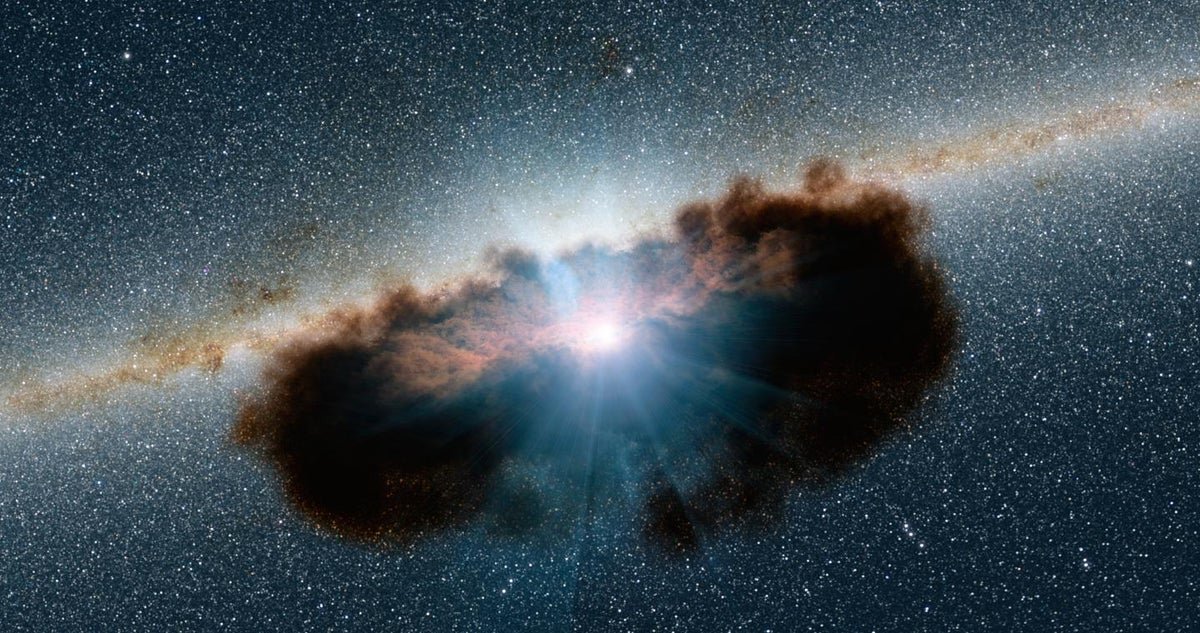
Artist’s rendering of a typical supermassive black hole partially obscured by a cloud of dust and gas. Astronomers are debating whether a strange newfound object in the early universe is one of these, or instead a “black hole star” chewing through its cocoon.
Astronomers have found a potential new piece of the ongoing puzzle over “little red dots” (LRDs). It’s a distant smudge in the sky reminiscent of the mysteriously compact, crimson orbs that keep cropping up in observations performed by NASA’s James Webb Space Telescope (JWST)—but this one also beams out x-rays.
First glimpsed in some of JWST’s earliest images, LRDs remain one of the telescope’s biggest surprises—ruby-red objects that shine like a star but may reach up to 500 light-years in size. Whatever they are, LRDs certainly aren’t rare: they seem to constitute nearly 10 percent of the luminous objects JWST sees in its surveys of faraway cosmic realms—investigations in which the telescope has looked back to a time when the universe was between about 5 and 15 percent of its 13.8-billion-year age.
After years of debate and follow-up studies, many astronomers now believe LRDs are a totally new class of galaxy. According to this idea, although these objects may look like supersize red stars, their shine is powered not by standard stellar thermonuclear fusion but rather by the relentless funneling of burning-hot plasma into the insatiable maw of a snowballing black hole. That fiery process heats a thick “cocoon” of gas surrounding and feeding the black hole, which then glows like a ruddy heat lamp.
On supporting science journalism
If you’re enjoying this article, consider supporting our award-winning journalism by subscribing. By purchasing a subscription you are helping to ensure the future of impactful stories about the discoveries and ideas shaping our world today.
The idea remains divisive, and it leaves one big question unanswered. None of the black holes we see in today’s universe are ensconced in such dense gaseous envelopes. So if LRDs are really “black hole stars,” then how did they shed their cocoon?
Now a group of researchers have uncovered an unusual object that has added more fuel to that debate. It combines the “redness” of an LRD with the telltale x-ray emission associated with a more exposed black hole. They’re hoping they’ve caught one of the hypothesized black hole stars just as it’s started chewing through its cocoon, the beginning of a metamorphosis that will transform it into one of the run-of-the-mill supermassive black holes that populate the modern cosmos. The team announced their discovery in a preprint posted online on January 14 and have submitted the paper to the Astrophysical Journal Letters.
“Have we found the rare LRD that is just on the precipice of its cocoon starting to fall apart?” asks the paper’s lead author, Raphael Hviding of the Max Planck Institute for Astronomy in Heidelberg, Germany.
Hviding and his co-authors wanted to explain LRDs’ sudden disappearance, so they went hunting for the objects in surveys of later cosmic epochs. “This kind of search is happening now more and more,” Hviding says. “Because we know these types of objects exist, we’ve started to pick through other datasets to find them.”
That’s how they found the “x-ray dot.” It shines light on the puzzle from a distant past, when the universe was just two billion years young. Several telescopes—including, crucially, NASA’s Chandra X-ray Observatory—had already caught it lurking near the tail of the Big Dipper, and imaged its glimmer in different parts of the electromagnetic spectrum. At the time though, the dot looked like what’s at the center of most active galaxies: a bright disk of hot matter slowly spiraling into a supermassive black hole that belches out x-rays throughout its feast.
But reexamining this dot in light of ongoing LRD fever, the team noticed something strange. Its color was off—a conspicuous blood red instead of the expected violet blue that’s more typical of an active galaxy’s core.
“This is an exciting object because it really seems to have characteristics of a little red dot and yet also has x-rays,” says study co-author Jenny Greene, an astrophysicist at Princeton University. “It’s very rare to see those things together.”
Lots of supermassive black holes appear red because most other emitted wavelengths are absorbed by orbiting clouds of dust. But the dust usually reemits that absorbed radiation, just at a different, lower-energy wavelength.
Scouring the data for evidence of this reemission, the team found none. The researchers are hoping this means the object isn’t merely a black hole seen through a dust filter but a crumbling cocoon. That would mark the transition between the LRD-filled universe seen by JWST and the black-hole-filled universe astronomers had grown accustomed to. It would also be the first conclusive proof of LRDs actually harboring black holes.
Some astronomers are skeptical that the x-ray dot is anything special, however. “The object looks to me like a simple, dust-obscured and reddened accreting black hole,” says Roberto Maiolino, an astrophysicist at the University of Cambridge.
There’s another issue: If the LRD is just beginning to punch holes through its red veil, shouldn’t the x-rays peeking through still be somewhat muted? “It doesn’t just have x-rays—it’s booming in x-rays,” Hviding says. “This object raises more questions than it answers.”
The authors have put in proposals for further observations of the x-ray dot to resolve those questions. It might also lead to the discovery of more like it. “That could go a long way toward determining what happens to LRDs,” says Amy Barger, an astronomer at the University of Wisconsin–Madison, who was not part of the study.
Meanwhile new ideas abound to explain JWST’s staggering wealth of LRDs. One argues that LRDs are really gas clouds collapsing into black holes—that the red glow is a violent birth rather than an adolescent feeding frenzy. Another argues that some of the apparent contradictions of LRDs can be reconciled by an amorphous, nonspherical shape. Both of these hypotheses appear in preprints posted in the past two weeks, and each has already garnered its critics.
Even Greene, who worked on one of the first little red dot studies in 2023, didn’t predict the sustained frenzy of publications. “I knew it was really cool, and I knew people were going to care about it,” she says. “I didn’t know there was going to be one paper a day for three years.”
It’s an unprecedented moment for astronomy—at least for an early-career researcher like Hviding. “We truly have something we’ve never seen before,” he says. “For the first time in a long time in extragalactic astronomy, we have found a new type of galaxy.
