

October 23, 2025
3 min read
Watch These Parasitic Worms Use Static Electricity as a Tractor Beam
These Worms Use Static Electricity like a Sci-Fi Tractor Beam
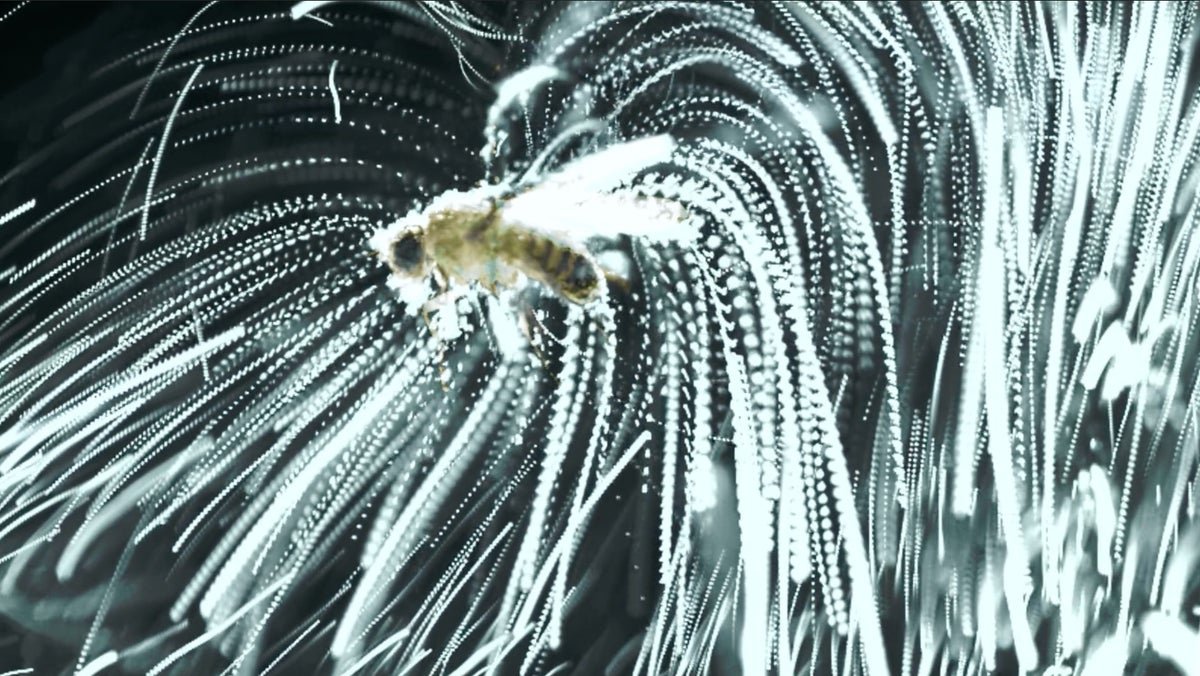
Flows of tracer particles show the attractive force of a positively-charged fruit fly. Parasitic nematodes use this static charge to leap onto the insects.
Victor Ortega Jimenez/University of California, Berkeley
At first glance, it’s a wonder that parasitic nematodes exist at all. To reproduce, these minuscule creatures—roughly the size of a pinpoint—must leap 25 times their body length and land on a flying insect as it zooms overhead. Given that wind, gravity and air resistance all stand in the way of a bull’s-eye, the worms’ chances seem poor. But new research shows there’s another force working to their advantage: static electricity.
At human scale, static electricity is little more than a curiosity. You walk across the carpet, friction transfers electrons from the floor to your socks, and you receive a mild zap when the electrical imbalance rights itself by discharging to the first metal doorknob you touch—ouch. But similar processes hold tremendous sway in the teensy world of insects. According to a new study in Proceedings of the National Academy of Sciences USA, the mere beating of insect wings generates enough positive charge to pull an oppositely charged, airborne nematode inexorably toward its unlucky host. The worms seem to have outsourced their accuracy to these electrical tractor beams. “They don’t need to be precise” when they jump, says senior study author Víctor Ortega-Jiménez, a biologist at the University of California, Berkeley, “just close enough to be attracted.”
Download the video
A nematode leaps and floats on the wind.
Victor Ortega Jimenez/University of California, Berkeley
On supporting science journalism
If you’re enjoying this article, consider supporting our award-winning journalism by subscribing. By purchasing a subscription you are helping to ensure the future of impactful stories about the discoveries and ideas shaping our world today.
This is the latest in a line of experiments that, over the past decade, have illuminated the exotic physics that govern small animals’ lives. In 2013 researchers reported that bees can sense electrical fields around flowers and use that information to guide their foraging decisions. Around the same time, Ortega-Jiménez discovered that spiderwebs deform when positively charged insects fly by, bulging out to ensnare them. Most recently, in 2023, a group of British researchers found that ticks are passively attracted to furry hosts, whose fluffy coats accumulate electrons.
The 2023 study was led by Sam England, now a postdoc investigating sensory ecology at Berlin’s Natural History Museum. Given the precedent in ticks, he wasn’t surprised to learn from the new study that nematodes have also harnessed electricity for parasitic purposes. But whereas ticks sit around waiting, worms “actively input force into the attraction” by jumping, he notes, becoming agents of their own grisly destiny. England was also impressed by how Ortega-Jiménez and his colleagues integrated the effects of other forces, such as air resistance, with those of static electricity in the new research. The work “helps us better connect all of these new and exciting discoveries in electrostatic ecology with the wider physics of ecological interactions,” he says.
Download the video
A nematode winds up for its leap.
Victor Ortega Jimenez/University of California, Berkeley
To test the effect of static charge on airborne nematodes, Ortega-Jiménez tethered living fruit flies to a live copper wire and adjusted the voltage between 100 and 700 volts, comparable to what insects would generate in the wild. (Because they weren’t flying, they didn’t generate their own charge.) Then he unleashed the worms, letting them fling themselves at their electrified prey. The trend was clear: the higher a fly’s electric potential, the more likely nematodes were to attach to it. With zero static, they almost always missed; at higher voltages, they latched on more than half the time.
Download the video
Nematode launches and is pulled toward a charged fruit fly.
Victor Ortega Jimenez/University of California, Berkeley
But coaxing nematodes is tricky and time-consuming, so Ortega-Jiménez collaborated with Ranjiangshang Ran, a postdoc studying fluid mechanics at Emory University, who ran computer simulations of thousands more jump trajectories. When the virtual voltage reached as high as 800 V, the digital worms were unstoppable: in simulations with a gentle, buoyant breeze to keep them aloft long enough for static to take over, their overall success rate soared to more than 70 percent, including launches that were in exactly the wrong direction.
For nematodes, a jump is no small thing. If they don’t stick the landing, these aerial hunters can quickly dry out, starve or become the hunted themselves. So their entire survival strategy depends on static electricity—without its reassuring pull, they’d likely never have left the ground. “It wouldn’t make sense for them to evolve this jumping mechanism without the presence of electrostatics,” Ran says. Other animals may not be so fully reliant on this force. But as the list of electrically sensitive species grows, England believes we’ll find that electrostatic effects “play countless roles” throughout the natural world. “Their importance to ecosystems as a whole,” he says, “has probably been historically quite underestimated.”
It’s Time to Stand Up for Science
If you enjoyed this article, I’d like to ask for your support. Scientific American has served as an advocate for science and industry for 180 years, and right now may be the most critical moment in that two-century history.
I’ve been a Scientific American subscriber since I was 12 years old, and it helped shape the way I look at the world. SciAm always educates and delights me, and inspires a sense of awe for our vast, beautiful universe. I hope it does that for you, too.
If you subscribe to Scientific American, you help ensure that our coverage is centered on meaningful research and discovery; that we have the resources to report on the decisions that threaten labs across the U.S.; and that we support both budding and working scientists at a time when the value of science itself too often goes unrecognized.
In return, you get essential news, captivating podcasts, brilliant infographics, can’t-miss newsletters, must-watch videos, challenging games, and the science world’s best writing and reporting. You can even gift someone a subscription.
There has never been a more important time for us to stand up and show why science matters. I hope you’ll support us in that mission.
