

Friedrich Engels stands accused of exaggerating, or perhaps taking “creative liberties”, with just how segregated Manchester was in the mid-19th century, a study has found.
The great socialist thinker, who co-authored with Karl Marx the Communist manifesto, was a Manchester resident, appalled and galvanised by the squalor and inequality he saw in the city.
His observations were published in his book The Condition of the Working Class in England, a blistering, furious polemic of life in Manchester seen as the defining text of the British industrial experience.
In it he described shocking segregation. He wrote about swathes of “unmixed working-people’s quarters” stretching “like a girdle”. Beyond them were the middle bourgeoisie in their townhouses and beyond that “in remoter villas with gardens in Chorlton and Ardwick” were the upper bourgeoise, also living it up on the “breezy heights of Cheetham Hill, Broughton, and Pendleton, in free, wholesome country air”.
Many historians have taken Engels’ observations at face value and assumed this was how Manchester was, with the middle classes sheltering in their smarter houses from the poor.
Emily Chung, of the University of Cambridge, used data from the digitised 1851 census of Manchester to map where people from different social classes were actually living. Photograph: Guillaume Proffit
But the Cambridge University historian Emily Chung, by mapping digitised census data, has uncovered a much more complicated picture.
“I wouldn’t go as far to as to say Engels was wrong,” she said. “I think what my research shows is that Engels exaggerated and took creative liberties.”
Chung’s research shows that many middle-class Mancunians did in fact live in the same buildings and streets as those in the working class.
It finds that more than 60% of buildings housing the wealthiest classes also housed unskilled labourers. In Manchester’s “slums”, more than 10% of the population was from the better-off, employed classes.
“Manchester’s wealthier classes did not confine themselves to townhouses in the city centre and suburban villas, as we’ve been led to believe,” Chung said.
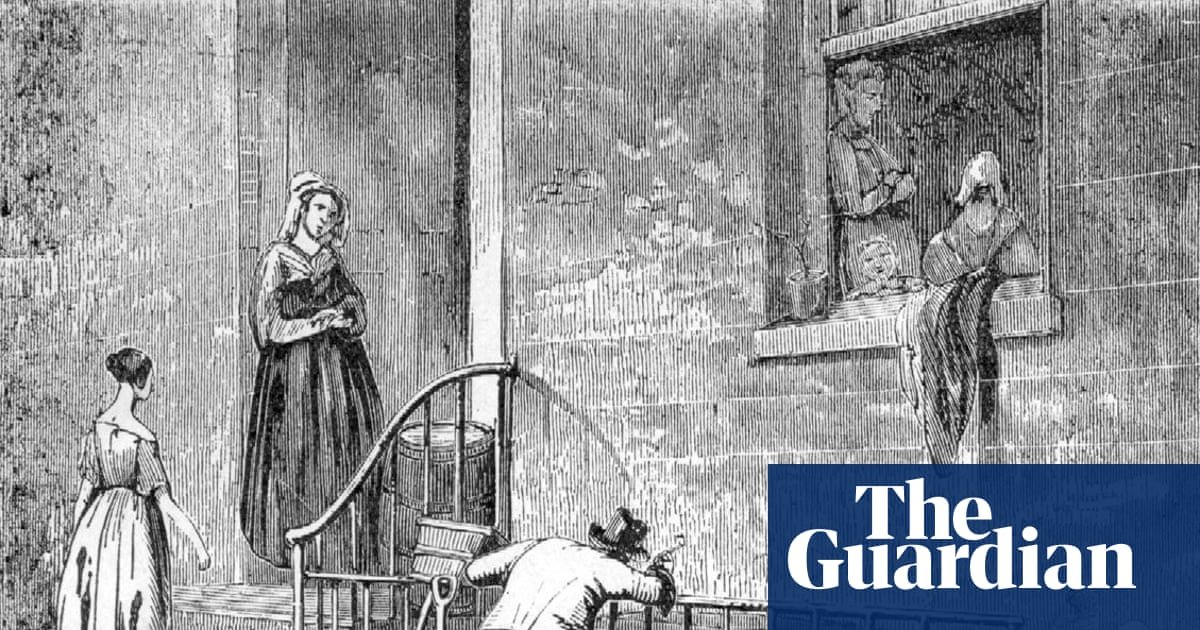
Victoria Street, Manchester, as depicted in a print from 1850. Illustration: Courtesy of Manchester Libraries
She uncovered evidence of doctors, engineers, architects, surveyors, teachers, managers and shop owners living alongside weavers and spinners.
“I found that not only did very diverse populations live in the same neighbourhoods, but they actually even lived in the same buildings. Different families were inhabiting the same buildings at the same addresses, even if they were very different classes.”
It is important to know this, she said. “Segregation in cities remains a major concern in many parts of the world, including Britain, so understanding what people experienced in Manchester, one of the world’s first industrialised cities, is really important.”
Engels was only 22 when he moved to the city in 1842, sent by his father to help run a family-owned cotton mill in Salford.
Workers in a cotton mill, as part of JR Barfoot’s The Progress of Cotton (1840). Illustration: courtesy of Manchester Libraries
His father hoped it would prepare his son for life as a businessman and knock out some of the more radical ideas he had picked up. It had the opposite effect.
In Manchester, he struck up a relationship with a poor, uneducated mill worker, Mary Burns, who guided him around slums where he found what he described as “cattle-sheds for human beings” and sharp separation between different classes.
Engels’ observations of the city have had a profound effect. “Without Manchester there would have been no Soviet Union,” said the historian Jonathan Schofield.
Chung’s research, published on Tuesday in The Historical Journal, uses data from the digitised 1851 census to map where people from different social classes were actually living in the city.
Chung’s research finds that families of different classes were living in dwellings at the same address. A print of a cellar home, 1838. Illustration: Courtesy of Manchester Libraries
“The most exciting moment was discovering that one in 10 people living in Ancoats, the notorious working-class slum, were middle-class,” she said.
Chung has discovered a lot about where people lived but also what their daily routines were, and when – because of work patterns and policing – there clearly was segregation.
“While Victorian London and Liverpool bustled with daytime activity, Manchester’s public spaces were almost deserted,” she said. “Its streets were rarely occupied by weavers and doctors at the same time.”
Chung’s research argues that it was work, shopping, church and the pub that kept apart different classes far more than ‘residential segregation’.
Her research process had been “gradual and gruelling”, she said. “I think it proves that local history still matters and uncovering local stories actually allows you to really dig in deep and find things that you wouldn’t if you’re only looking at big national pictures.”
