

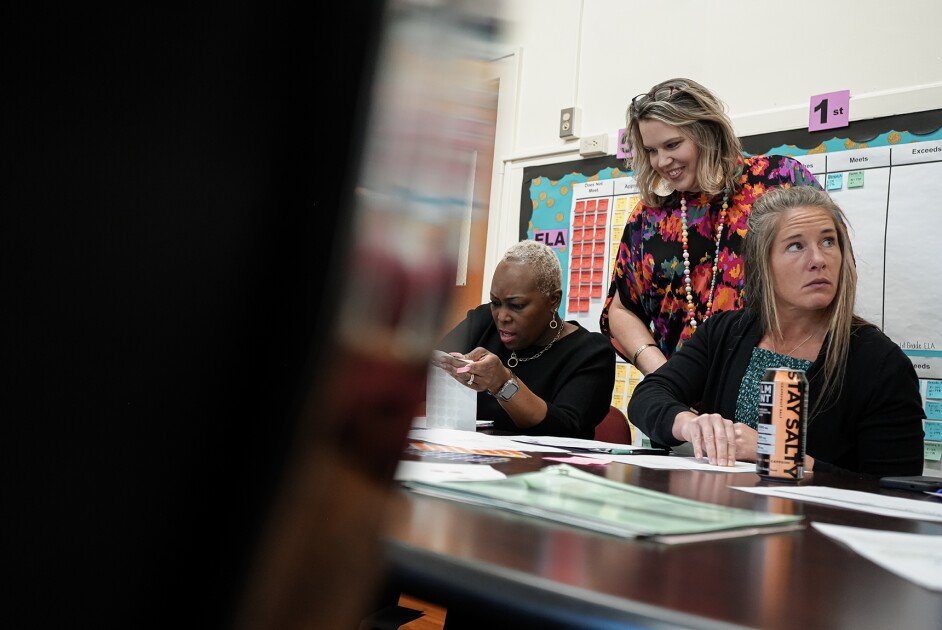
Like it or loathe it, professional development is part of most every teacher’s job.
State laws might mandate training to prepare for new curricula. Districts often require attendance at “in-service” days for professional development. Contracts sometimes attach a requisite number of professional development hours before teachers can receive salary bumps. In these ways, teachers don’t really have a say in their professional development.
But if the end goal of these learning experiences is to grow teachers’ knowledge and skills—and, in turn, improve student success—then giving teachers a say in their professional development matters. So, what do teachers want from professional development?
Above all else, they want the opportunity to collaborate with their colleagues, according to multiple sources: a Gallup-Walton Family Foundation survey on U.S. public school K-12 teachers released last month, an interview with a researcher from a nonprofit that studies education policy and practice, and a conversation with the most recent recipient of the Council of Chief State School Officers’ National Teacher of the Year award.
Teachers give collaboration with peers high marks
Teachers learn by collaborating, and they collaborate best with their colleagues, according to Teaching for Tomorrow: How Supporting Teachers Today Shapes Classrooms Tomorrow, the Gallup-Walton Family Foundation report. (The foundation provides support for Education Week’s coverage of strategies for addressing the opportunities for students most in need. Education Week retains sole editorial control over the content of this coverage.)
Nearly 70% of teachers who responded to the survey ranked collaborative planning meetings as “highly or moderately valuable” to their overall development. An even higher percentage of teachers surveyed, 71%, agreed that the most effective meetings are those led by teaching colleagues—or without an appointed leader.
Notably, teachers surveyed ranked peer observation and mentorship as more effective than traditional coaching practices—but only one in three teachers surveyed report having the opportunity to experience those practices.
Why collaboration works, and what gets in the way
That teachers find collaborating with colleagues beneficial comes as no surprise to Maria Hyler, a senior researcher at the Learning Policy Institute, a nonprofit that conducts research to improve education policy and practice.
“It’s a space where teachers can focus specifically on their student needs and focus on their teaching practices. And their peers are working with the same student population in the same communities,” Hyler said. “When you think about that, that’s a really powerful space of knowledge coming together.”
Despite the high regard teachers have for collaborating with colleagues, the majority of districts don’t carve out time for teachers to engage in it, according to the Gallup-Walton Family Foundation survey results.
“Sometimes we get so busy that we often go with the ‘least resistance’ route. That contributes to professional development that’s not aligned with the professional learning needs of teachers,” Hyler said.
“There really needs to be some thought put into things like: How are we going to arrange our schedules to ensure that our teachers have the time and space to collaborate in meaningful ways?”
What can happen when teachers take the initiative to collaborate
Some teachers carve out the time to collaborate in meaningful ways with colleagues. Ashlie Crosson, an English teacher at Mifflin County High School in Lewistown, Pa., and the 2025 Council of Chief State School Officers’ National Teacher of the Year, is one of them.
Crosson has been teaching for 15 years and says, at this point in her career, if she needs to find new course content or other information related to instruction, she knows which resources to tap. But for ways to truly grow as a professional, she turns to colleagues.
“If I want to consistently grow within this profession, I need to be working with other colleagues. I need to be brainstorming ideas with them, I need to be bouncing ideas off of them and their experience and what’s going on in their classrooms, because that makes me more dynamic as a teacher in my English classroom,” she said.
She’s even ventured into cross-discipline collaboration in an effort to meet her students where she believes the future will take them—to a world that blurs the lines between college and career readiness and traditional academics.
“Every teacher’s responsibility at this point is: How do you make your class ‘career and future ready,’ which isn’t a natural part of [AP English Language and Composition],,” Crosson observed.
To help her students transfer what they learn in her literature class to skills they will likely use in future jobs in growing fields such as mass communication and marketing, she reached out to the school’s technology education teacher. An informal conversation evolved into a project now in its 5th year.
The teachers brainstormed how their students could work together on a “real-world” project to design a coffee cup that would be displayed in a local coffee shop during the holidays. Crosson’s literature students examined motifs and themes of the holiday and traditions of the local community and ultimately created the coffee cups’ look, and the students in the technology class figured out how to mass-produce “sleeves” for the cups. Both groups of students applied classroom knowledge to a real-world project, thanks to their respective teachers’ collaborative brainstorming.
Crosson would like to see this sort of classroom-oriented, collaborative professional development gain more traction. She likens it to “genius hour,” a term for inquiry-based learning adopted by some schools as well as some highly successful startup companies.
“You’re basically giving people time, space, and resources to pursue something that is of interest to them,” Crosson said. “That’s making them more productive workers, because it’s about bringing them a sense of fulfillment.”
