

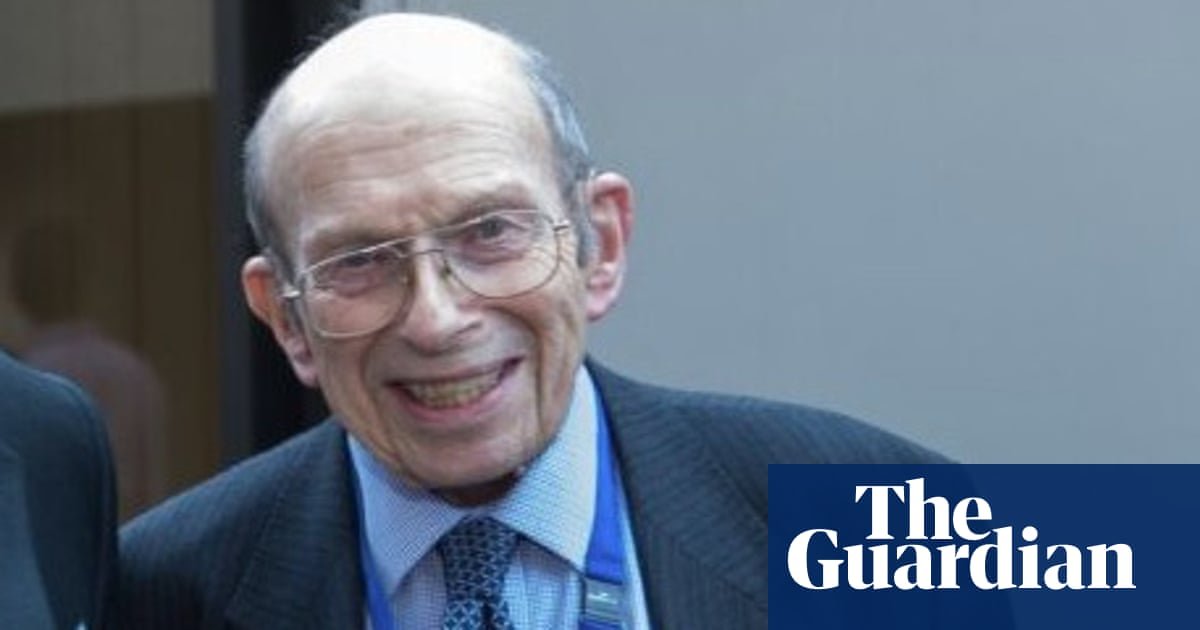
When Peter Hirsch produced the first images of defects or faults in crystalline structures using transmission electron microscopy at Cambridge University’s Rutherford Laboratory, he transformed our understanding of materials science and redefined our knowledge of crystallography.
In particular, in 1956 he and his team directly observed a specific type of fault, known as a dislocation, in pieces of stainless steel and aluminium foil, which previously had only been a somewhat controversial hypothesis. These faults are important because they control the ductility of the material, that is, its ability to sustain deformation before breaking.
Specifically, in metallurgy, understanding and controlling dislocations has been fundamental to the modern use of metals. Without them metals could not be used as structural materials in fields from bridge-building and architecture to rail transport, because they would be too brittle. Hirsch, who has died aged 100, realised that identifying where such dislocations occur helps us better comprehend a metal’s strength and, crucially, how it can be made even stronger.
Later, in 1965, alongside co-authors Archie Howie, Robin Nicholson, Don Pashley and Michael Whelan, Hirsch published Electron Microscopy of Thin Crystals – known in the industry as the “Yellow Bible” because of its original yellow cover. Following frequent updates and reprints, it is still considered to be a field-defining text.
Hirsch was born in Berlin to Jewish parents, Ismar, who worked in the textile industry, and Regina (nee Less). His birth name was Kurt, which he later changed to Peter, on arrival in the UK. When he was nine, his parents divorced and his father died two years later, in 1936.
On the night of 9 November 1938, aged 13, Hirsch witnessed first-hand the events of Kristallnacht (the Night of Broken Glass), a pogrom against German Jews. Nazi party paramilitaries, assisted by the Hitler Youth, smashed the windows of Jewish-owned shops, schools and synagogues and invaded the homes of Jewish families.
Under his guidance the department of metallurgy at Oxford became the pre-eminent institution in its field
Hirsch’s older brother, Hans, who would later adopt the forename John, was already in the UK, studying engineering. His mother, who had remarried, worried by the deteriorating situation in Germany, asked an English friend to send her a fake telegram demanding she attend her sick son in London, leaving Hirsch behind with his stepfather. Once she had managed to extend her visa after accepting work in Chelsea as a domestic servant, she arranged for her remaining son to be placed on a Kindertransport train. He arrived in England on 1 January 1939, his stepfather following soon after.
Hirsch attended Sloane grammar school in Chelsea, excelling despite also having to learn English, and, in 1943, was offered a place at St Catharine’s College, Cambridge, where he studied natural sciences and physics. He graduated with first-class honours in 1946 and joined the crystallography department of the Cavendish Laboratory to study for an MA and subsequently a PhD on X-ray diffraction of work-hardened metals – the process whereby a metal becomes harder and stronger due to the accumulation of dislocations in its crystal structure – earning his doctorate in 1951. His first postgraduate job, funded by the National Coal Board, was studying the crystallography of coal, work that is still cited today.
Following his pioneering transmission electron microscopy research, he moved to Oxford University in 1966 to take up the Isaac Wolfson chair in metallurgy, where he remained until his retirement in 1992. Throughout the latter part of the 20th century, under his guidance the department of metallurgy (now the department of materials) at Oxford became the pre-eminent institution in its field. His co-author Howie said: “He had great intuition about which experiments to do and was brilliant at interpreting the results.”
Known to everyone in his field as PBH, he was so immersed in his work that colleagues recalled him phoning the department to ask how experiments were progressing while he was supposed to be on holiday, explaining that he was calling from a telephone box “so my wife won’t find out”.
He was renowned for championing ability from whatever source and the departments he headed were notable for their international mix of students. His liberal humanist outlook and early life experiences led him to encourage students from diverse backgrounds to achieve their potential however unfavourable their circumstances. “The university environment and common scientific interests overcame any political differences,” he said. Many of the students he mentored would go on to become internationally significant in their own fields.
He was knighted in 1975 for services to industry after becoming a fellow of the Royal Society in 1963. Between 1982 and 1984 he was the chair of the United Kingdom Atomic Energy Authority. An undergraduate bursary in his name runs at Oxford’s department of materials which, in 2001, also instigated a series of biennial lectures in his honour.
In 1959 he married Mabel Kellar (nee Stephens), known as Steve, a librarian. She had two children from a previous marriage, Janet and Paul.
Steve died in 2016. Hirsch is survived by his stepchildren.
Peter Bernard Hirsch, materials scientist, born 16 January 1925; died 12 September 2025
