
Close Menu

    Subscribe to Updates

    Get the latest creative news from FooBar about art, design and business.

    What's Hot

    EU introduces €3 customs charge on small parcels to curb cheap Chinese imports | International trade

    UK state threats bill could pull British journalists into terror prosecutions – experts | UK security and counter-terrorism

    Five Americans die every hour from toxic vehicle emissions, study finds | US news

    Facebook X (Twitter) Instagram
    Facebook X (Twitter) YouTube LinkedIn
    Naija Global News |
    Monday, June 29
    • Business
    • Health
    • Politics
    • Science
    • Sports
    • Education
    • Social Issues
    • Technology
    • More
      • Crime & Justice
      • Environment
      • Entertainment
    Naija Global News |
    You are at:Home»Science»Nobel prize in chemistry awarded to scientists for work on ‘Hermione’s handbag’ | Nobel prizes
    Science

    Nobel prize in chemistry awarded to scientists for work on ‘Hermione’s handbag’ | Nobel prizes

    onlyplanz_80y6mtBy onlyplanz_80y6mtOctober 8, 2025004 Mins Read
    Share Facebook Twitter Pinterest LinkedIn Tumblr Email
    Nobel prize in chemistry awarded to scientists for work on ‘Hermione’s handbag’ | Nobel prizes
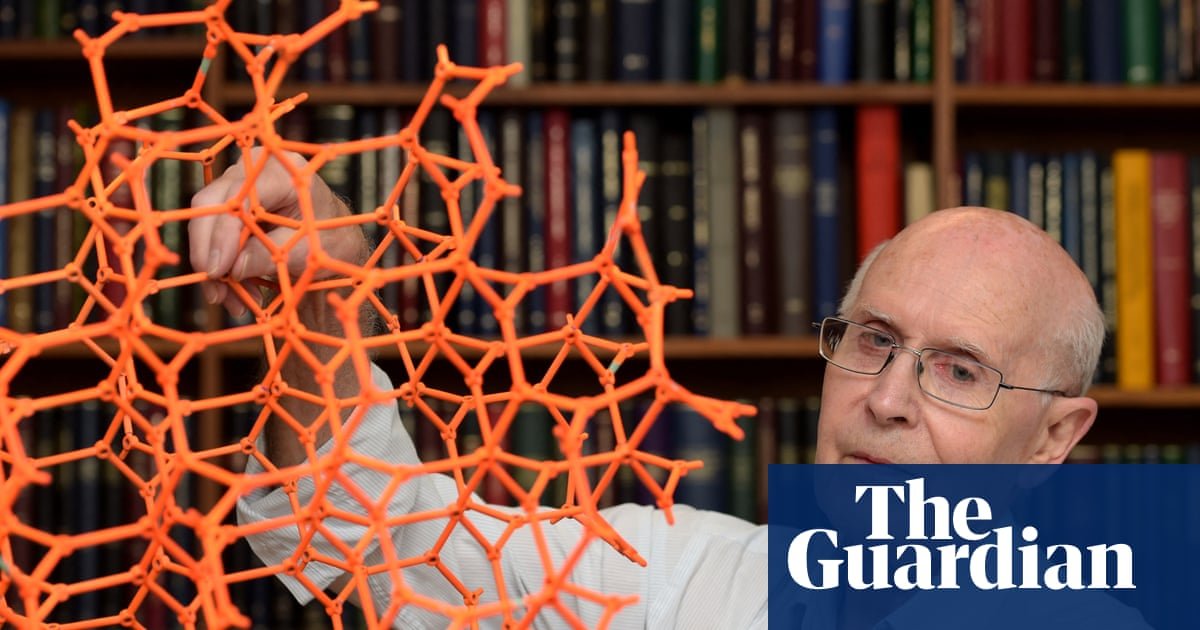
    UK-born Richard Robson, one of the Nobel prize winners, with a model of a metal-organic framework Photograph: University of Melbourne/AFP/Getty Images
    Share
    Facebook Twitter LinkedIn Pinterest Email

    The Nobel prize in chemistry has been awarded to three scientists who created revolutionary porous materials that can harvest water from desert air, capture carbon dioxide from industrial facilities and remove toxins from water.

    Susumu Kitagawa, of Kyoto University, Richard Robson, of the University of Melbourne, and Omar Yaghi, of the University of California, Berkeley, shared the 11m Swedish kronor (about £871,400) prize awarded by the Royal Swedish Academy of Sciences in Stockholm.

    The trio found ways to combine metal ions and organic molecules into highly porous structures through which liquids and gases could flow. Tens of thousands of such materials have since been made for applications ranging from storing hydrogen to removing forever chemicals from water and recovering valuable rare earth metals from waste.

    The scientists were honoured “for the development of metal-organic frameworks”, or MOFs, which have such potential that they have been called the material of the 21st century.

    Speaking at the prize announcement, Prof Heiner Linke, the chair of the Nobel committee for chemistry, said: “They have found ways to create materials, entirely novel materials with large cavities on the inside, which can be seen almost like rooms in a hotel, so that guest molecules can enter and also exit again from the same material.

    “A small amount of such material can be almost like Hermione’s handbag in Harry Potter. It can store huge amounts of gas in a tiny volume.”

    The Nobel prize committee announce the winners, from left Susumu Kitagawa, Richard Robson and Omar Yaghi Photograph: Anadolu/Getty Images

    The research began in 1989 with Robson, a chemist born in Glusburn, West Yorkshire, who moved to Australia after studying at Oxford and Stanford universities. Inspired by the structure of diamonds, he combined copper ions with a four-armed molecule to make pyramid-shaped molecules. These bonded together to form crystals strewn with cavities.

    Robson realised the potential for the structures but they were unstable and tended to fall apart. It took further work from Kitagawa and Yaghi to turn metal-organic frameworks into the valuable materials they are today.

    Kitagawa showed that similar structures based on cobalt, nickel and zinc were not only stable but could be used to store and release methane, nitrogen and oxygen. He went on to show that MOFs could be tailored to different tasks and even made from flexible materials.

    Reached by the Nobel committee, Kitagawa said he was “deeply honoured and delighted” to receive the prize. Asked about his hopes for the future, Kitagawa said he wanted to use MOFs to extract important elements such as carbon and oxygen from the air and with green energy turn them into useful materials. “This is my dream,” he said.

    Yaghi became fascinated with chemistry at the age of 10 after sneaking into the school library, which was usually locked, and plucking a book at random from the shelves. He was brought up with his siblings in a single room in Amman, Jordan, with no running water or electricity. At his father’s insistence he went to study in the US.

    Frustrated with the traditional way of building new molecular structures, Yaghi developed a more precise approach that was more like assembling pieces of Lego into large crystals. In the 1990s, he revealed MOFs that resembled nets held together with copper or cobalt. Later, he created an extraordinary zinc-based MOF. A couple of grams held an area as large as a football pitch, meaning it could absorb a vast amount of gas for its size.

    Dr Becky Greenaway, a chemist at Imperial College London, said: “Lots of chemists have been wondering when metal-organic frameworks would get the Nobel prize, and it’s finally happened.

    “Their discovery has enabled a whole range of applications, from gas storage and separations to drug delivery, and also opened up other areas, including porous liquids – liquids with holes in – which are showing promise in carbon capture and catalysis.”

    awarded Chemistry handbag Hermiones Nobel Prize prizes Scientists work
    Share. Facebook Twitter Pinterest LinkedIn Tumblr Email
    Previous ArticleAfter 30 Years of Discovery, These Are Astronomers’ Top Five Exoplanets
    Next Article The car finance scandal payouts: what does ruling mean and how much compensation could you get? | Motor finance
    onlyplanz_80y6mt
    • Website

    Related Posts

    Too hot for work: why extreme heat is a threat to Europe’s productivity | Productivity

    June 26, 2026

    Bending forwards a lot at work in early pregnancy may increase miscarriage risk, study suggests | Miscarriage

    June 18, 2026

    Why is the UK launching an ‘Australia plus’ social media ban and how will it work? | Social media ban

    June 16, 2026
    Add A Comment
    Leave A Reply Cancel Reply

    Top Posts

    The science influencers going viral on TikTok to fight misinformation

    February 17, 20262 Views

    Watch Lady Gaga’s Perform ‘Vanish Into You’ on ‘Colbert’

    September 9, 20251 Views

    Advertisers flock to Fox seeking an ‘audience of one’ — Donald Trump

    July 13, 20251 Views
    Stay In Touch
    • Facebook
    • YouTube
    • TikTok
    • WhatsApp
    • Twitter
    • Instagram
    Latest Reviews

    At Chile’s Vera Rubin Observatory, Earth’s Largest Camera Surveys the Sky

    By onlyplanz_80y6mtJune 19, 2025

    SpaceX Starship Explodes Before Test Fire

    By onlyplanz_80y6mtJune 19, 2025

    How the L.A. Port got hit by Trump’s Tariffs

    By onlyplanz_80y6mtJune 19, 2025

    Subscribe to Updates

    Get the latest tech news from FooBar about tech, design and biz.

    Most Popular

    The science influencers going viral on TikTok to fight misinformation

    February 17, 20262 Views

    Watch Lady Gaga’s Perform ‘Vanish Into You’ on ‘Colbert’

    September 9, 20251 Views

    Advertisers flock to Fox seeking an ‘audience of one’ — Donald Trump

    July 13, 20251 Views
    Our Picks

    EU introduces €3 customs charge on small parcels to curb cheap Chinese imports | International trade

    UK state threats bill could pull British journalists into terror prosecutions – experts | UK security and counter-terrorism

    Five Americans die every hour from toxic vehicle emissions, study finds | US news

    Recent Posts
    • EU introduces €3 customs charge on small parcels to curb cheap Chinese imports | International trade
    • UK state threats bill could pull British journalists into terror prosecutions – experts | UK security and counter-terrorism
    • Five Americans die every hour from toxic vehicle emissions, study finds | US news
    • One person a week in England dies with undiagnosed TB, study finds | Tuberculosis
    • England facing children’s mental health ‘crisis’ as referrals hit 1m | Mental health
    © 2026 naijaglobalnews. Designed by Pro.
    • About Us
    • Disclaimer
    • Get In Touch
    • Privacy Policy
    • Terms and Conditions

    Type above and press Enter to search. Press Esc to cancel.