

October 6, 2025
4 min read
The 2025 Nobel Prize in Physics Goes to Researchers Who Showed Quantum Tunneling on a Chip
John Clarke, Michel H. Devoret and John M. Martinis shared the 2025 Nobel Prize in Physics for their work showing how bizarre microscopic quantum effects can infiltrate our large-scale, everyday world
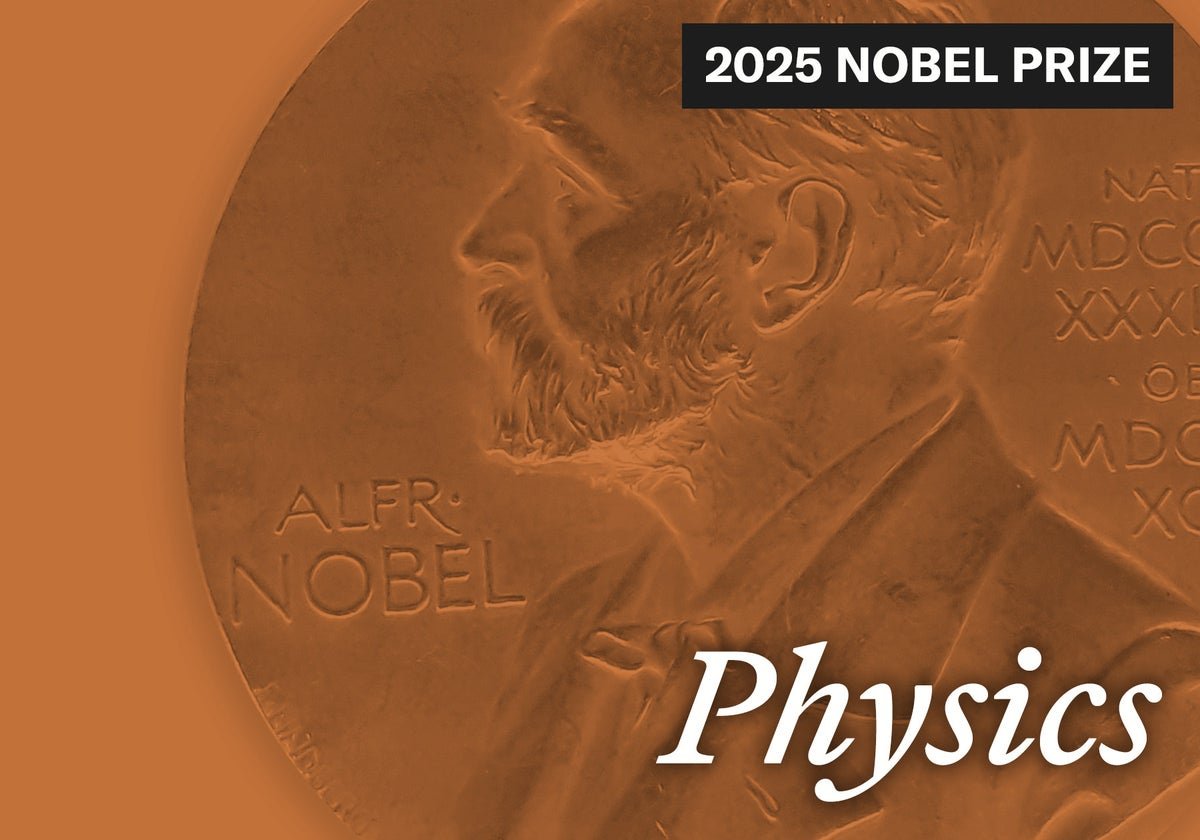
The 2025 Nobel Prize in Physics
vanbeets/Getty Images (medal)
This story will be updated.
In the 100th anniversary year of quantum mechanics, which describes the universe at its smallest, most fundamental scales, the 2025 Nobel Prize in Physics has gone to three pioneers in bringing its mysterious effects into the everyday world.
Revered as one of the most successful scientific theories in history, quantum mechanics is key to most of today’s transformative technologies, from supercomputers to smartphones. The theory is also notorious for its many counterintuitive revelations: particles can also be waves, can exist simultaneously in superpositions of multiple seemingly contradictory states, and can have their properties perfectly correlated—entangled—so that they are linked irrespective of how apart they are. Befitting the centenary milestone, this year’s Nobel Prize in Physics was awarded to three scientists—John Clarke, Michel H. Devoret and John M. Martinis—who brought another bizarre microscopic quantum effect, called quantum tunneling, into the macroscopic world.
On supporting science journalism
If you’re enjoying this article, consider supporting our award-winning journalism by subscribing. By purchasing a subscription you are helping to ensure the future of impactful stories about the discoveries and ideas shaping our world today.
Quantum tunneling occurs when a particle passes directly through an otherwise impassable barrier to appear on the other side. This is akin to throwing a ball at a wall and, rather than seeing it bounce back, finding it unscathed on the other side with the wall itself fully intact. The effect is the basis for transistors, yet it usually diminishes for assemblages of many particles—which is why you never see anyone phasing through walls and floors in everyday life. But in a series of experiments performed at the University of California, Berkeley, in 1984 and 1985, Clarke, Devoret and Martinis showed that the process could occur at larger scales than previously thought possible. (Relatedly, Clarke also penned an essay for Scientific American in 1994 on superconducting quantum interference devices, or SQUIDS, highly sensitive magnetometers used in medical diagnostic equipment and other high-performance hardware.)
“It’s worth remembering that for most of the 100-year history of the field, quantum theory was thought of as the theory of the very small,” says Aephraim Steinberg, a physicist at the University of Toronto who studies quantum tunneling. The experiments of Clarke, Devoret and Martinis constitute “some of the first evidence that quantum mechanics appears to describe not just the world of the very small, but even the ‘mesoscopic’ world of billions and billions of electrons—and potentially our larger world as well.”
Inspired by the theoretical work of the physicist (and eventual Nobel laureate) Anthony Leggett, their experiments relied on electronic circuits built from superconductors, which can conduct current with no electric resistance. The resulting electronic chip–like devices, which the Nobel Committee noted in a statement were “big enough to be held in the hand,” contained superconducting components divided by a thin barrier of non-conductive material. This arrangement is known as a Josephson junction, after the Nobel Prize-winning work of British theoretical physicist Brian Josephson who first proposed it in the early 1960s. Through exhaustive mapping and measurement of the circuit’s properties, Clarke, Devoret and Martinis were able to show how electrons moving through the system act as if they are a single particle, tunneling across the dividing barrier to fill the entire circuit.
Their experimental system only exhibited two distinct modes—one in which the current was “trapped” in a zero-voltage state, and another in which the current escaped this state via tunneling to show a voltage. This clearly demonstrated the quantized nature of the system, in which only a specific amount of energy could be emitted or absorbed, as predicted by quantum mechanics.
“It is wonderful to be able to celebrate the way that century-old quantum mechanics continually offers new surprises,” said Olle Eriksson, chair of the Nobel Committee for Physics, in a statement announcing the award. “It is also enormously useful, as quantum mechanics is the foundation of all digital technology.”
The prize represents a triumph for the University of California system; Clarke remains at Berkeley, and Devoret and Martinis are at the University of California, Santa Barbara. (Devoret also holds a position at Yale University.)
Reached on his cell phone from his home in California, the “completely stunned” Clarke noted that the phenomenon that’s now made him a Nobel laureate is also “one of the underlying reasons that cell phones work” and that “our discovery, in some ways, is the basis of quantum computing.”
Quantum computers hold promise for profoundly increasing the speed and efficiency of certain complex calculations far beyond what classical computers can achieve. Their power relies upon quantum bits, or qubits, rather than the bits used in classical computing. Unlike bits, which encode information as a binary series of 0s and 1s, a qubit can encode not only 0 or 1 but also most any values in between. Accessing all those intermediate values, however, requires holding a qubit in superposition—which typically involves cooling to nearly absolute zero and shielding from all manners of error-inducing environmental noise.
For their work, which the Nobel citation describes as “the discovery of macroscopic quantum tunneling and energy quantization in an electric circuit,” the researchers will split equally a prize of 11 million Swedish kroner (about $1.17 million).
It’s Time to Stand Up for Science
If you enjoyed this article, I’d like to ask for your support. Scientific American has served as an advocate for science and industry for 180 years, and right now may be the most critical moment in that two-century history.
I’ve been a Scientific American subscriber since I was 12 years old, and it helped shape the way I look at the world. SciAm always educates and delights me, and inspires a sense of awe for our vast, beautiful universe. I hope it does that for you, too.
If you subscribe to Scientific American, you help ensure that our coverage is centered on meaningful research and discovery; that we have the resources to report on the decisions that threaten labs across the U.S.; and that we support both budding and working scientists at a time when the value of science itself too often goes unrecognized.
In return, you get essential news, captivating podcasts, brilliant infographics, can’t-miss newsletters, must-watch videos, challenging games, and the science world’s best writing and reporting. You can even gift someone a subscription.
There has never been a more important time for us to stand up and show why science matters. I hope you’ll support us in that mission.
