

Before the government shutdown began Wednesday, many agencies published contingency plans — routine frameworks that are typically updated before a shutdown. These documents included details about which programs will be suspended and how many employees will be furloughed until the shutdown is over.
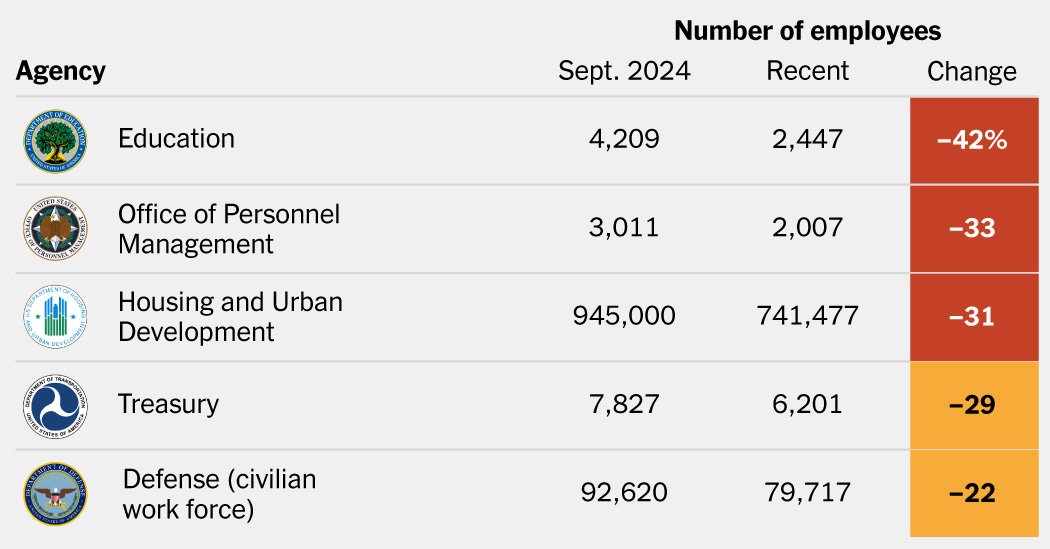
They reveal, to some extent, how much President Trump has slashed the federal work force through firings, layoffs and incentivized resignation programs, because they also include a recent report of how many employees work at each agency.
4,209–42%
Office of Personnel Management
3,011–33
Housing and Urban Development
8,843–31113,992
81,165
As of July 24 or later
–29
Defense (civilian work force)
945,000
741,477
Date not provided
–22
Small Business Administration
7,827–2169,367–15
Health and Human Services
92,620–1498,473–1314,578–1148,442–11
Social Security Administration
58,409–11
Environmental Protection Agency
16,839–1057,014–6482,831–4117,129–2217,889
219,550
As of May 31 or later
+0.8
Sources: Office of Personnel Management (Sept. 2024); official government agency shutdown plans (recent)
Notes: Up-to-date counts of an agency’s total work force may not be reflected. Figures for Homeland Security exclude U.S. Coast Guard. Subagencies within Homeland Security reported their employment counts as of May 31, Aug. 31, Sept. 6, and Sept. 26. Figures for Treasury exclude two small subagencies that have not yet released plans. Two Treasury subagencies reported their employment counts as of July 24 and Oct. 1; the rest did not specify dates.
Before these shutdown plans were published, there was no official data that offered a snapshot of how much the federal work force has shrunk since Trump took office. But not all government agencies have published their plans — like the Department of Energy and some subagencies of the Department of the Treasury — and there are limits to the data provided by those that did.
Some employment figures reported by these agencies were from as early as March 2025, so they do not capture the sweeping cuts made through the year by Mr. Trump and Elon Musk’s cost-cutting effort, the Department of Government Efficiency.
And many of the agencies’ figures still include the tens of thousands of employees who accepted the deferred resignation program, generally ending their employment with the government at the end of September or December.
But the employment numbers do appear to reflect the large reductions in force at the Education, Interior and Health and Human Services Departments, as well as the Office of Personnel Management.
Some departments published staffing counts by subagency. A selection of them is shown below.
Health and Human Services
Administration for Strategic Preparedness and Response
5,123–81%
Food and Drug Administration
20,912–23
Substance Abuse and Mental Health Services Administration
916–18
National Institutes of Health
21,097–14
Centers for Medicare & Medicaid Services
6,557–5
C.D.C. and the Agency for Toxic Substances and Disease Registry
12,993+513,859+7
Cybersecurity and Infrastructure Security Agency
3,395–25%
Citizenship and Immigration Services
22,004+2
Customs and Border Protection
66,514+2
Federal Law Enforcement Training Centers
1,333+2
Immigration and Customs Enforcement
20,606+2
Federal Emergency Management Agency
24,348+28,066+3
Bureau of Safety and Environmental Enforcement
875–36%21,866–34
Bureau of Ocean Energy Management
634–25
U.S. Fish and Wildlife Service
9,067–238,417–203,748–17
Bureau of Land Management
10,925–15
Executive Office for Immigration Review
2,716–6%
Bureau of Alcohol, Tobacco, Firearms and Explosives
5,298–3
Federal Bureau of Investigation
37,414–2
Drug Enforcement Administration
8,912–0.45,544–0.235,710+0.9
Office of Disability Employment Policy
66–23%
Employee Benefits Security Administration
830–20
Occupational Safety and Health Administration
1,896–12
Bureau of Labor Statistics
2,321–11
Federal Transit Administration
718–28%
National Highway Traffic Safety Administration
790–27
Federal Highway Administration
3,013–25
Federal Aviation Administration
46,170–3 99,001–25%
Bureau of the Fiscal Service
3,303–21
Alcohol and Tobacco Tax and Trade Bureau
518–11
Financial Crimes Enforcement Network
267–7
Sources
Data is based on publicly available contingency plans from the Departments of Agriculture, Commerce, Defense, Education, Health and Human Services, Homeland Security, Housing and Urban Development, Interior, Justice, Labor, Transportation, Veterans Affairs, Environmental Protection Agency, Office of Personnel Management, Small Business Administration, Social Security Administration and Treasury.
