

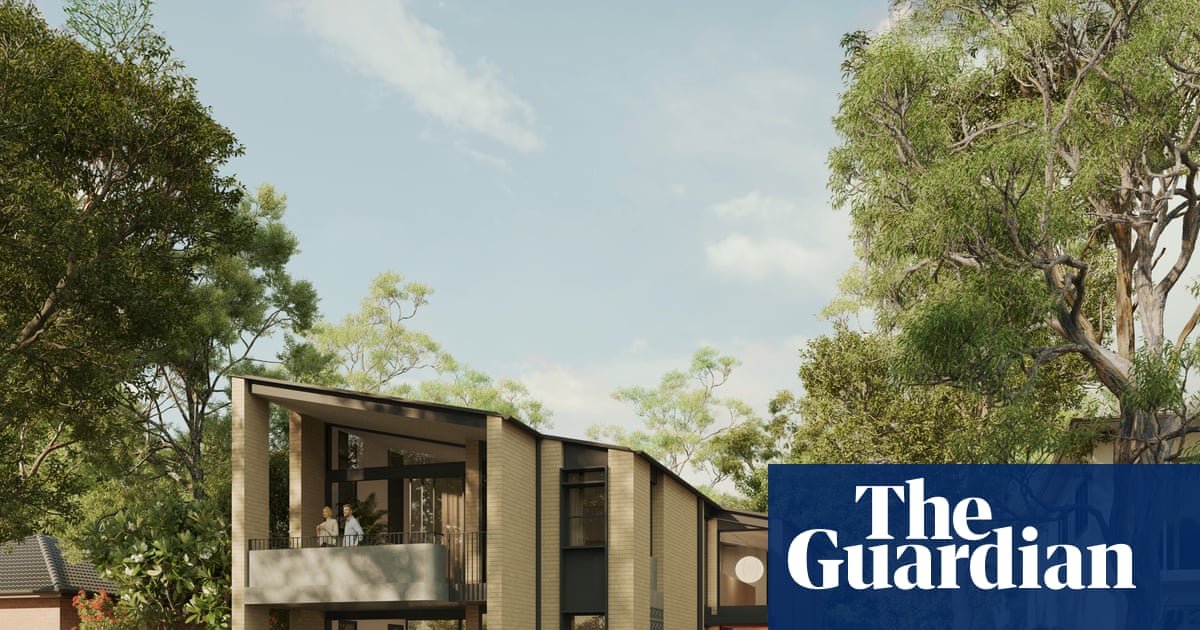
An Australian government faced with a housing crisis has launched an inexpensive, quick-fix plan that has caught the attention of countries around the world.
For just one Australian dollar anyone can download a set of architect-designed housing templates, which in New South Wales – Australia’s most populous state and its most expensive – have already been preapproved by the state government for fast-track development.
There are no glossy brochures for the NSW Housing Pattern Book, although it does feature some beguiling artists’ impressions.
Essentially it is a practical toolkit for tackling what Australian architects and town planners have long bemoaned as the “missing middle” in the country’s major cities: terraces, townhouses and manor houses.
Designed by Australian award-winning architects in a competitive process, the government’s criteria went beyond the usual checkboxes of sustainability, affordability and adaptability. Designs had to respond to Australia’s distinct climate and be functionally sound.
They also had to be beautiful.
Anthony Gill Architects’ design. Illustration: Anthony Gill Architects
And homebuilders in 15 other countries across Europe and Asia have already taken advantage of the $1 deal. While New Zealand, the US, the UK and Singapore make up the bulk of these sales (to date more than 200), homebuilders as far afield as Turkey, Jordan and the Bahamas have purchased the NSW plans.
From July this year, new developments using these $1 designs in NSW will be eligible for approval in just 10 days – a seismic shift in a country where planning delays routinely stretch into months, and sometimes years.
The pattern book is part of a broader push to densify cities such as Sydney and Newcastle without resorting to high-rise towers or speculative sprawl.
While the fast-track approval guarantee only applies to NSW, it is expected state governments in other jurisdictions will view the pattern book as a stride forward in public architecture and legislate accordingly, or commission their own, tailored to the distinctive environments and the needs of their urban populations.
A home design by the architecture firm Saha featured in the NSW Housing Pattern Book. Illustration: SAHA
The call for entries was issued in mid 2024, and although the winners were all based in Australia or New Zealand, the competition drew global attention. Of the 212 submissions, five came from UK architecture firms, including Stirling prize-winning Mae Architects, the only UK practice to make the 21-strong shortlist. The jury reflected the international interest of the project, with Paul Karakusevic of London-based Karakusevic Carson Architects among those tasked with assessing the entries.
At a time when cities around the world are grappling with housing affordability, the idea of publicly available, architect-designed templates, fast-tracked for approval and tailored to local conditions, has struck a chord well beyond Australia’s borders.
Within the OECD, only Canada boasts a similar project, having recently launched its Housing Design Catalogue, offering 50 preapproved templates for terraces and townhouses. Backed by federal funding, the initiative aims to accelerate construction while promoting energy efficiency and accessibility. The UK, by contrast, has yet to embrace a national design catalogue, although individual councils have dabbled in pattern books and design codes in the past.
Across Europe, housing crises are deepening. It is what the European Commission president, Ursula von der Leyen, described in her State of the Union address earlier this month as “more than a housing crisis. It is a social crisis”.
A street view of a design by Other Architects x NMBW. The idea of publicly available, architect-designed templates has resonated around the world. Illustration: Other Architects x NMBW
According to the European Commission, since 2015, housing prices across the EU have risen by more than 20%, while building permits have dropped by more than 20%.
Germany, Spain, Ireland, France and the Netherlands are all grappling with rising rents, limited supply and widening inequality. Even smaller nations such as Estonia and Luxembourg show signs of extreme wealth concentration and housing pressure. The UK is no exception.
So far 33 homebuilders in the UK have purchased the NSW pattern book.
Alex Ely, founding director of Mae Architects, believes the model could work if government and councils allow pattern books to override planning rules that typically slow down development and inflate costs. He told the UK’s Architects’ Journal earlier this year that UK developers would embrace higher-quality designs if it meant avoiding the “arbitrary and gruelling” planning process.
They provide a compelling vision of what higher-density housing could – and should – look likeProfessor Philip Oldfield
A broader snapshot of UK industry opinion by Architects’ Journal, however, revealed significant scepticism. Meredith Bowles of Mole Architects noted that pattern books already exist in practice, with house builders replicating designs nationwide. Bowles said she doubted the model would significantly boost housing numbers or address critical issues such as public realm, parking and site layout.
Neil Murphy, co-founder of developer Town, warned that pattern books risked prioritising aesthetics over functionality, echoing concerns about the UK’s recent push for design codes.
Nigel Ostime of Hawkins\Brown questioned the commercial viability of the approach, citing its rigidity and the lack of capital for upfront investment.
“The trick is to balance standardisation and flexibility,” he said. “Too much standardisation will break the system.”
This design by Sam Crawford Architects was inspired by terrace homes in the Sydney suburb of Paddington. Illustration: Sam Crawford Architect
Back in Australia, Professor Philip Oldfield, head of the University of NSW’s Built Environment school, said he doubted the pattern book would transform housing affordability in Australia. But he believed there was value in its potential to offer developers greater speed and certainty, and provide the market with a more inspired plan for higher-density communities.
“They provide a compelling vision of what higher-density housing could – and should – look like, for both potential residents and communities,” he said.
“But we need to do much more than this to tackle our housing affordability crisis, including increasing social housing provision and reducing construction costs through prefabrication.”
