

Having been summoned by a few clicks in an app, the electric car slows to a halt outside the former cargo hall of Berlin’s now defunct Tegel airport. No one is at the wheel, but upon a passenger stepping inside, a voice announces: “This is Bartek, I am your driver today. Please buckle up and we can be on our way.”
The car emits a friendly jingle, then makes its way to the former runway, where it performs a fault-free manoeuvre around a route marked by traffic cones.
This is not your standard driverless car. “Bartek” is not the automated voice of a robotaxi but Bartek Sztendel, a very real man sitting several hundred metres away at a remote driving station.
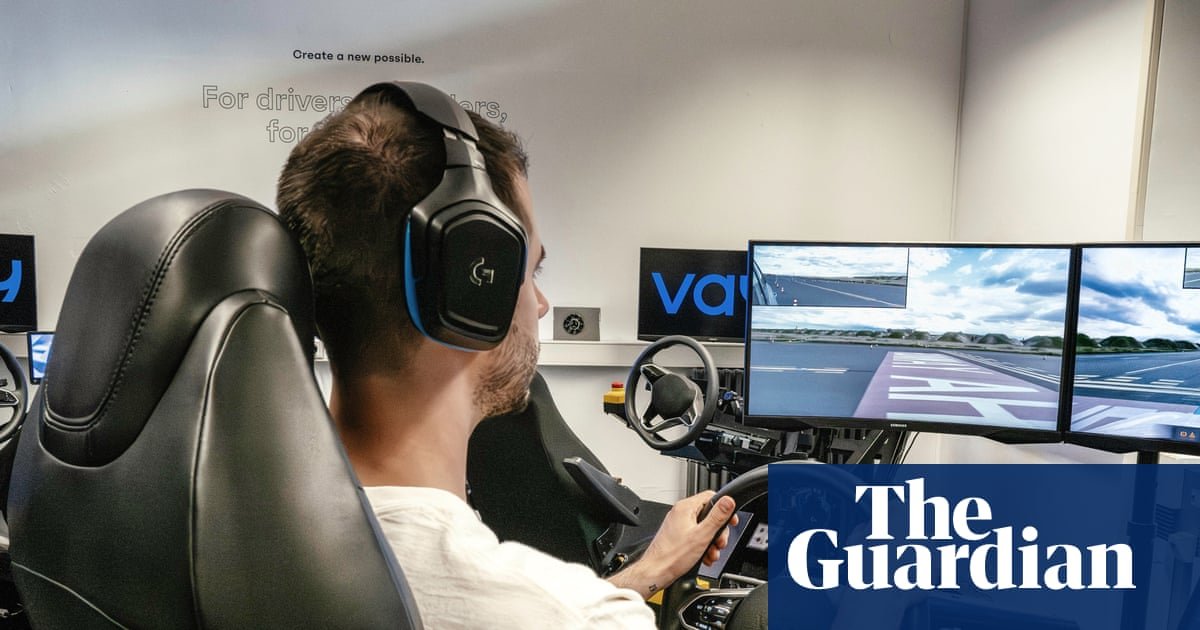
Bartek Sztendel, a remote driver at work. Photograph: Nicoló Lanfranchi/The Guardian
In a high-back leather chair, he operates the car by pressing foot pedals and turning a steering wheel, while monitoring the drive on three large screens in front of him, captured by the car’s four discreet rooftop cameras. Headphones feed him the sounds from inside and outside the car, and sensors enable him even to feel any bumps in the road.
Sztendel works for Vay – the name mimics the way many Germans pronounce “way” – a remote-driving tech company set up in Berlin in 2018 with the aim of revolutionising mobility in Europe’s cities.
Silvia Avanzini, head of communications at Vay, checks the app used to start and end journeys as the car is driven remotely. Photograph: Nicoló Lanfranchi/The Guardian
The continent has been slow to embrace the self-driving robotaxis that are commonplace on the roads of San Francisco and Shanghai. But Vay hopes that its remote-controlled cars will soon offer Berliners the chance to order a rental car, have it delivered to their location by a remote driver, drive it themselves to where they want to go and then simply end the rental – leaving any irritating parking dilemmas to the remote driver. App users will pay per minute for their electric vehicle at a rate that Vay says is about half of what a current car-sharing service costs.
Thomas von der Ohe, Vay’s chief executive and co-founder, used Las Vegas as a testing ground for the service and expects to launch in Germany soon. The US city “had the necessary legal framework in place”, said von der Ohe, a graduate of computer science and entrepreneurship from Stanford.
Thomas von der Ohe, CEO of Vay, poses in front of one of the electric cars in the fleet. Photograph: Nicoló Lanfranchi/The Guardian
“It fitted on to three pages. Germany’s ran to many more, but we’ve worked closely with the authorities here to make sure we can fulfil everything that’s required of us, from technical to safety concerns. Now that the legislative landscape is in place, we’re raring to go.”
Before the summer recess, the German parliament passed legislation allowing the commercial operation of remote-controlled vehicles in pre-approved areas, by qualified drivers, from 1 December. Though not as bold as the laws that allow companies such as Waymo and Cruise to operate self-driving vehicles in, respectively, Los Angeles and San Francisco, it nonetheless pointed to a new willingness of a large European car manufacturing country to experiment with a technology of which many remain wary, with cost and safety concerns still major obstacles but increasingly less of a hindrance.
There is an app used to start and end journeys. Photograph: Nicoló Lanfranchi/The Guardian
Von der Ohe said his goal was to make private car ownership redundant and cities more sustainable “by persuading people to not buy the second or even the first car”.
Aside from its engineers, the company’s most valuable asset and biggest cost are its drivers. Despite an overall skills shortage, attracting recruits to this new profession has so far not been a problem.
Many controllers have reportedly been recruited from Uber, as well as from more conventional taxi companies – especially female drivers “who have described horrible knife attacks and facing other safety concerns”, according to von der Ohe. Truck drivers fed up with driving long distances and being away from their families, including “one who had stomach problems triggered by the vibration of his truck”, have also been among those signing up, he said.
“People see this as a job of the future. They get bathroom breaks and lunch breaks, they get to work in a team rather than on their own,” said von der Ohe. They also earn by the hour, not by the ride.
Sztendel, who comes from Poland, clocked up several hundred miles of driving over a period of weeks before qualifying as a remote driver. He said those with gaming experience were more quickly able to pick up the initial skills required, though this did not count as much as “the ability to stay calm and having a strong sense of safety and responsibility”. He enjoyed playing online racing games such as Need for Speed, he said, but to be remotely controlling a real car on the road, “is quite mind-blowing”.
Looking up from his screen, he explained that a big red button to his left could be pressed in an emergency and would bring the car to an immediate halt.
