

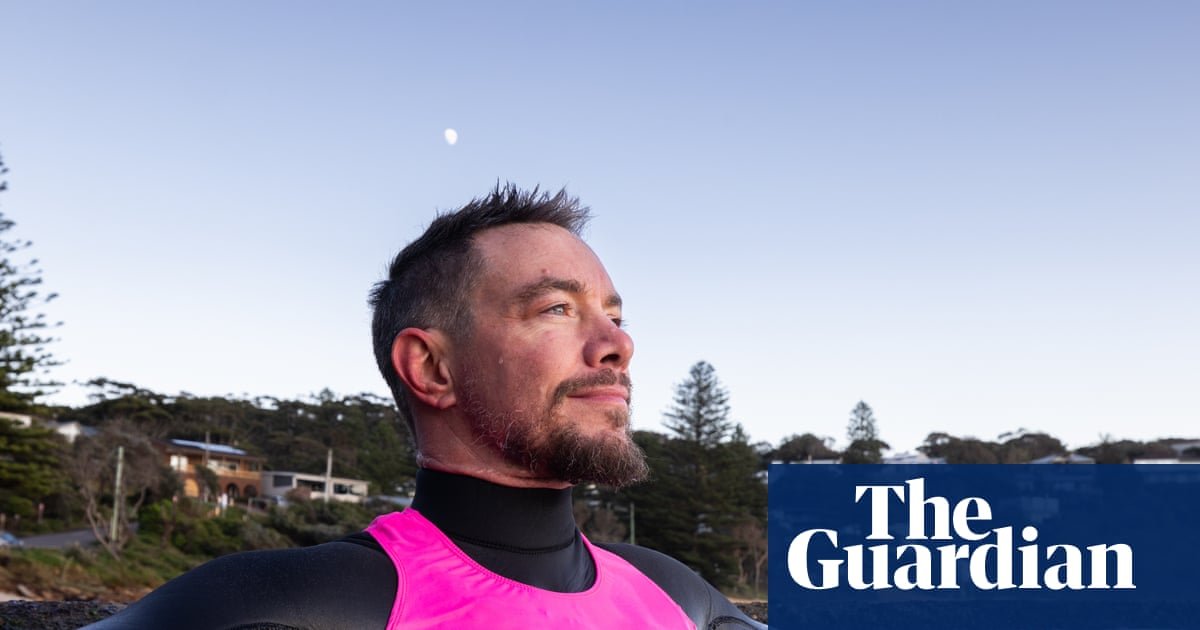
It was an exhilarating day in every possible way. Standing on the cold sand on a Sunday morning, I saw the sun flash off powerful surf as it curved into whitewater that rushed up the beach. The sound of it boomed around the nearby cliffs. The passing clouds threw dark green patches across the frothy water, the air was crisp and dry. Today’s swim promised to be great.
The members of my winter swimming club were pulling on cozzies, bright pink swimming caps and goggles as they assessed the challenging conditions. The car park was jammed with surfers from all around. Word had spread that MacMasters beach here on the NSW central coast was the place to experience this monstrous east swell.
After sizing up the ocean, most swimmers opted to stay in the shallows where they could still stand up, or headed to the protected rockpool to do a few laps. After all, the only rule of the winter swimming club is to get your head wet.
But I decided to swim out, along with one other swimmer.
‘My desire to swim further out evaporated. I didn’t know what had happened but it was time to get out of the water.’ Photograph: Blake Sharp-Wiggins/The Guardian
To avoid the dumping waves as they hit the shore, and to negotiate the partially hidden rocks, timing was everything. When a lull arrived we ran and dived in, feeling the shock of the cold water. As I reached deeper water I pulled on my swim fins and goggles and let my breathing adjust to the chill.
I was about a hundred metres from shore when a large set loomed, broke and rushed towards me. I dived deep into gloomy green water and felt the wave’s power move through and over me. More waves came and I dived again. After the third dive I came up and felt something was wrong.
White noise rushed into my left ear. I began to feel weak. A cramping kind of pain moved down the right side of my neck. My desire to swim further out evaporated. I didn’t know what had happened but it was time to get out of the water.
I tried swimming freestyle but my face suddenly hated the idea of immersion. I tried sidestroke interspersed with bursts of freestyle and pauses, hoping for a wave that would take me to shore. Absurdly, I kept an eye on my fellow swimmer, who did not have swim fins on, in case he needed help. We inched closer to shore, where worse awaited me.
The beach was steep, eroded by the crash of waves. I tumbled around in the shallows, confused by the jumble of sand and water, and a little embarrassed that I seemed so uncoordinated. Wave after wave hit me, pushing me, pulling me back out to sea. I didn’t have much say about where I went.
‘I looked up to see a surfer in hisa wetsuit with a board under his arm, crouching down with a look of concern.’ Photograph: Blake Sharp-Wiggins/The Guardian
Other members of the swimming club saw that I was close to shore and turned back towards the clubhouse, assuming I was just having trouble removing my fins. I wanted to call out for help but I couldn’t. They were a few metres away but I couldn’t make a sound.
In place of fear or panic there was a void. Every inch of me was devoted to trying to regain my senses.
I reached the sand but any relief was short-lived. I could not stand up. My head weighed a tonne, my neck was as weak as string, helpless as a newborn baby. All my skull wanted to do was connect with the ground. There I might find rest, I might stop the beach from spinning and the arcs of distortion in my vision might ease.
Minutes went by with me slumped in a nauseous lump on the sand, sometimes sitting, sometimes on all fours, but always with my head inches from the ground. People walked past me. I was still too confused to ask for help.
Then a hand touched my shoulder. “Are you all right, mate?”
I looked up to see a surfer in a wetsuit with a board under his arm, crouching down with a look of concern. My brain had no choice in the face of such a direct inquiry. I told him I couldn’t stand up, that my left ear was full of white noise and that he needed to alert my club mates. He ran to get help.
Relief sluggishly spread over me. Someone knew I needed help and my friends – who were surf lifesavers like me – would know what to do. I rested, watching as two of them ran up the beach towards me.
I was half-dragged to the club, placed on a chair and wrapped in a space blanket. I mumbled about getting someone to call my wife to pick me up. Two ambulances arrived instead.
skip past newsletter promotion
Sign up to Five Great Reads
Each week our editors select five of the most interesting, entertaining and thoughtful reads published by Guardian Australia and our international colleagues. Sign up to receive it in your inbox every Saturday morning
Privacy Notice: Newsletters may contain information about charities, online ads, and content funded by outside parties. If you do not have an account, we will create a guest account for you on theguardian.com to send you this newsletter. You can complete full registration at any time. For more information about how we use your data see our Privacy Policy. We use Google reCaptcha to protect our website and the Google Privacy Policy and Terms of Service apply.
after newsletter promotion
MacMasters beach at dawn. Photograph: Blake Sharp-Wiggins/The Guardian
A sleepless 36 hours in emergency later, a neurologist visited my bed to tell me an arterial dissection in my neck – essentially a tear in the inner lining of the artery – had created a clot and caused a stroke on the left side of my cerebellum, which in turn affected balance on the right hand side of my body. My blood vessels were fascinating, she said with a hint of excitement, with a congenitally narrow one the source of the problem.
It was hard not to feel anything other than utterly blessed. The stroke had not stopped me from getting to shore, nurses told me I had had the best possible stroke, if such a thing existed, and there was every indication I would dodge the stroke mortality rates ranging from 9% to 39% that Google threw at me. The literature I was given about stroke recovery also made me realise how lucky I’d been. I left hospital a day later with a few packs of blood thinners and no impairments beyond exhaustion.
A week later I returned to the beach. As I drove there I worried I wouldn’t be able to stand the sight of where it all happened. Would it bring back memories of the nauseous swirl of confusion, of the crowd of paramedics carrying out stroke tests, staring into my eyes, putting a cannula into my arm, attaching electrodes to my chest?
The moment I looked out over the ocean those fears disappeared. My connection to that quietly tucked away place had become richer. I had helped save lives there for years as a volunteer surf lifesaver. Now I had my own story to tell, and God to thank for still being around to tell it.
As I stood there thanking those who had saved me, it felt as though a circle had been completed. It was clear to me that we are not designed to live in isolation. We need to rely on others. My gratitude that day reminded me of the CS Lewis quote about how joy is not complete until it is expressed in praise.
‘It turns out the problem in my neck had been building for a few weeks. It was sheer luck that the vessel blew at a time when help was close at hand.’ Photograph: Blake Sharp-Wiggins/The Guardian
A couple of days earlier, I had tracked down the surfer whose instinct to check on me had made all the difference. I thanked him profusely. It felt important.
When I returned to the neurologist for a check-up a month later, I found that healing was under way. But she warned me to avoid big surf in the future. I tried to negotiate her down to a few months but she wouldn’t budge. It made me realise just how much I need the ocean, how dependent I am on it, how much I use it as a counterbalance to the pressures of life. It’s where I go when I am happy, it’s where I go when I am stressed or struggling, it’s where I go to be alone, and where I go to be with others who love it in the same way. Family holidays with my wife and two daughters revolve around it. When a holiday at a seaside town ends, I joke that we will just have to go back to the seaside town where we live.
Will this injury take all that away? If I go out on a big day and have another stroke, will I be as lucky?
A part of me feels a little selfish for still wanting to get out there, to again feel that thrill, that force of nature. And for nearly 10 years I have loved the community and purpose that lies at the heart of surf livesaving. Would I still be able to do that?
It turns out the problem in my neck had been building for a few weeks. It was sheer luck that the vessel blew at a time when help was close at hand.
I have gone back to the water. Bit by bit. Not the big surf. I now know that I have a weak point. I just have to take the future one swell at a time.
Graham Russell is Guardian Australia’s deputy international editor
