

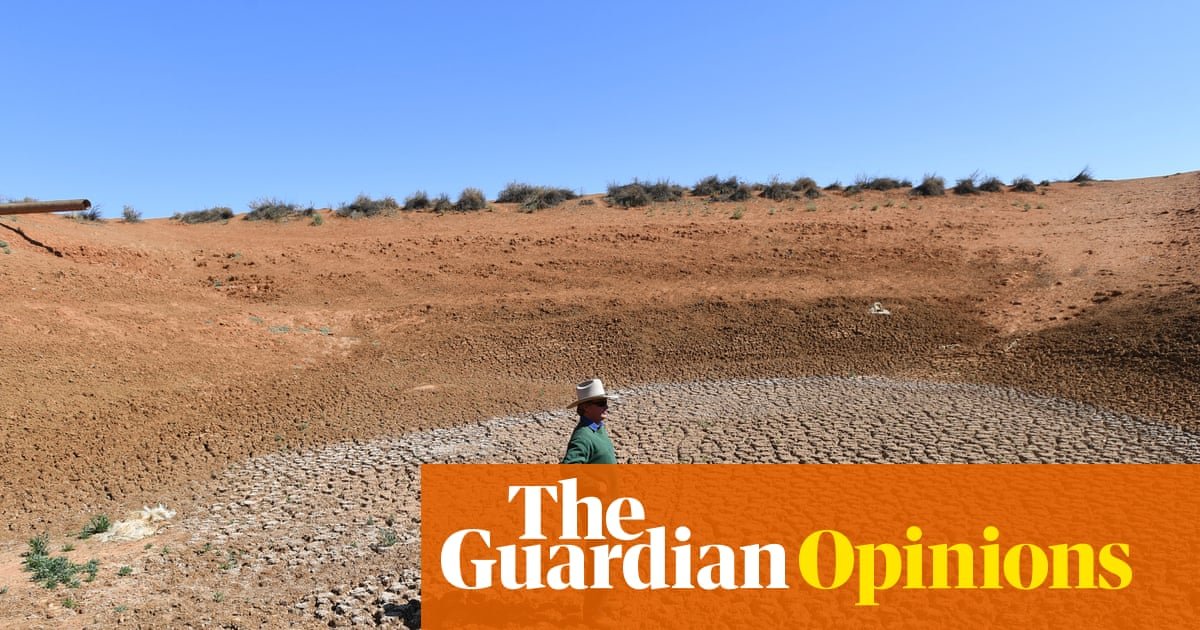
Agriculture and land: farmers are on the frontline of climate change
The 62-70% emissions target is a slap in the face to the people growing Australia’s food. It is nothing short of betrayal to farmers around the country and the generations who come after us. The climate chaos described in Australia’s first Climate Risk Assessment is not inevitable, but with a weak target like this it pushes us towards a future no one wants or deserves.
The climate crisis is already devastating Australian agriculture. Farmers are facing hotter summers, longer droughts, devastating floods and increasingly unpredictable seasons. These shocks are not just hitting the farm gate; they’re flowing through to supermarket shelves, pushing food prices higher for every Australian family.
The Climate Risk Assessment lays out the risks in stark detail: heat stress in livestock slashing productivity and animal welfare; horticulture yields dropping as fruit literally burns on the tree; cropping regions in Western Australia and south-east Australia facing declining rainfall; irrigation systems struggling under dwindling water supplies. Biosecurity threats are set to rise, and dangerous heat is already cutting into agricultural jobs and output. Farmers see the realities of climate change playing out in real time.
Australian government announces 2035 emissions reduction target – video
Farmers and rural communities are on the frontlines of climate change, and that’s why we need every sector playing its part, especially the heavy polluting energy sector. Every new coalmine and gas project adds pollution that heats our atmosphere, and these emissions make it harder for farmers to keep producing the food we all rely on. A weak emissions target suggests that the government has more interest in protecting profits from coal and gas corporations and exports than in the safety of Australians.
A stronger target means more jobs and investment in rural Australia, it means fewer disasters and a more productive food system. Farmers are already leading with renewable energy, soil carbon projects, and regenerative practices. They’re showing what a low-pollution future can look like. To keep Australians safe from worsening climate harm and unlock opportunities in rural communities, the government needs to strengthen its policies and deal with the polluting fossil fuel industry. We need to move quickly, sensibly, and together. Australia can cut pollution, safeguard our farmers, stabilise food prices, and seize the enormous opportunities of a clean economy. That’s a future worth fighting for.
Dr Anika Molesworth, a farmer and agricultural environmental scientist, is a founding director of Farmers for Climate Action
Resources: if we are to reduce emissions we must measure them effectively
The resources sector plan focuses on decarbonising existing emissions through electrification, using low carbon fuels, and reducing fugitive emissions. While it outlines the technical mechanisms to do this, the policies to actually make this happen are limited. They often rely on government outlays and direction rather than the market incentives that would come with pricing carbon.
For example, it is cheaper to use diesel in mining site equipment and vehicles, and this diesel does not pay excise because diesel excise is seen as a road user charge and the resources sector use is off-road. Those seeking to use clean rather than diesel fuel are at a competitive disadvantage without a mechanism to charge for the damage to the environment caused by diesel.
There are widespread concerns with the current approach to the measurement of fugitive emissions. We often rely on outdated benchmarks rather than actual measurement at site verified by satellite technology. If we are to reduce our emissions we need to measure them effectively.
The resources sector currently often relies on land use offsets to meet its emission reduction obligations under the safeguard mechanism. We need to take further steps to ensure their integrity, yet the sector plan does not seem to focus on this.
Sign up to get climate and environment editor Adam Morton’s Clear Air column as a free newsletter
Of further concern is the heavy reliance on carbon capture and storage (CCS) technologies, which are unlikely to occur as this technology is high-cost and unproven in many applications. The examples given of where it is successful are where it is used to extract more gas from an existing reservoir.
Finally, the plan doesn’t appear to connect with the other sector plans and the Treasury modelling which show large declines in coal-fired electricity generation beyond 2030, which is an important way we can reduce emissions.
Rod Sims is the chair of the Superpower Institute and enterprise professor at the Melbourne Institute of Applied Economic and Social Research, faculty of business and economics, University of Melbourne. He is also an expert adviser to the Treasury’s competition taskforce and to the UK’s Competition and Markets Authority on digital issues. From 2011 to 2022 he was chair of the Australian Competition and Consumer Commission
Built environment: we must improve energy-intensive homes
Thursday’s built environment sector plan identifies the need to retrofit our existing homes to electrify them, improve their thermal performance and add more efficient appliances. Such a “renovation wave” would have the double benefit of reducing emissions and saving households thousands of dollars from their energy bills every year.
The energy performance of our 11m homes can be measured on the Nationwide House Energy Rating Scheme (NatHERS). This spans from “zero stars” for the worst possible performance to 10 stars for a super “eco-home”. In 2022, the minimum performance required for a new home increased from six stars to seven stars, which should reduce heating and cooling energy needs in a new house by 11-27%. However, while new homes have improved, our existing homes remain leaky, uninsulated and energy-intensive. Over half of all existing Australian homes have a NatHERS rating below two stars, meaning there’s an urgent need for improvement – for our health and the environment.
We also need to reduce the emissions from the materials we use to build, and the construction process itself. This is called “embodied carbon” and is responsible for about 10% of all Australian greenhouse gas emissions. Embodied carbon is rarely measured and entirely unregulated in Australia – except recently in New South Wales. What’s more, the emissions from many of the building materials we commonly use, such as cement, steel, glass and plasterboard, don’t come from electricity, but from chemical and heat-related manufacturing processes, making them difficult to decarbonise. The sector plan calls for the use of lower carbon materials – but other strategies such as building smaller homes, and adaptively reusing existing buildings will also be necessary. In 2024 building ministers agreed on a voluntary pathway for commercial buildings to report their embodied carbon. However, if we have any hope of reducing built environment emissions by 70% by 2035, regulating and capping embodied carbon emissions (like France, Denmark, Sweden and the Netherlands have already done) will be a much-needed next step.
Philip Oldfield is the head of UNSW’s school of the built environment and a researcher in sustainable and low-carbon architecture
Industry: big progress is possible – with smart support
Industry will need to contribute to the 2035 targets, but “industry” is a complex, diverse category and one size won’t fit all. There are big cross-cutting challenges like process heat and heavy vehicles – both eventually solvable with a mix of electrification and renewable fuels, though neither replacing major capital equipment nor paying higher fuel costs is easy. But a lot of challenges are very specific to industry subsectors: dealing with eroding carbon anodes in aluminium smelting, how to cleanly reduce iron ore for steel, shifting the mix of inputs and storing or using the carbon output in cement-making, and many more. Technical solutions are visible but often not yet tangible.
skip past newsletter promotion
Sign up to Clear Air Australia
Adam Morton brings you incisive analysis about the politics and impact of the climate crisis
Privacy Notice: Newsletters may contain information about charities, online ads, and content funded by outside parties. If you do not have an account, we will create a guest account for you on theguardian.com to send you this newsletter. You can complete full registration at any time. For more information about how we use your data see our Privacy Policy. We use Google reCaptcha to protect our website and the Google Privacy Policy and Terms of Service apply.
after newsletter promotion
The challenge for industry is more than technical, it’s how to make the necessary investments while staying competitive. Policy will have to help in many ways beyond the useful but limited funds announced today. The safeguard mechanism gives a growing carbon value signal, and it will get deeper and likely broader. But business will need a level playing field, so they don’t lose ground just because they face a carbon constraint while their competitors ride free. “Border carbon adjustment” is being rolled out in Europe to ensure equal treatment in critical sectors like cement, and Australia should develop its own approach while respecting our trade commitments.
While the safeguard covers most industrial emissions, most individual facilities are too small to be part of it and will never be a good fit. They’ll need different kinds of help to transition: for example, policies more like the “white certificate” schemes to credit energy efficiency and fuel switching that New South Wales and Victoria operate today.
Some of industry’s diverse transitions will stretch well beyond 2035. But big progress is possible – with smart support and a focus on building competitiveness.
Innes Willox is chief executive of the Australian Industry Group
Transport: we have technological solutions but not the policies to get us there
The transport sector plan released on Thursday doesn’t have a target for emissions reduction for the sector. That’s a shame – it’s difficult to design policy well without understanding what we’re aiming at.
Transport emissions have grown by 14m tonnes or 18% since 2005. The biggest increases have been in aviation (up 68% since 2005) and light commercial vehicles (up 62% since 2005).
This happened because we are flying more often, and increasingly buying personal cars that count as “light commercial” – think big 4WD utes.
The CSIRO’s work for the Climate Change Authority estimates that transport emissions could be reduced by 20% by 2035, with most of this coming from road transport.
Three policies act on transport emissions at the moment: the fringe benefits tax exemption for electric cars, the safeguard mechanism, and the new vehicle efficiency standard.
But between these three policies, only 11% of transport emissions are subject to a constraint.
The holes in policy are for heavy vehicles – we need incentives for truck owners to switch to cleaner sources, but also more attention on the logistics of providing them with alternative fuel sources. We need charging infrastructure for electric trucks, both at depots and along highways; and we need upgrades to electricity infrastructure to support that. There’s almost no supply chain at the moment for alternative fuels such as biodiesel, and there is no incentive to use alternative fuels. Meanwhile, fuel tax credits provide a disincentive to switch and there’s uncertainty over road user charging. The government announced a $1bn package for low-emissions fuels on Wednesday but we’re yet to see the detailed policy design.
Bottom line: the destination is clear, the technological solutions are clear, but it’s a long journey, and we don’t have the right policies yet to get us there.
Alison Reeve is the energy and climate change program director at the Grattan Institute
Electricity and energy: there is no excuse for a lack of ambition
Dramatically expanding the share of renewables in our electricity system is fundamental to achieving our emission targets. If we can’t decarbonise electricity then we’ll struggle to also reduce emissions from transport and heating of buildings and manufacturing processes, which both hinge on a switch to electric power.
Unfortunately, the Albanese government is encountering significant difficulty delivering on its target to grow renewable energy to 82% of power supply by 2030. We’re doing reasonably OK on rooftop solar, extremely well in expanding battery capacity, but falling abysmally short on wind and solar farms due to inadequate transmission links. Yet while we might fall short on targets for 2030, this is no excuse for a lack of ambition on 2035 targets. It is extremely hard to transform the electricity sector within five years because it takes at least five years to plan and build new transmission lines. A 10-year timeframe, however, dramatically expands the scope for change. In addition, rooftop solar drives change by steadily accumulating in small increments, rooftop by rooftop. Over the space of 10 years that can add up to a very large amount of power.
But there is also no time to waste. To speed things up the Albanese government must expand its policy suite to options that don’t rely on new transmission lines. This means instituting new policy measures to help households and businesses become more energy efficient and install more rooftop solar. In particular, it has to find a way to push (not just encourage) landlords to upgrade rental properties.
We still need to push on with the rollout of wind and solar farms as well. For a small proportion of the population this will mean their rural view will be obscured by transmission lines and wind turbines. That’s unfortunate, but what’s the alternative?
Tristan Edis is the director of analysis and advisory at Green Energy Markets
