

September 19, 2025
3 min read
Astronomers’ Exoplanet Haul Tops 6,000 Alien Worlds
It’s a crowded galaxy, the latest exoplanet tally shows
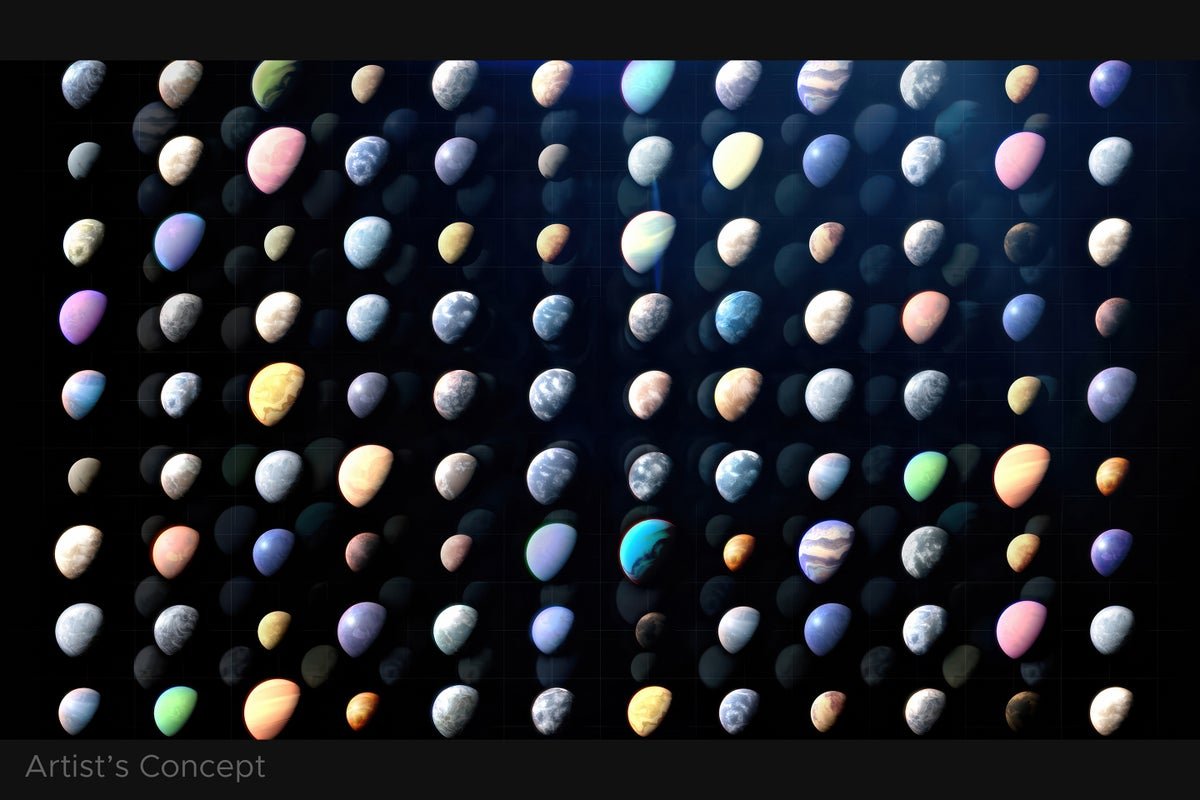
Scientists have found thousands of planets outside our solar system, called exoplanets, throughout the galaxy. This artist’s concept shows how they range in size and composition, although scientists have not seen most of them directly.
NASA’s Goddard Space Flight Center
Since astronomers found the first planets outside our solar system in 1992 and the first planet around a sunlike star in 1995, scientists have sought the telltale glimmers, flickers and wobbles that denote a distant world. Now NASA has announced the number of confirmed exoplanets has cracked 6,000, reaching a total of 6,007.
The batch of 18 planets that bring us to this milestone are mostly rocky orbs between the size of Earth and Neptune—the most common type of planet found so far. Astronomers identified them with ground telescopes and NASA’s Transiting Exoplanet Survey Satellite (TESS), which is currently orbiting Earth, and even by combing through data from the U.S. space agency’s Kepler space telescope, which hasn’t operated in seven years.
“Everywhere we look, we find planets,” says Jessie Christiansen, chief scientist of the NASA Exoplanets Institute at the California Institute of Technology. “Every time you turn on a new telescope and point it at stars, we find planets—and that’s amazing. That could have not been the case; it could have been that the solar system was a weird fluke.”
On supporting science journalism
If you’re enjoying this article, consider supporting our award-winning journalism by subscribing. By purchasing a subscription you are helping to ensure the future of impactful stories about the discoveries and ideas shaping our world today.
The first exoplanets were found mostly by the gravitational pull they exert on their host stars: that pull causes a star to wobble, and this movement can be observed visibly or (far more often) detected via a change in the wavelength of stellar light. With the Kepler mission’s launch in 2009, more and more exoplanets were discovered via the so-called transit method: a regular flicker in a star’s light that occurs when its planet happens to pass between it and a watching telescope. The TESS mission, which launched in 2018, surveys the entire sky for transiting exoplanets and brought the number up even higher: nearly half of the 1,000 exoplanets that have been confirmed since 2022 were spotted by TESS. Less commonly, planets can also be imaged directly (if they’re bright enough and orbit far enough from their stars) or detected through changes in how light curves around a star because of its planet’s gravity.
“For the last year, we’ve basically been rewriting our software under the hood to cope with thousands of planets coming in at once,” Christiansen says. She predicts that the tally will hit 10,000 planets within a few years—and that soon more finds will come from the European Space Agency’s Gaia mission, which will release a batch of exoplanet data in 2026. NASA’s new Nancy Grace Roman Space Telescope, which could launch as early as next year, is set to survey the entire sky for even more worlds, potentially bringing the total to 100,000 exoplanets within the next six to seven years, she estimates. “And that’s partly why we’re madly redesigning all of our software so that we can accommodate trying to jam in 100,000 planets into an archive that’s only held a few thousand until now,” Christiansen adds.
But discovering planets is not just a numbers game. At a certain point, scientists begin to care more about understanding planets than finding them—even as the database keeps growing. NASA’s current flagship observatory, the James Webb Space Telescope, doesn’t scan the sky for new planets; it follows up to try to glimpse evidence of particular planets’ atmospheres and compositions. And the major telescope NASA envisions after Roman, the Habitable Worlds Observatory, will search candidate planets for signs of life.
“We’re kind of evolving out of the stamp-collecting phase of exoplanets and into the physics phase,” Christiansen says. Researchers hope to learn about planet populations: How do they form? How do they evolve? How do they migrate? “When we have a big enough sample, you actually start to be able to identify the dominant physics that’s happening,” she says. You’re no longer just asking “what”; you’re asking “why”—“and that’s, for me, where it gets exciting.”
It’s Time to Stand Up for Science
If you enjoyed this article, I’d like to ask for your support. Scientific American has served as an advocate for science and industry for 180 years, and right now may be the most critical moment in that two-century history.
I’ve been a Scientific American subscriber since I was 12 years old, and it helped shape the way I look at the world. SciAm always educates and delights me, and inspires a sense of awe for our vast, beautiful universe. I hope it does that for you, too.
If you subscribe to Scientific American, you help ensure that our coverage is centered on meaningful research and discovery; that we have the resources to report on the decisions that threaten labs across the U.S.; and that we support both budding and working scientists at a time when the value of science itself too often goes unrecognized.
In return, you get essential news, captivating podcasts, brilliant infographics, can’t-miss newsletters, must-watch videos, challenging games, and the science world’s best writing and reporting. You can even gift someone a subscription.
There has never been a more important time for us to stand up and show why science matters. I hope you’ll support us in that mission.
