

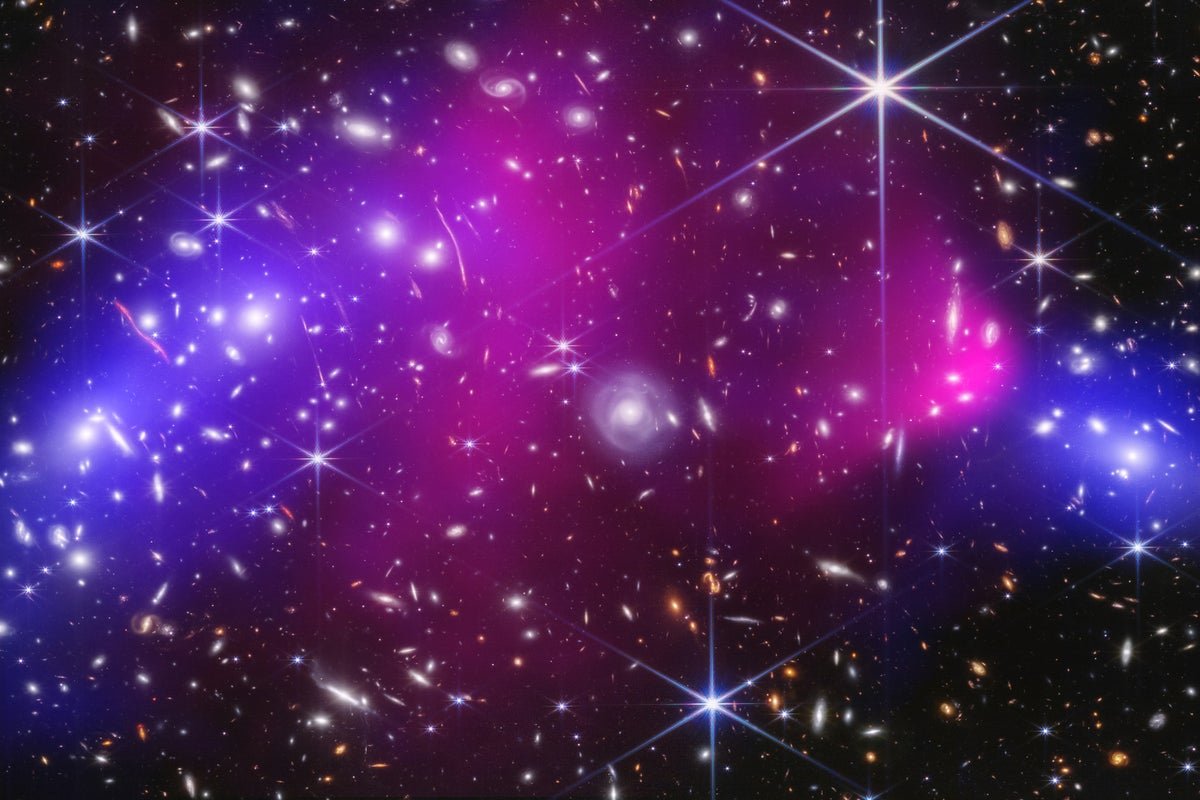
For astronomers studying dark matter, the Bullet Cluster is one of the greatest laboratories in the universe.
It was discovered almost by accident, a blip of x-rays in the sky that was detected by NASA’s Einstein Observatory in 1992 and given the designation 1E 0657-56. Follow-up observations in visible light confirmed it to be a galaxy cluster—a swarm of dozens or even hundreds of galaxies all bound together by gravity and orbiting a common center. The 1E 0657-56 cluster is decently far away from Earth; the light we see left it about four billion years ago.
The cluster is not just one simple system of galaxies, though. There’s a main cluster, big and somewhat elongated, with a more compact and spherical subcluster offset to one side, separated by more than 1.5 million light-years. Note that the nearest big galaxy to our own Milky Way is the Andromeda galaxy, 2.5 million light-years away. Imagine having dozens of galaxies in our sky at less than half that distance!
On supporting science journalism
If you’re enjoying this article, consider supporting our award-winning journalism by subscribing. By purchasing a subscription you are helping to ensure the future of impactful stories about the discoveries and ideas shaping our world today.
Deeper observations of 1E 0657-56 taken using the Chandra X-ray Observatory revealed the cluster was loaded with hot gas, and I do mean hot: most of it was tens of millions of degrees Celsius. This is common in galaxy clusters, where such gas is generally assumed to be superheated by radiation spewed out from supermassive black holes, as well as the huge amount of kinetic energy absorbed as galaxies zoom around in the cluster.
But the gas in 1E 0657-56 had an odd structure. Like the cluster itself, it was divided into two main clouds, both located in between the main cluster and the subcluster. The bigger cloud, nearer the main cluster, was elongated and diffuse. But the other one, closer to the compact subcluster, was smaller and had a characteristic bow shock shape, a dull cone similar to the wake left behind as a ship moves through water.
This meant 1E 0657-56 wasn’t a single cluster but actually two clusters that recently collided—“recent” on a cosmic scale, that is: about 200 million to 100 million years ago. The collision occurred at breathtakingly high speed, with the two clusters slamming into each other at a relative velocity of about 4,000 kilometers per second. That’s more than 1 percent of the speed of light!
The conical shape of the gas gave the system its nickname of the Bullet Cluster, which is also appropriate because the second cluster is smaller than the other one and appears to have blasted right through it.
Galaxies are small compared with the size of the Bullet Cluster, so very few galaxies in it physically collided. In a sense, this cosmic object’s two smaller constituent clusters passed right through each other. But the hot gas that suffused the space between the galaxies in each cluster would have crashed head-on. While the galaxies slipped by relatively unscathed, that hot gas was slowed considerably by the collision. That’s why most of the gas is located between the two galaxy clusters; it was left behind at the scene of the smashup between the two fleeing systems.
But there’s more to the Bullet Cluster than meets the eye.
For decades, astronomers have amassed a lot of evidence for the existence of dark matter—a mysterious substance that has mass and gravity but emits no light and rarely, if ever, interacts with normal matter.
On cosmic scales, dark matter betrays its presence via its gravity. The speed at which stars orbit around in a galaxy depends on the gravity they feel from the galaxy at large, which in turn depends on how much mass it has—that is, how much matter it holds. The more mass, the stronger the gravity, and the faster a star moves. American astronomers Vera Rubin and Kent Ford used this principle in the 1970s to show that stars in the outermost part of the Andromeda galaxy were moving far too rapidly, given Andromeda’s measured mass. This implied there was a halo of dark matter in which the galaxy was embedded.
Something similar has been seen in many galaxy clusters: the galaxies are moving far too quickly for the calculated mass of their home cluster. They should fly off into space, but instead they stay in orbit, implying there’s a lot more mass to these clusters that we cannot see.
Whatever dark matter is, it isn’t thought to interact with normal matter except through gravity, and it is also predicted not to interact well even with itself. That means if you have two colliding objects surrounded by dark matter, those halos will pass right through each other and continue into space.
You probably see where this is going: the Bullet Cluster is exactly that sort of situation, a dark matter experiment just waiting for us to examine. Detecting the dark matter, though, requires a gravitational trick.
When a beam of light passes by an object with mass, the gravity of that object will bend the path of the light ray. For very massive or dense objects, the light can bend significantly. For example, light from a background galaxy can be warped into an arc shape, or be broken up into multiple images. This phenomenon is called strong gravitational lensing because it acts very much like a glass lens.
If the gravity of a lens isn’t as strong, it can still mildly distort the image of a background galaxy, but it’s hard to know how distorted any individual galaxy might be. This sort of weak gravitational lensing can be detected statistically, however, by looking at a great number of background galaxies and measuring their shapes.
Astronomers mapped the weakly lensed galaxies seen behind the Bullet Cluster, which they then used to trace the position of the cluster’s dark matter. What they found was amazing: there was a huge excess of mass surrounding both subclusters! That meant the dark matter halos of the subclusters passed right through each other, just as theory predicted.
Because of this, the Bullet Cluster is considered by nearly all astronomers as the smoking gun (pun very much intended) for dark matter’s existence, especially in halos surrounding galaxies and clusters.
But scientists aren’t done examining the cluster. An international team of astronomers observed it with the James Webb Space Telescope (JWST), which allowed them to see many more distant background galaxies, which in turn let them map the dark matter using gravitational lensing in far more detail. They published their results inthe Astrophysical Journal Letters in June 2025.
JWST’s field of view is somewhat small, so they didn’t observe the entire cluster, but they were still able to gauge its mass and find that the whole cluster—stars, hot gas, dark matter and all—contains several hundred trillion times the mass of the sun. That’s actually smaller than earlier estimates, which may be linked in part to JWST’s smaller field of view but may also be a real result based on its sharper vision. The team is currently working on analyzing data from both JWST and the huge Dark Energy Camera to see if they can refine the mass estimate.
The researchers also note that the JWST data show that the elongated main cluster contains at least three clumps of galaxies, whereas a smoother distribution is expected. This means the main cluster may have undergone other collisions recently, further complicating the Bullet Cluster’s already complex history.
Invisible dark matter may be, but that doesn’t mean undetectable. And every time we point a new telescope at the Bullet Cluster, we learn more about it. We’re closing in on dark matter, and soon, hopefully, its constituents will be illuminated.
