

September 10, 2025
5 min read
New Black Hole Measurements Show More Ways Stephen Hawking and Albert Einstein Were Right
Spacetime ripples from a black hole collision across the cosmos have confirmed weird aspects of black hole physics
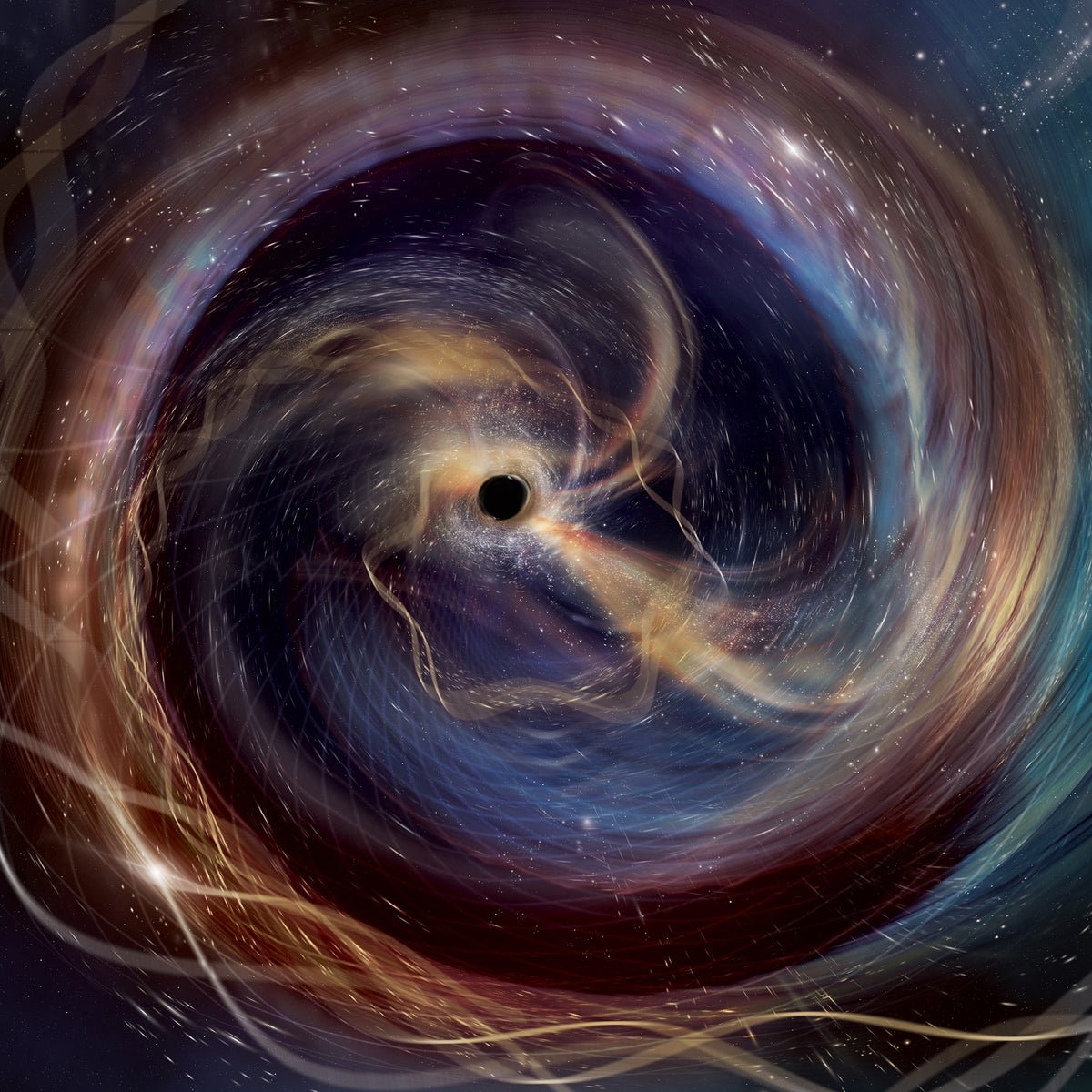
An illustration imagines GW250114, a powerful collision between two black holes observed in gravitational waves by the LIGO experiment, from the perspective of one of the black holes as it spirals toward its cosmic partner.
Aurore Simonnet (SSU/EdEon)/LVK/URI
An eon ago, when only microbes dwelled on Earth, a pair of black holes some 1.3 billion light-years beyond the solar system spiraled toward each other until they crashed. The two became one big black hole that rang out in far-reaching undulations of spacetime called gravitational waves.
These ripples finally reached Earth in January 2025, where they registered in the Laser Interferometer Gravitational-Wave Observatory (LIGO) experiment as the most precise direct measurements of gravitational waves ever made. These measurements confirmed a 54-year-old theorem from the late physicist Stephen Hawking about how black holes grow when their mass increases. The waves also confirmed a bizarre property of black holes known as the “no-hair” theorem. Scientists announced the findings in a paper published today in Physical Review Letters.
The black holes involved in the smash-up contained about 33 and 32 times the mass of the sun, respectively. As they fell toward each other and coalesced, the resulting gravitational waves spread out into the universe in all directions; the fraction that trickled into LIGO’s detectors was a signal that researchers named GW250114. Studying the particular features of this signal allowed them to determine the black holes’ initial sizes, as well as the fact that the resulting larger black hole contained about 62 times the mass of the sun. The waves also revealed that the original black holes had a combined surface area of about 240,000 square kilometers (roughly the size of Oregon), whereas the final black hole had an area of some 400,000 square kilometers (roughly the size of California).
On supporting science journalism
If you’re enjoying this article, consider supporting our award-winning journalism by subscribing. By purchasing a subscription you are helping to ensure the future of impactful stories about the discoveries and ideas shaping our world today.
These measurements confirm a prediction Hawking made in 1971 about black hole event horizons—the boundaries beyond which nothing, not even light, can escape from their gravitational grasp.
“The event horizon of a black hole is in some sense a measure of its entropy” or disorder, says David Reitze, LIGO’s executive director. And the laws of thermodynamics say that entropy can only increase, never decrease. “There’s a deep connection between black holes and thermodynamics. The theorem basically says that if you have two black holes merging to form a bigger black hole, the total area of the final black hole must be at least equal to but probably bigger than the sum of the initial areas.”
Now, for the first time, researchers have precise measurements to prove it.
The observations also confirm a famous idea about black holes called the “no-hair” theorem. This prediction suggests that black holes are fundamentally simple objects with no frills. They can be described by just two numbers: their mass and their spin. All black holes with the same mass and spin must be exactly the same, with no distinguishing features. All the information about what fell into the black hole—the “hair”—is lost behind the event horizon.
“Because they can only be described by two numbers, it means that everything you can measure about them must be described by those two numbers,” says Katerina Chatziioannou, a physicist at the California Institute of Technology and a co-author of the new study. “This signal allowed us, for the first time, to measure something that can be described by those numbers.”
The gravitational-wave signal showed that the object left over after the collision exactly fits a theoretical construct known as the Kerr metric, which describes a rotating black hole within the bounds of Albert Einstein’s general theory of relativity.
“The way they are able to see that the resulting geometry is Kerr is quite powerful,” says Edgar Shaghoulian, a theoretical physicist at the University of California, Santa Cruz, who was not involved in the new research. “Confirming this in effect confirms that the final thing you form is a black hole,” he adds, rather than some more esoteric object that mimics the features of a black hole, which some extensions of Einstein’s theory postulate might exist.
Researchers previously tried to test these predictions with gravitational waves, but the comparatively weaker signals left a lot of uncertainty in the conclusions. The new tests offer a much greater level of confidence, says theoretical physicist Feryal Özel of the Georgia Institute of Technology, who was not involved in the research. “If we found any evidence of violation of either the area theorem or of the Kerr solution, then one or both of the assumptions would have to be changed,” she says. “In other words, either general relativity would need to be modified, or the objects are not black holes.”
This latest announcement from LIGO comes almost exactly 10 years after the project saw its first gravitational waves. The precision of the recent measurements was only possible now, after scientists have tweaked and tuned LIGO to be roughly four times as sensitive as it was when it started. It can now identify distortions in spacetime smaller than one ten-thousandth the width of a proton.
LIGO detects gravitational waves by looking for minute changes in the lengths of two arms arranged in an L shape. Each arm is four kilometers long, and extremely accurate clocks measure the time it takes laser light to travel their extent. If a gravitational wave moves through Earth, the size of one leg will be stretched while its perpendicular counterpart will be squeezed. LIGO employs two versions of this setup, one in Hanford, Wash., and another in Livingston, La., to better distinguish gravitational waves from local vibrations such as earthquakes, crashing ocean waves and even the rumblings of traffic.
Over the past decade, LIGO and its counterparts in Italy (called Virgo) and Japan (called KAGRA) have found on the order of 300 black hole merger candidates. Collectively, these observatories now detect such an event about once every three days. In November LIGO will shut down for a multiyear upgrade project that should further boost its sensitivity by about another 25 percent. Scientists are worried, however, about a recent White House proposal to shutter one of LIGO’s two stations, which would effectively render the entire project defunct.
Such a move would be not only a waste of the more than $1.5 billion already spent on the experiment but also a profound loss for science that would cut gravitational-wave astronomy off at the knees just as it’s hitting its stride—as this latest result demonstrates. “If you rank LIGO’s greatest hits, the most important detections we’ve made, I would put this one very high up,” Reitze says. “This confirms a lot of what we already knew theoretically. But it also, I think, shows the power of gravitational waves in really understanding fundamentally how black holes behave. And we are nowhere near done.”
