

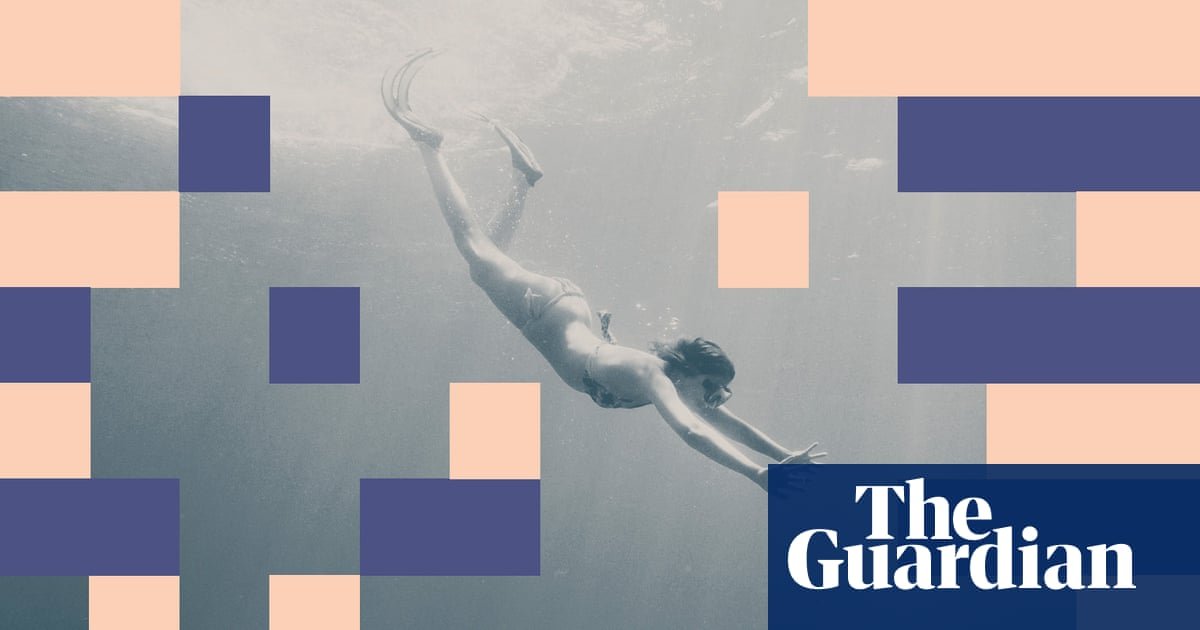
Ever since I discovered the mating dynamics of the deep-sea anglerfish, where the male fuses with the female, and how closely this mirrors some disturbing human relationship patterns, I have been chewing over the idea that everything that exists in our unconscious also exists in the ocean. From the methodical violence of sharks, to dolphins who mourn their dead and jellyfish whose pulsating contractions remind me of my labour, the only phenomenon on Earth that is as rich and colourful and dark and fascinating as the deep sea is the deep unconscious.
My problem, as I realised in a session not long ago with my psychoanalyst, is that I have been swimming in shallow waters. This is something I have seen many times in myself, and perhaps these moments of recognition help me to see it in my patients – the unconscious pull to stay in the emotional shallows, not to delve deeper into your own internal experience and understand the more profound wishes and hungers that drive us. Instead, we scroll away our difficult feelings, staring at whatever screen is in front of us rather than looking inwards. We cheapen our relationships with others, craving and offering a particular kind of emotional stroking that keeps things at surface level. We buy things, we watch things, we listen to things, we squeeze things, we try things on and send things back, and we do, do, do – we do to stay in the shallows, so we don’t have to be in the depths.
But we know the way to a better life sits below the surface, not on it. I recently read the brilliant How to Speak Whale by Tom Mustill, who writes about the Dutch microbiologist Antonie van Leeuwenhoek. In the mid-17th century, Leeuwenhoek developed magnification technology comparable to modern light microscopes, which exposed the truth of the extraordinary life teeming within a “thimbleful of water from a local lake”. Mustill offers us Leeuwenhoek’s wonderful quote: “No more pleasant sight has yet met my eye than this of so many thousands of living creatures in one small drop of water, all huddling and moving.”
Unfelt emotions are like deep-sea creatures – hidden, powerful, and capable of immense force when brought to light
It made me think again of our unconscious; the extraordinary depth of meaning hiding within one slip of the tongue, one image in a dream. A patient can seem to be having a lovely time in their session, and a single blink-and-you’ll-miss-it half-glance towards the door can reveal they’re absolutely desperate to get out; their politeness hiding the painful emotions that they didn’t realise they were so desperate to run away from.
If I draw their attention towards that glance, towards their true feelings, it offers them the opportunity to realise that this is what has actually kept them running around in circles, stuck exactly where they have always been. This can then be the doorway – if they choose to walk through it – to a better life.
These unfelt, unconscious emotions, whatever they might be – pain, rage, envy, hatred, love, guilt, shame – are like the powerful creatures living deep in the sea. Both are capable of incredible force: the energy that comes from immense weight and propulsion. To bring these feelings and dynamics into consciousness is what it means to me to swim in deeper waters; to live more truly, with more weight and more propulsion, with a particular kind of energy, building a life that is truly meaningful.
Mustill’s book tells the powerful story of how, in the 20th century, whales were hunted and feared, valued by humans only for what their butchered body parts could be sold for, and destroyed to near-extinction by the end of the 1960s. It was Dr Roger Payne who was determined to save them by helping people to understand the intrinsic worth of these creatures through the beauty of their song. Released in 1970, his album of recordings, Songs of the Humpback Whale, went multi-platinum, and became the soundtrack to the protest movement that ultimately resulted in the 1982 adoption of a moratorium on commercial whaling by the International Whaling Commission. Estimates suggest that in the 19th century, humans killed about 3 million whales; today, many populations are “rebounding and expanding”, Mustill writes. “This is a counterpoint to the dangerous narrative of innate human destructiveness, which leads to apathy. It shows how we can change, and life can recover.”
I see this as a therapist in my consulting room most days, and I occasionally get a taste of it as a patient myself. Our capacity to destroy sits alongside our creative power to repair and recover. When therapy is useful, and a patient can grow the capacity to allow their true feelings into their minds, this can spark a new thought, often one that links their past with their present, that illuminates how something got stuck along the way. This can light the way out of apathy to new life. We can unstick, we can change. We can make things better for ourselves, for the natural world, and the generations to come. But just like Leeuwenhoek with his magnifying glass, we have to go deep.
Moya Sarner is an NHS psychotherapist and the author of When I Grow Up – Conversations With Adults in Search of Adulthood
Do you have an opinion on the issues raised in this article? If you would like to submit a response of up to 300 words by email to be considered for publication in our letters section, please click here.
