

September 4, 2025
3 min read
This Sneaky Spacecraft Bacteria Can Play Dead to Survive
A type of bacteria found in clean rooms has an unexpected method of survival, with implications for planetary protection
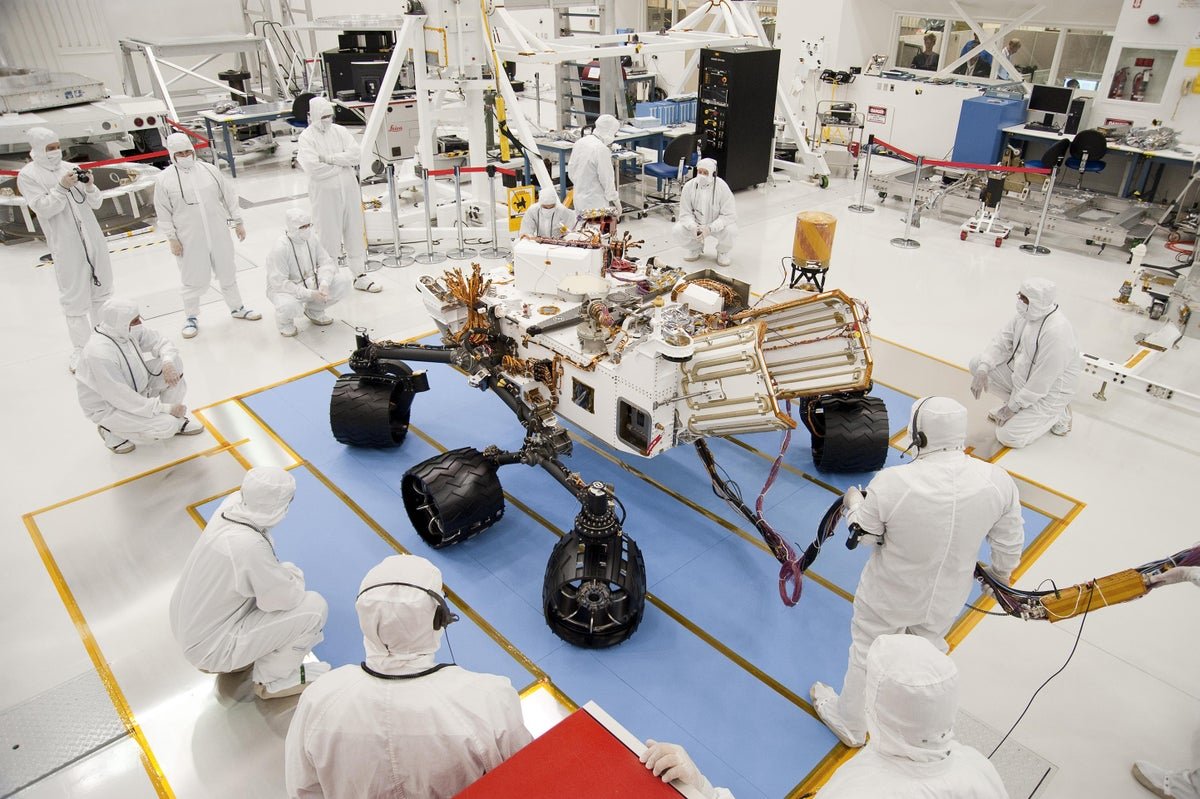
NASA’s Curiosity rover is prepared for launch in the clean room at the Spacecraft Assembly Facility at NASA’s Jet Propulsion Laboratory, Pasadena, CA.
A bacterial species found in spacecraft clean rooms can survives intensive antimicrobial cleaning in spacecraft clean rooms by going dormant, new research finds. That’s important because other clean-room survivors had been known to live through disinfection by forming spores, which are thick-walled structures that protect bacteria from high temperatures or toxins such as ethanol. The actinobacterium Tersicoccus phoenicis can’t form these spores, but a new study published in the journal Microbiology Spectrum shows that it can go into a state similar to hibernation. In this state, it has no growth and almost no metabolism but has the ability to “wake up” when conditions improve.
“In the cleanest places we build—spacecraft, pharma plants, food facilities—some microbes aren’t dead: they’re dormant,” says Alberto G. Fairén, an astrobiologist at Cornell University who wasn’t involved in the research.
While in this dormant state, T. phoenicis can’t be detected by the usual method of swabbing surfaces and checking which bacteria grow in culture from the swabs. That means it could theoretically sneak aboard spacecraft that are supposed to be free of Earth contaminants. If such a bug hitched a ride to another planet, it could wake up upon arrival and potentially disrupt existing extraterrestrial life. “It’s a huge planetary protection concern,” says Madhan Tirumalai, a biologist and biochemist at the University of Houston and lead author of the new study.
On supporting science journalism
If you’re enjoying this article, consider supporting our award-winning journalism by subscribing. By purchasing a subscription you are helping to ensure the future of impactful stories about the discoveries and ideas shaping our world today.
T. phoenicis was first discovered in a clean room at NASA’s Kennedy Space Center in Florida, where the Mars lander Phoenix was being prepared for launch. Two years later it popped up in a European Space Agency clean room in South America. In 2013 scientists discovered that this mystery survivor was not only a new species but a new genus of bacteria.
This species is part of a larger group of bacteria, known as actinomycetota or actinobacteria, that are able to go dormant when conditions aren’t conducive to growth. (One famous member of this group is Mycobacterium tuberculosis, the bacterium that causes tuberculosis, which can go dormant and persist in the lungs over a lifetime.) To learn whether T. phoenicis was capable of dormancy, Tirumalai and his colleagues deprived cells of nutrients and extracted all water from them (a process called desiccation). The cells stopped growing, and the number of viable cells plummeted within days.
To show that these nonviable cells were dormant, not dead, the researchers added a protein called a resuscitation-promoting factor (Rpf), which is known to “wake up” other species of dormant actinobacteria. The Rpf revived the cells, “proving they were alive but silent,” Tirumalai says.
That’s a concern for human travel to a place such as Mars, which could offer a new, nutrient-rich environment to the hibernating microbes. Astronauts trying to survive on the red planet would need to grow food, and the sugars and nutrients involved could revive the bacteria, says study co-author William Widger, a University of Houston biologist. “That would be in the environmental safe quarters of astronauts, probably where you’d not want them.”
The microbe likely couldn’t survive on the Martian surface, however, Fairén says. “The high UV flux, extreme cold and desiccation, low atmospheric pressure, and cosmic radiation on Mars are overwhelmingly hostile—even to spore-formers. Dormant nonspore, nonprotected cells would almost certainly not endure long on exposed surfaces on Mars—minutes or less.”
That makes contamination from a robotic mission an unlikely concern, Fairén says, although human missions to the planet will almost certainly contaminate it. The paper does highlight the need for better detection and targeting of non-spore-forming bacteria in clean rooms, he says.
It’s not yet clear how to effectively clean up dormant microbes. Tirumalai and his colleagues are now looking to test other clean-room survivors for their dormancy potential, which would make a case for upending current cleaning procedures.
“If we can show that a significant number of these organisms that have been isolated from clean rooms can go into dormancy,” Tirumalai says, “bingo—we have a much bigger story.”
It’s Time to Stand Up for Science
If you enjoyed this article, I’d like to ask for your support. Scientific American has served as an advocate for science and industry for 180 years, and right now may be the most critical moment in that two-century history.
I’ve been a Scientific American subscriber since I was 12 years old, and it helped shape the way I look at the world. SciAm always educates and delights me, and inspires a sense of awe for our vast, beautiful universe. I hope it does that for you, too.
If you subscribe to Scientific American, you help ensure that our coverage is centered on meaningful research and discovery; that we have the resources to report on the decisions that threaten labs across the U.S.; and that we support both budding and working scientists at a time when the value of science itself too often goes unrecognized.
In return, you get essential news, captivating podcasts, brilliant infographics, can’t-miss newsletters, must-watch videos, challenging games, and the science world’s best writing and reporting. You can even gift someone a subscription.
There has never been a more important time for us to stand up and show why science matters. I hope you’ll support us in that mission.
