

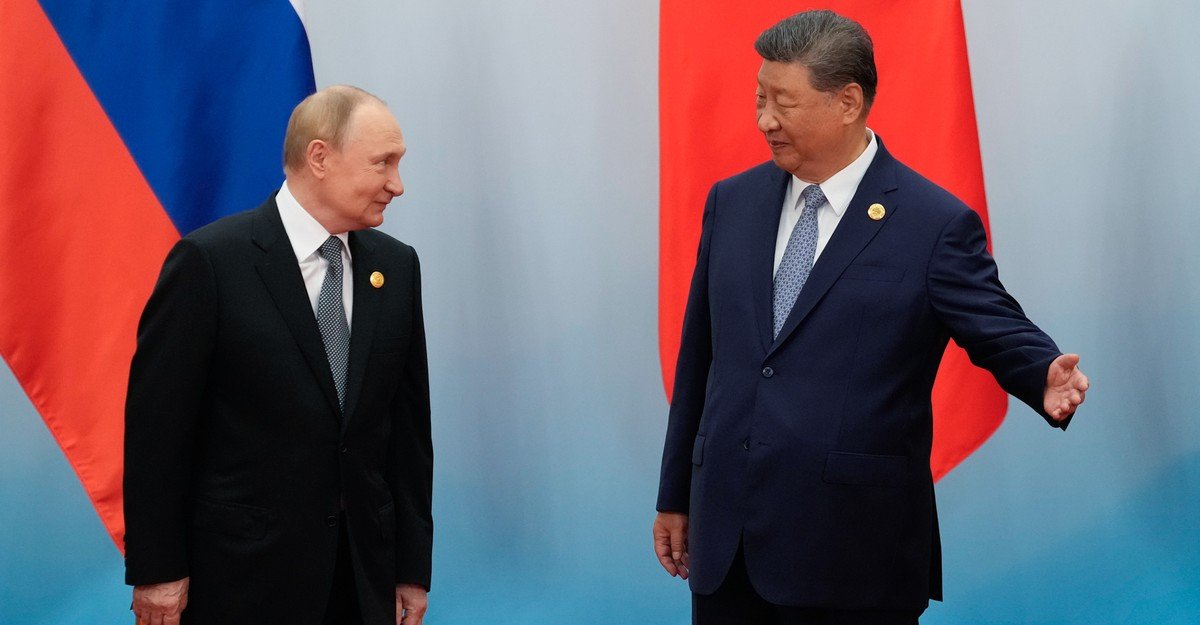
At their meeting in Beijing today, the Chinese leader Xi Jinping and Russian President Vladimir Putin made a show of how close they’ve become. Putin and Xi, referring to each other as friends, praised the strength of their relationship as their two countries advanced an agreement to build a gas pipeline that would bind their economies even more tightly together.
The continued friendship between the two leaders is a stark reminder that Donald Trump, despite his attempted outreach to Russia and talk of “ununiting” America’s two major rivals, hasn’t redrawn the global map of strategic alliances to his advantage. But here’s the curious thing: Neither has China.
Within weeks of the inauguration, many observers—I was one of them—warned that by courting Russia and punishing Europe, Trump might be handing the world and, most alarmingly, Washington’s traditional allies to China. That Beijing would welcome such an opportunity seemed obvious: China had often sought to drive a wedge between the U.S. and its friends, but lately Xi had strained China’s relations with Europe by supporting Putin’s invasion of Ukraine. Now Beijing could patch things up by presenting itself as a more reliable partner than Washington.
But to the extent that Beijing has made any such effort so far, it was short-lived. Chinese Foreign Minister Wang Yi reportedly told the European Union’s top diplomat in July that China could not accept a Russian loss in Ukraine, because that might lead the United States to focus its energies on containing China’s rise. This position on Ukraine, combined with a hard stance on trade issues, has left China unable to improve its ties with Europe, as was evident at a Beijing summit with EU leaders in July, during which the two sides found hardly any common ground.
China hasn’t done much to shake up American alliances in Asia, either. Beijing has continued to alienate its neighbors by aggressively asserting claims to nearly all of the South China Sea; in August, two Chinese naval vessels collided there as they tried to chase away a Philippine coast-guard boat. South Korea’s newly elected president, Lee Jae Myung, has expressed an interest in improving relations with China, but rather than seize on that, Xi has made clear that his government’s sympathies lie with Seoul’s primary adversary, North Korea, whose dictator, Kim Jong Un, will visit China this week for a celebration of the 80th anniversary of the end of World War II in Asia. In recent days, Indian Prime Minister Narendra Modi attended the Shanghai Cooperation Organization meeting in Tianjin—his first trip to China in seven years. But Modi is not likely to rush into Xi’s arms, given China’s role in supplying India’s chief rival, Pakistan, with fighter jets and missiles used in the recent clashes over Kashmir. New Delhi is embroiled in a trade dispute with Trump, but India remains a member of the Quad, a partnership with the U.S., Japan, and Australia aimed at counterbalancing Beijing in Asia.
This pattern of decision making suggests that Beijing has not made much of Trump’s disruptions to American alliances. Rather, China is still treating the established democratic powers—the United States, the European Union, Japan, and their partners—as the main impediments to its global ambitions. Within that strategic calculus, Putin remains a crucial partner for China. Last week, Xi told Vyacheslav Volodin, the chair of the Russian Duma, that the two countries should “jointly safeguard their security” and “work for a more just and equitable international order”—in other words, one no longer dominated by the U.S. and its allies, according to an official Chinese-government summary of his comments.
That Washington, under Trump, has abandoned the language, and seemingly the agenda, of shared values with fellow democracies does not seem to have altered this calculation. Chinese leaders still see Western countries “as a unit and do not see that there’s enough profit to be gained by trying to play them against one another,” Sergey Radchenko, an expert on China-Russia relations at the School of Advanced International Studies at Johns Hopkins University, told me. As a consequence, he added, Chinese leaders “need Russia as a counterbalance to that.” Alexander Gabuev, the director of the Carnegie Russia Eurasia Center, argues that to Xi and Putin, Trump is simply another president seeking to extend and maintain U.S. dominance. From the perspective of China’s leaders, the Americans and Europeans “like us to be weak, poor, and looking up to them, which we don’t accept,” Gabuev told me.“That’s the narrative that’s really impossible to change” under current circumstances.
China does seek to extend its influence within the global South at American expense. On Monday, Xi criticized “hegemonism and protectionism”—a not-so-veiled dig at Washington—and proposed a new initiative to strengthen the role of developing countries in international decision-making. But neither Russia nor China seems to have fully clocked the opportunity that Trump’s withdrawal of the United States from global leadership presents. For Russia, courting better relations with American allies might help relieve the economic pressure that sanctions have imposed. In China’s case, a more subtle and flexible foreign policy could scramble long-established relationships and reshape the global order.
Trump’s disdain for foreign-policy precedent and erratic flip-flops will continue to open opportunities for Xi and Putin to expand their global influence at Washington’s expense. But wooing Western partners would likely involve some compromises that these dictators are probably unwilling to make. China remains intent on, for example, pursuing technological superiority, upgrading its military, and partnering with Putin—all policies that stand in the way of improving relations with American allies.
By continuing to align with each other and treat the West as a unified adversary with common values and interests, Xi and Putin are, in effect, holding the U.S. alliance system together. They are also leaving open the possibility that the next U.S. president can repair the global order that sustained American dominance.
