

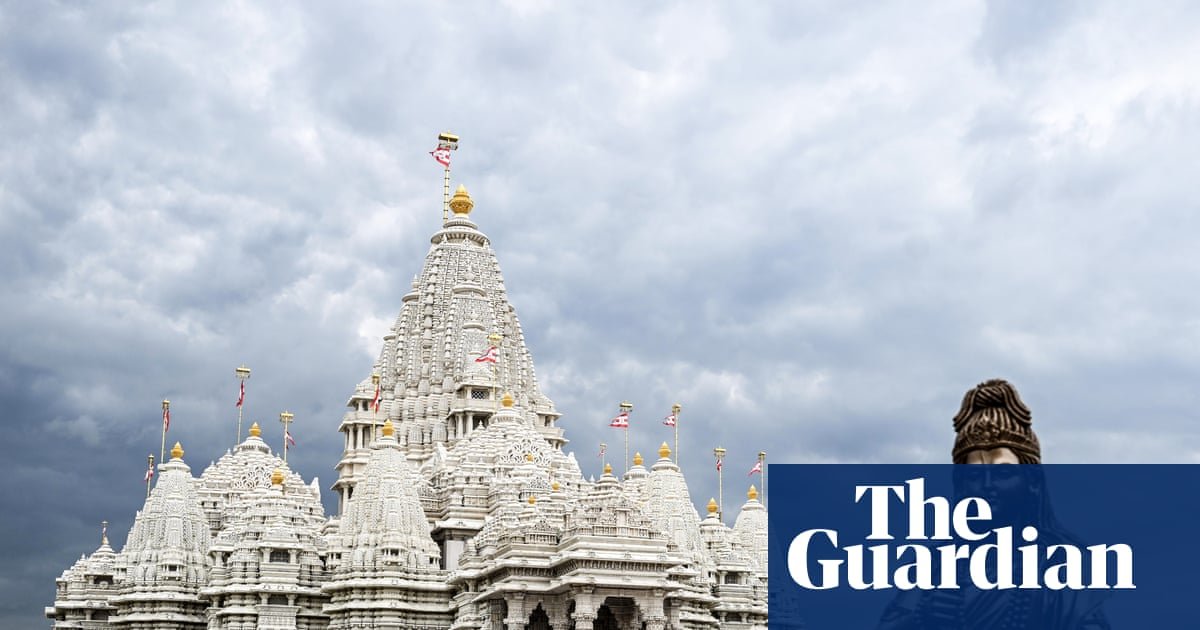
In the center of the suburban town of Robbinsville, New Jersey, sits the largest modern Hindu mandir outside India.
What visitors from around the world see is a breathtaking display of craftsmanship – hand-carved stone from Rajasthan assembled across a sprawling 185-acre complex. The temple has gone viral on social media for its intricate designs, which took millions of hours to complete. Baps Swaminarayan Akshardham, the religious organization behind the site, has built similar temples across the globe. But some workers say these monumental structures came at a high cost.
Beneath the beauty and sheer scale of the Robbinsville complex lies a darker story: allegations of worker abuse, visa fraud and medical neglect during the temple’s construction between 2015 and 2023. Workers believe that at least two laborers, Ramesh Meena and Devi Lal died from a largely preventable, irreversible lung disease called silicosis, caused by inhaling fine silica dust produced while carving stone, according to court documents and labor advocates familiar with the case. Lal died while waiting for a lung transplant.
Workers say others have been diagnosed with other respiratory illnesses such as tuberculosis and chronic bronchitis. Workers spoke to the Guardian on condition of anonymity for fear of retaliation and to protect their families. Symptoms of silicosis include shortness of breath, persistent cough, chest pain and fatigue and can lead to severe disability and premature death.
Devi Lal. Photograph: Obtained by The Guardian
“A person would prefer committing suicide rather than dying from silicosis because it’s such a painful death,” said a former Baps temple worker, who developed tuberculosis. “The breathing problem is so bad that you really pray for the person to die, so that he can be at peace.”
The temple denies the allegations and asserts a ministerial exception, which is a first-amendment based legal doctrine that prevents courts from interfering with religious institutions’ employment decisions on “ministers” or equivalent responsibilities – such as teaching faith, leading workshops, or carrying out religious duties.
Two hundred Dalit workers, members of the lowest caste in India’s rigid social hierarchy, came from Rajasthan to New Jersey to work on the temple. Historically subjected to extreme social and economic marginalization, Dalits have long been relegated to the most dangerous and lowest-paid labor. Dalit workers are also purportedly not allowed to worship in these temples because of their low caste ranking.
At the Robbinsville site, workers say they labored for 90 hours a week for as low as $1.20 an hour, according to the complaint. Workers allege that passports were taken from them and they were not allowed to contact their families for long periods of time.
“I saw my kids growing up on the phone,” a worker said, explaining that he also hadn’t seen his parents, brother and wife for seven years. His roommate had also died by suicide after returning to India. His roommates’ family say depression and the working conditions at the temple played a significant role in his death.
“At that time his health was fine. He had a check up along with everyone else, and was told he had some silicosis, but not much, around 10 to 20%,” Ankush Kumar, son of the deceased, wrote in a Signal message.
Ramesh Chandra Meena. Photograph: Obtained by The Guardian
“No one contacted us or helped us at the time of this tragedy. We had to deal with everything on our own. Since then, life has been really hard for me. I’m the only earning member in the family. I support my two siblings and my mother. I’ve had to give up my full-time education to start earning,” he said.
In addition to the emotional toll of family separation, workers also say that they were not given proper PPE while carving and weatherizing stones for construction. Multiple workers say that they were given surgical masks or cloth masks. In one case, a worker said they brought their own cloth mask from India. For prolonged exposure to fine silica dust, the Occupational Safety and Health Administration (Osha) says that N95 masks are the minimum requirement to prevent diseases such as silicosis. Some opted out of wearing surgical masks because of fatigue and discomfort.
Some workers said they developed silicosis while working at the temple after they had been medically evaluated as having no respiratory issues before hiring.
“The moment they found anyone developing a fever, coughing, respiration breathing problems, they send them back [to India] right away,” the worker whose roommate died by suicide explained.
“They didn’t give us a single day off, no matter how much it snowed. They even made us work in the snow,” said another worker with silicosis who was sent back to Rajasthan. “So, I took eight days of rest. During those eight days, they didn’t let me go back to the house [where workers stayed.] After I recovered a bit, they sent me and my brother-in-law back to India. Now my brother-in-law is also in a bad condition, and so are many other men along with me.”
Workers also say that the temple had a small clinic but were discouraged from seeking care outside of the temple’s networks. Workers also spoke little to no English and found it difficult to seek outside treatment without assistance. Multiple workers also said that doctors prescribed medication without explaining what the meds were and their effects.
“The allegations in the civil lawsuit are wrong,” said Patel in an email. “[The workers’] presence in New Jersey – and at the other stone mandirs in Atlanta, Houston, Los Angeles, and Chicago – was well known to and approved by federal, state and local officials. And Baps provided the artisans with government-inspected housing; all meals; round-trip flights from and to India at the beginning, end, and during their service; medical care; health insurance; pre-paid phone cards; and unlimited and unmonitored access to the internet. That is not forced labor; it is not human trafficking; it is not any of the things alleged in the lawsuit.”
Baps says that worker safety was covered during orientation and that PPE such as gloves, boots and masks were provided.
“The health and safety of the volunteers was a priority,” said Darshan Patel, a volunteer and media representative for Baps. Patel, who also worked on the construction of the temple, emphasized the spiritual aspect of religious volunteering in Hindu called Seva, which in Sanskrit means “selfless giving”.
“The construction of the mandir was an opportunity to contribute to something bigger than yourself,” he added.
“There is no such thing as Seva,” said one worker with silicosis, clarifying that religious volunteering was used for the sole purpose of obtaining the R-1 visa in order to work. R-1 visas are a US non-immigrant visa for religious workers which grants temporary entry to serve religious vocations for up to five years.
The central sanctum of Bhagwan Swaminarayan is pictured during the opening ceremony in October 2023. Photograph: Kena Betancur/AFP/Getty Images
In 2021, federal agents entered the temple and removed 90 workers after Baps was accused of forced labor under the guise of religious volunteering. In addition to medical neglect, workers say they also endured unsafe living conditions and that say they were afraid to leave the campus to seek help.
The Department of Justice recently closed the criminal investigation in September without charges. Now, a civil case against Baps that was paused during the criminal investigation can resume.
Experts say that Dalit exploitation has historical roots in India. Gunjan Singh, a human rights attorney, explained that the Bonded Labor Act of 1976 was meant to end forced labor in India between landlords and Dalit workers who owed debts. However, the law isn’t properly enforced, especially the act’s provision on rehabilitation after workers are rescued from abuse, leaving low-ranking caste members in a loop of exploitation. Singh considers the treatment of Baps workers as “modern slavery”.
“Religious volunteerism can happen with people who have means to feed themselves,” Singh said, “not for somebody who is doing a job primarily to feed themselves.”
Moreover, silicosis remains a widespread health issue among lower caste members in India. The People’s Rights and Social Research Centre filed a petition to India’s supreme court in 2006 to address silicosis and labor rights issues in a few states such as Rajasthan. In 2024, thesupreme court expanded the scope to include the entire country.
As the civil case moves forward, workers seek backpay and compensation for harm allegedly caused by poor working conditions. Others hope that the Indian government bans R-1 visas and to work without fear.
As one worker said: “People appreciate the art but they don’t know the blood.”
