

August 31, 2025
3 min read
Huge Cracks in the Earth Are Slicing through Cities, Swallowing Houses and Displacing Thousands of People
Hundreds of thousands of people are at risk of losing homes, businesses—and lives—as giant “gullies” expand into cities across Africa
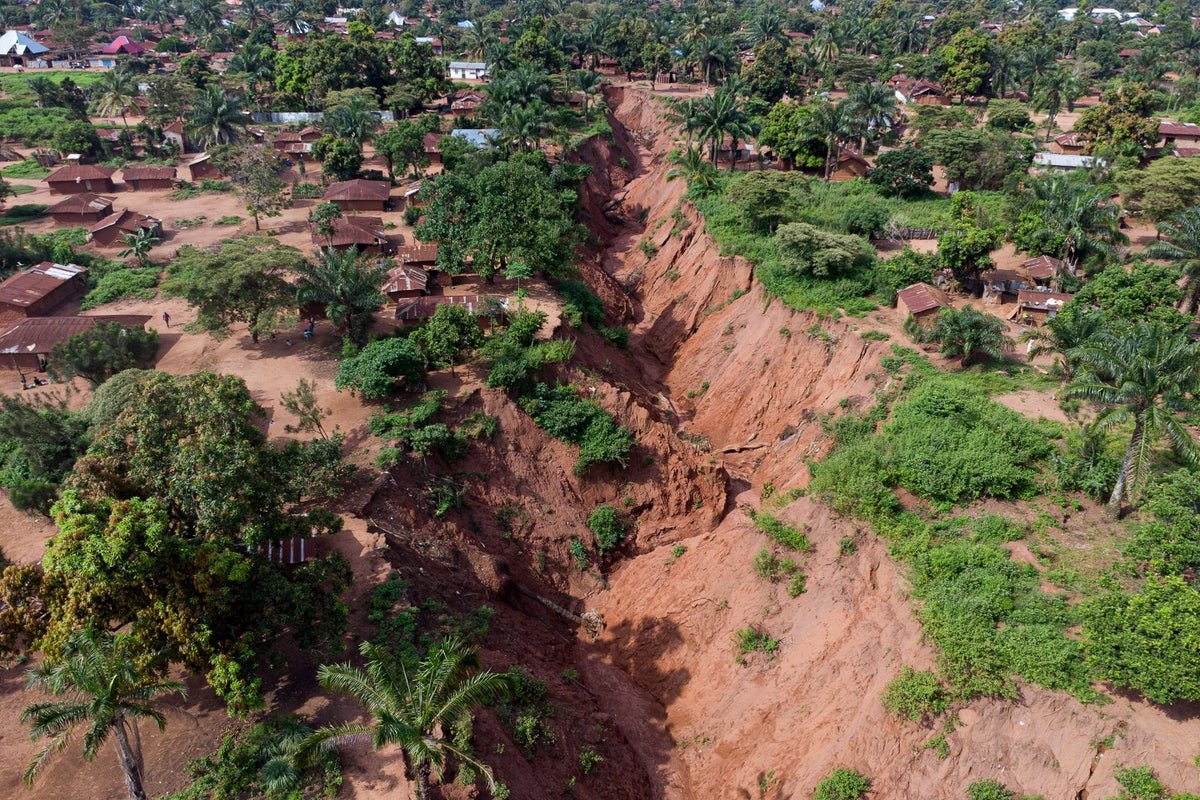
A view of a deep urban gully in Kamonia in the Democratic Republic of the Congo. More than 3,000 people are at risk of this gully expanding.
Ruben Nyanguila/Anadolu via Getty Images
Gigantic trenches known as gullies are opening up in cities in Africa, swallowing up homes and businesses, sometimes in an instant, a study has found.
About 118,600 people, on average, in the Democratic Republic of the Congo (DRC) alone were displaced between 2004 and 2023, according to researchers reporting their findings in Nature.
Without urgent action, researchers estimate that hundreds of thousands of people across Africa are likely to be displaced within the next 10 years, including more than one-quarter of the 770,000 or so people in the DRC living in the expected expansion zone of these gullies.
On supporting science journalism
If you’re enjoying this article, consider supporting our award-winning journalism by subscribing. By purchasing a subscription you are helping to ensure the future of impactful stories about the discoveries and ideas shaping our world today.
“It’s an underestimated and severely under-researched hazard,” says study co-author Matthias Vanmaercke, a geographer at the Catholic University of Leuven (KU Leuven) in Belgium. It is caused by “a combination of natural and human factors,” he says, but this is “not at all unavoidable.”
Expanding gullies
Gullies are expanding across cities that are built on sandy soils and lack adequate drainage. When there are heavy rains, water accumulates on roads and rooftops. When the drainage systems are inadequate, the water finds its way into unprotected ground, carving deep holes that can stretch for hundreds of metres. Over time, the gullies swallow houses and other infrastructure, and sometimes even result in deaths.
Vanmaercke and his colleagues used satellite images taken between 2021 and 2023 to identify 2,922 urban gullies in 26 of 47 cities, covering a cumulative distance of nearly 740 kilometres. The team cross-checked these images with historical aerial photographs stored at the Royal Museum for Central Africa in Belgium and found that only 46 of the gullies were present in the 1950s. This “gave the first clear indication that this is indeed attributable to the ongoing urbanization,” Vanmaercke says.
A woman and a boy look through the collapsed wall of a house left by the collapse of one of the main roads in the Mont Ngafula district in Kinshasa, the capital of the Democratic Republic of Congo on November 4, 2021.
Alexis Huguet/AFP via Getty Images
In 99% of cases, the gullies had expanded by at least 10 square metres between 2004 and 2023. The average gully was 253 metres long and 31 metres across at its widest point, and nearly all of them were linked to the road network. “The water cannot infiltrate, and it concentrates along these roads which basically become big canals that turn into rivers,” says Vanmaercke.
The researchers then combined data on population density with the gully maps. This enabled them to estimate that an average of 118,600 people were displaced because of gullies over the period — with displacement rates more than doubling after 2020.
Guy Ilombe Mawe, a geomorphologist at the Official University of Bukavu in the DRC and a co-author of the paper says that the widening of gullies can be catastrophic and even fatal, and that families living near gullies often have no safe alternatives.
In November 2019, the researchers visited Kinshasa, the DRC’s capital and one of the most affected cities, with 868 urban gullies stretching over a total of 221 kilometres. There they met a mother whose home stood near a gully edge. Two days later, several of her children were killed while sheltering at a relative’s house, when an expanding gully collapsed overnight. At least 40 people in Kinshasa died that night.
Investment needed
As African cities expand, the threat of expanding gullies is likely to increase. The continent’s population is expected to nearly triple by 2050, and rainfall intensities in tropical Africa could increase by up to 15% in the coming decades.
The site of a house in Kinshasa where a family lost several children to gully formation. People tried to prevent the gully from expanding using sand, cement and sticks.
The authors note in their study that preventing gullies from forming is more effective and affordable than is stabilizing them after they form, which can cost upwards of US$1 million per gully. “The trick would be to have interventions that are well thought of and installed in time. But there’s such a huge lack of money and resources that usually when something is done, it’s either inadequate or too late,” says Vanmaercke.
Ana Mijic, a hydrologist at Imperial College London, says that governments and private-sector organizations need to step up their investments in interventions such as sufficient drainage systems. But high costs and maintenance of long-term solutions act as barriers.
Gina Ziervogel, a geographer at the University of Cape Town in South Africa, says that governments should prioritize sustainable infrastructure. “We need to understand the role of the environment and resources in cities — soil and water particularly — and so engaging experts from those fields is really important.” She adds that involving the affected communities in planning interventions “would go a long way to understanding their insights, both on the experience of living with this and on potential solutions.”
“The sooner we can invest, the better, because we know that the later we leave it, the bigger the scale of the challenge,” says Ziervogel.
This article is reproduced with permission and was first published on August, 27 2025.
It’s Time to Stand Up for Science
If you enjoyed this article, I’d like to ask for your support. Scientific American has served as an advocate for science and industry for 180 years, and right now may be the most critical moment in that two-century history.
I’ve been a Scientific American subscriber since I was 12 years old, and it helped shape the way I look at the world. SciAm always educates and delights me, and inspires a sense of awe for our vast, beautiful universe. I hope it does that for you, too.
If you subscribe to Scientific American, you help ensure that our coverage is centered on meaningful research and discovery; that we have the resources to report on the decisions that threaten labs across the U.S.; and that we support both budding and working scientists at a time when the value of science itself too often goes unrecognized.
In return, you get essential news, captivating podcasts, brilliant infographics, can’t-miss newsletters, must-watch videos, challenging games, and the science world’s best writing and reporting. You can even gift someone a subscription.
There has never been a more important time for us to stand up and show why science matters. I hope you’ll support us in that mission.
