

Ten years ago, Alastair Harper was an advocate for young people’s health sitting in a stuffy meeting room in London planning an air pollution campaign. “My phone started buzzing,” he said. “I took the call, and then told the room I needed to leave immediately.
“I had to get to UCLH [one of London’s major hospitals]. My own child was headed there in a blue-lit ambulance because she was struggling to breathe London’s toxic air.”
Hundreds of thousands of parents across the UK capital had similar experiences in those years. Between about 6,000 and 8,000 people were dying prematurely each year in London in the late 2010s. In 2020, an inquest found that the death of Ella Adoo-Kissi-Debrah in 2013 had been a direct result of air pollution, the first time it had been listed as a cause of death in the UK.
Commuters cross London Bridge on a smoggy morning in 2012. Photograph: Barry Lewis/Corbis/Getty Images
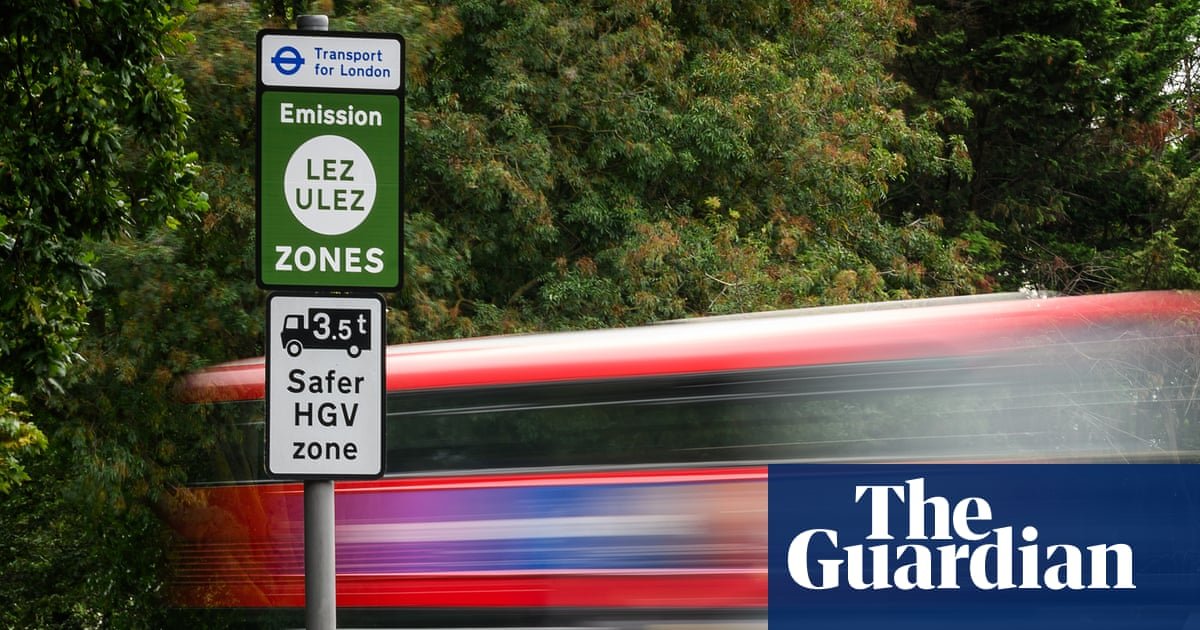
This week, a study from Queen Mary University London (QMUL) showed a significant reversal. Children’s lungs had grown bigger and stronger since the most polluting vehicles have been restricted on the capital’s roads, scientists found. The ultra-low emission zone (Ulez) – introduced by London’s mayor Sadiq Khan in 2019 and expanded in 2021 and 2023 – charges £12.50 a day for more polluting vehicles that do not meet stringent standards. It has drastically cut levels of nitrogen dioxide, a harmful pollutant.
To Harper, who later worked for Khan as an environmental adviser, and now works independently, relief at his own child’s recovery has been supplemented by the satisfaction of knowing that far fewer parents will experience such dread. “To know now that same air is so much safer for the kids that breathe it because of the political choice of one man makes me feel proud of this city,” he said.
Nick Hopkinson, a professor of respiratory medicine at Imperial College London, said the QMUL study was not a surprise. “There is an absolute wealth of evidence that air pollution is a major cause of ill health and premature death across the planet,” he said. Air pollution kills 7 million people a year globally, according to the World Health Organization.
Poor air not only causes respiratory difficulties and the stunting of children’s lungs, but also heart disease and stroke. It is associated with some forms of cancer, dementia, autism and cognitive difficulties in children too. New studies are adding to our knowledge, but we have known for decades of the basic dangers of dirty air. So why is there so much opposition to curbs on air pollution, which are clearly sound public health measures?
This opposition, culture war even, is central for all cities hoping to follow Khan’s lead. The leading causes of air pollution vary around the world – coal use in power stations in China and India, agricultural burning in south-east Asia, waste burning in many of the poorest countries and dust and local industry in others – but road traffic is a constant.
The Reform UK leader, Nigel Farage, speaks to the driver of a van taking part in a protest against London’s Ulez. Photograph: Leon Neal/Getty Images
The technology to cut all of these types of air pollution already exists, says a former social development minister of Ecuador and now executive director of the Breathe Cities initiative, whose supporters include the Clean Air Fund and C40, a global coalition of mayors and leaders of nearly 100 major cities. “We know that we have the means to make a difference, and we are sharing knowledge and success stories so they can be replicated with impactful policies,” she said.
In the case of coal, the alternatives are renewable energy. Halting the burning of forests and peatlands would also combat the climate crisis. The alternatives to polluting traffic are public transport, electric vehicles, the redesign of cities and encouragement of active transport – walking and cycling. Trees are also important everywhere.
Paris and Barcelona have shown what is possible within a few years when mayors embrace the joys of cycling, following the lead long ago taken in Denmark and the Netherlands. New York’s Zohran Mamdani, now wearing a cycle helmet, hopes to do the same. But elsewhere in car-dominated America, infamously poor public transport provision, an intractable SUV culture and a president in Donald Trump intent on rolling back environmental protections mean widespread change is unlikely.
Other cities are working to make a difference. Bogotá is about to embark on its second Zuma, a clean air zone that involves expanding cycle lanes and footpaths, paving roads to suppress dust and planting trees. The Colombian capital won last year’s global Earthshot prize for its first Zuma. The city’s environment secretary, Adriana Soto, said: “Residents helped shape the design, particularly how the works would maintain access to their homes and respond to local mobility needs.” Hundreds of cities around the world now have clean air zones of varying sizes.
Rush-hour traffic in the Kenyan capital, Nairobi, in July. Photograph: Tony Karumba/AFP/Getty Images
Another is Kenya’s capital, Nairobi, which passed an air quality act in 2022 that requires harmful emissions to be halved by 2035 and has installed a network of 50 low-cost monitoring stations as a first step. Imports of vehicles more than eight years old are banned, and the city is consulting on establishing clean air zones. The lead for the C40 Breathe Cities project in Nairobi, Victor Indasi, said: “More remains to be done, but Nairobi is firmly on the right trajectory.”
Bulgaria’s capital, Sofia, is saddled with old-fashioned heating systems dependent on coal and wood burning. These are being phased out and replaced with cleaner heat pumps, subsidised for those on low incomes, as part of a city-wide introduction – the first in south-east Europe – of low-emissions zones for transport and heating. Recent results show a 22% reduction in the average concentration of PM10 particulate matter, and a halving of days that exceed air quality guidance levels. Poland is also cutting its reliance on solid fuels.
A tram runs along a boulevard in Sofia. Photograph: Hristo Rusev/Getty Images
In Australia, Melbourne’s mayor was inspired by a speech Khan gave last year before Brazil’s Cop30 climate summit. The first step was discovering that state-level monitoring was telling the city little about the real quality of its air at a neighbourhood level. “It was surprising to us that this wasn’t being measured,” a spokesperson said. With the new monitoring data coming in, the mayor has yet to decide what actions will be taken, whether a clean air zone or other restrictions, or carrots in the form of scrappage schemes and improved public transport. “We are still at the beginning of this journey,” the spokesperson said.
London’s low emission zone might not have happened if Khan had not staked his reputation on it. When he launched the scheme in 2019, he faced fierce opposition from political opponents and large groups of voters, and even his own party. The plan was challenged in the courts, businesses complained of the supposedly crippling costs, and Khan received personal threats and shouts of “Nazi” at public appearances. One survey found 60% of Londoners who replied to a consultation were against it.
skip past newsletter promotion
Sign up to Down to Earth
The planet’s most important stories. Get all the week’s environment news – the good, the bad and the essential
after newsletter promotion
People protest outside Downing Street after the low emission zone was expanded in 2023. Photograph: Anadolu Agency/Getty Images
In 2023, the resurgent Labour party under its new leader Keir Starmer faced an important byelection in Uxbridge, on the outer edge of London. The Ulez was a key issue for voters and Labour lost by a small margin, leading Starmer’s advisers to blame the zone and demand row-backs in London and elsewhere. Andy Burnham, then the mayor of Greater Manchester, who took over from Starmer as prime minister this autumn, abandoned plans for a Ulez after Uxbridge.
In all of these cities there is a sense of caution, even hesitancy, and none are moving fast enough. In London, the successes of the Ulez are threatened by the ballooning number of wood-burning stoves, a fashion accessory rather than a necessity for most of their urban owners. These are now a bigger source of particle pollution than traffic. More than 110,000 children were admitted to hospital with breathing difficulties in London in 2024.
Monitoring is a vital first step, but what is done with the data is what counts. That will involve tough measures. “There is always a price. You have to change people’s behaviour, you have to change the transport, the heating, the energy generation,” said Hopkinson. “The way things are in cities is the way they have developed over long periods, and changing all that is difficult.”
The pollution is often invisible. As Vaca Jones put it: “Air is not a tangible public good that people can feel and see. That means it is not a priority on the political agenda.”
Vested interests also intervene. Though studies show that air pollution takes an economic as well as a physical toll, businesses often complain – with little evidence – that curbs on driving will hurt them.
There is also the fact that the people driving the cars and operating the polluting factories are often not the same people whose children are being admitted to hospital. “Those who are suffering are those who have done least to cause the pollution,” said Chris Griffiths, a professor of primary care at Oxford University.
When Khan embarked on London’s Ulez, hysterical misinformation quickly spread online, suggesting the mayor intended to shut down London for his own ends. His deputy, Mete Coban, recalls the shock. “The personal abuse Sadiq got on the back of it was incredible,” he said. “I think it’s this, the misinformation, that is the number one thing that puts off other countries from doing this.”
People protest against the expansion of London’s low emission zone in 2023. Photograph: Guy Bell/Shutterstock
Hopkinson said: “There is a kind of madness about it. “Disinformation, which is lying to people, is confusing them. They are trying to persuade people that air pollution is not bad for them, and climate change is not real.
“They are spreading wild conspiracy theories [for instance that 15-minute cities, where all amenities can be accessed within a small area, are devices of government control] and the far right are exploiting this and generating grievance.”
With the latest study adding to a growing pool of evidence of the Ulez’s success, proponents of cleaner urban air hope to be able to cut through the madness with facts that speak loudly to parents and responsible people everywhere.
As Hopkinson put it: “The question for pro-pollution campaigners is ‘why do you hate children?’”
