
Close Menu

    Subscribe to Updates

    Get the latest creative news from FooBar about art, design and business.

    What's Hot

    Svalbard’s polar bears are showing remarkable resilience to climate change

    Nursing a skink: endangered alpine lizard numbers set to rise after Omeo falls pregnant in Victoria | Reptiles

    Brent crude tops $70 per barrel on Iran concerns, pushing FTSE 100 to record high, as gold and copper rally – business live | Business

    Facebook X (Twitter) Instagram
    Facebook X (Twitter) YouTube LinkedIn
    Naija Global News |
    Thursday, January 29
    • Business
    • Health
    • Politics
    • Science
    • Sports
    • Education
    • Social Issues
    • Technology
    • More
      • Crime & Justice
      • Environment
      • Entertainment
    Naija Global News |
    You are at:Home»Science»Deep-Sea Worm Produces Orpiment, a Toxic Yellow Pigment Used in Historical Art
    Science

    Deep-Sea Worm Produces Orpiment, a Toxic Yellow Pigment Used in Historical Art

    onlyplanz_80y6mtBy onlyplanz_80y6mtAugust 29, 2025004 Mins Read
    Share Facebook Twitter Pinterest LinkedIn Tumblr Email
    Deep-Sea Worm Produces Orpiment, a Toxic Yellow Pigment Used in Historical Art

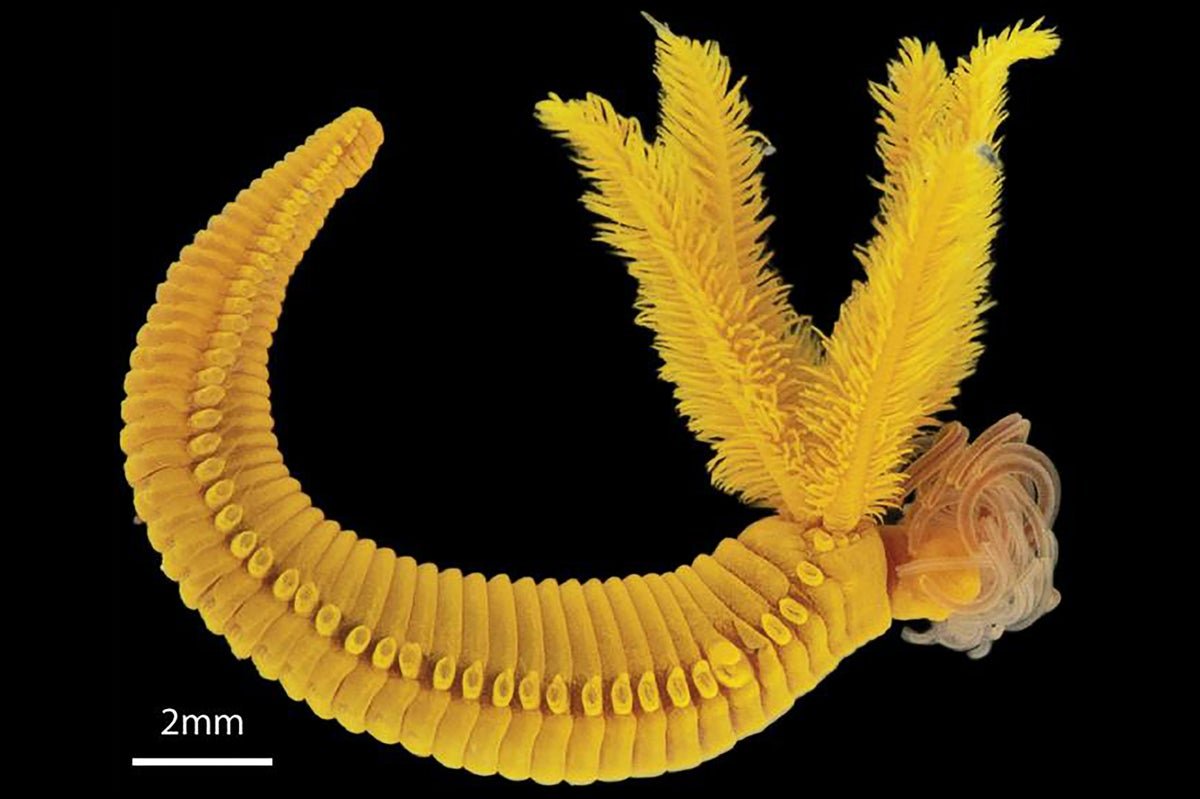
    Paralvinella hessleri accumulates microscopic particles of arsenic on its outer skin, which reacts with sulfide to form a microscopic armour of yellow orpiment.

    Wang et al./PLoS Biol (CC BY 4.0)

    Share
    Facebook Twitter LinkedIn Pinterest Email

    August 28, 2025

    2 min read

    This Deep-Sea Worm Creates a Toxic Yellow Pigment Found in Rembrandt and Cézanne Paintings

    A deep-sea worm that lives in hydrothermal vents is the first known animal to create orpiment, a toxic, arsenic-containing mineral that was used by artists for centuries

    By Mohana Basu & Nature magazine

    Paralvinella hessleri accumulates microscopic particles of arsenic on its outer skin, which reacts with sulfide to form a microscopic armour of yellow orpiment.

    A bright-yellow worm that lives in deep-sea hydrothermal vents is the first known animal to create orpiment, a brilliant but toxic mineral used by artists from antiquity until the nineteenth century. The findings were published in PLoS Biology this week.

    The worm (Paralvinella hessleri) is the only creature to inhabit the hottest part of deep-sea hydrothermal vents in the Okinawa Trough in the western Pacific Ocean. The hot, mineral-rich water that shoots up from the sea floor contains high levels of toxic sulfide and arsenic.

    Researchers found that the worm accumulates microscopic particles of arsenic on its outer skin cells as well as along its internal organs. This reacts with sulfide from the hydrothermal vent to form small clumps of orpiment, fashioning a microscopic armour around the worm that protects it from the toxic environment.

    On supporting science journalism

    If you’re enjoying this article, consider supporting our award-winning journalism by subscribing. By purchasing a subscription you are helping to ensure the future of impactful stories about the discoveries and ideas shaping our world today.

    Orpiment is a naturally occurring arsenic sulfide mineral, often found in hydrothermal and magmatic ore deposits.

    The findings came as a surprise to the research group. In the deep sea, creatures dwell in total darkness and are typically grey-ish white or adorned in hues of orange to dark red, says co-author Hao Wang, a deep-sea biologist at the Chinese Academy of Sciences in Qingdao. It “doesn’t make any sense to make pigment in total darkness,” Wang says.

    Unknown mechanism

    The team is yet to discover how arsenic is transported into the creature’s internal organs.

    Other deep-sea creatures are known to produce minerals as a protective armour. The scaly-foot snail (Chrysomallon squamiferum) for instance, hosts bacteria that detoxifies sulfide through the extracellular biomineralization of iron sulfides in its scales, says Narissa Bax, a marine scientist at Greenland Institute of Natural Resources in Nuuk.

    “Paralvinella hessleri may intentionally combine toxins into a single, ‘safe’, crystalline mineral within its own cells,” she says. It’s ability to fight poison with poison in this way is remarkable, she adds.

    But further research to confirm how this occurs will be challenging, owing to the extreme conditions in deep-sea vents, and difficulties studying such species outside their natural environments, she says. Cultivation of P. hessleri in a laboratory setting is currently not possible.

    This article is reproduced with permission and was first published on August 28, 2025.

    It’s Time to Stand Up for Science

    If you enjoyed this article, I’d like to ask for your support. Scientific American has served as an advocate for science and industry for 180 years, and right now may be the most critical moment in that two-century history.

    I’ve been a Scientific American subscriber since I was 12 years old, and it helped shape the way I look at the world. SciAm always educates and delights me, and inspires a sense of awe for our vast, beautiful universe. I hope it does that for you, too.

    If you subscribe to Scientific American, you help ensure that our coverage is centered on meaningful research and discovery; that we have the resources to report on the decisions that threaten labs across the U.S.; and that we support both budding and working scientists at a time when the value of science itself too often goes unrecognized.

    In return, you get essential news, captivating podcasts, brilliant infographics, can’t-miss newsletters, must-watch videos, challenging games, and the science world’s best writing and reporting. You can even gift someone a subscription.

    There has never been a more important time for us to stand up and show why science matters. I hope you’ll support us in that mission.

    ART DeepSea Historical Orpiment Pigment Produces toxic Worm yellow
    Share. Facebook Twitter Pinterest LinkedIn Tumblr Email
    Previous ArticleTreasury should tax big banks on quantitative easing windfalls, argues thinktank | Economic policy
    Next Article SUNY Expands Local News Collaborations for Student Learning
    onlyplanz_80y6mt
    • Website

    Related Posts

    Five ways to make the academic workplace happier and healthier this year

    January 29, 2026

    Does Antarctica really have the bluest sky in the world? | Science

    January 29, 2026

    Wikipedia is needed now more than ever, 25 years on

    January 29, 2026
    Add A Comment
    Leave A Reply Cancel Reply

    Top Posts

    Watch Lady Gaga’s Perform ‘Vanish Into You’ on ‘Colbert’

    September 9, 20251 Views

    Advertisers flock to Fox seeking an ‘audience of one’ — Donald Trump

    July 13, 20251 Views

    A Setback for Maine’s Free Community College Program

    June 19, 20251 Views
    Stay In Touch
    • Facebook
    • YouTube
    • TikTok
    • WhatsApp
    • Twitter
    • Instagram
    Latest Reviews

    At Chile’s Vera Rubin Observatory, Earth’s Largest Camera Surveys the Sky

    By onlyplanz_80y6mtJune 19, 2025

    SpaceX Starship Explodes Before Test Fire

    By onlyplanz_80y6mtJune 19, 2025

    How the L.A. Port got hit by Trump’s Tariffs

    By onlyplanz_80y6mtJune 19, 2025

    Subscribe to Updates

    Get the latest tech news from FooBar about tech, design and biz.

    Most Popular

    Watch Lady Gaga’s Perform ‘Vanish Into You’ on ‘Colbert’

    September 9, 20251 Views

    Advertisers flock to Fox seeking an ‘audience of one’ — Donald Trump

    July 13, 20251 Views

    A Setback for Maine’s Free Community College Program

    June 19, 20251 Views
    Our Picks

    Svalbard’s polar bears are showing remarkable resilience to climate change

    Nursing a skink: endangered alpine lizard numbers set to rise after Omeo falls pregnant in Victoria | Reptiles

    Brent crude tops $70 per barrel on Iran concerns, pushing FTSE 100 to record high, as gold and copper rally – business live | Business

    Recent Posts
    • Svalbard’s polar bears are showing remarkable resilience to climate change
    • Nursing a skink: endangered alpine lizard numbers set to rise after Omeo falls pregnant in Victoria | Reptiles
    • Brent crude tops $70 per barrel on Iran concerns, pushing FTSE 100 to record high, as gold and copper rally – business live | Business
    • Survey of over-50s women finds almost two in three struggle with mental health | Mental health
    • L.A. Community Colleges Boost Work-Based Learning
    © 2026 naijaglobalnews. Designed by Pro.
    • About Us
    • Disclaimer
    • Get In Touch
    • Privacy Policy
    • Terms and Conditions

    Type above and press Enter to search. Press Esc to cancel.