

For a brief few weeks in early 2025, astronomers were worried about the asteroid 2024 YR4.
Discovered in late 2024 by an automated telescope in Chile as part of the Asteroid Terrestrial-Impact Last Alert System (ATLAS) sky survey, it’s a not only a near-Earth asteroid but one that astronomers feared could get too close for comfort to our fair planet and pose a potential impact risk. At 60 or so meters in diameter, 2024 YR4 wouldn’t cause global damage if it fell to Earth, but it would explode upon impact with the energy of an eight-megaton bomb, so local damage would be considerable. Thus, astronomers were right: it was something to worry about.
Initial observations indicated the asteroid might hit Earth on December 22, 2032. Calculating the trajectory of an asteroid is tricky, and the further ahead the prediction goes, the fuzzier the numbers get. By mid-February 2025, astronomers had refined that Earth-impact probability to around 3 percent, which wasn’t high but was still somewhat concerning.
On supporting science journalism
If you’re enjoying this article, consider supporting our award-winning journalism by subscribing. By purchasing a subscription you are helping to ensure the future of impactful stories about the discoveries and ideas shaping our world today.
Happily, follow-up observations tightened the uncertainties in the projected orbit, effectively ruling out a late-2032 impact.
They ruled out an Earth impact, that is. Amazingly, a chance remains that 2024 YR4 will hit the moon!
As it stands now, the chance of a lunar impact on December 22, 2032, is actually higher than the mid-February probability of the asteroid hitting Earth on that date: about 4 percent. That’s still small but not zero.
If 2024 YR4 does whack into our lone natural satellite, what will happen? Is Earth (or, more to the point, those of us who live on it) in any danger? In a preprint paper accepted for publication in the Astrophysical Journal Letters, astronomers investigated the potential fallout. The answer they got is reassuring—mostly.
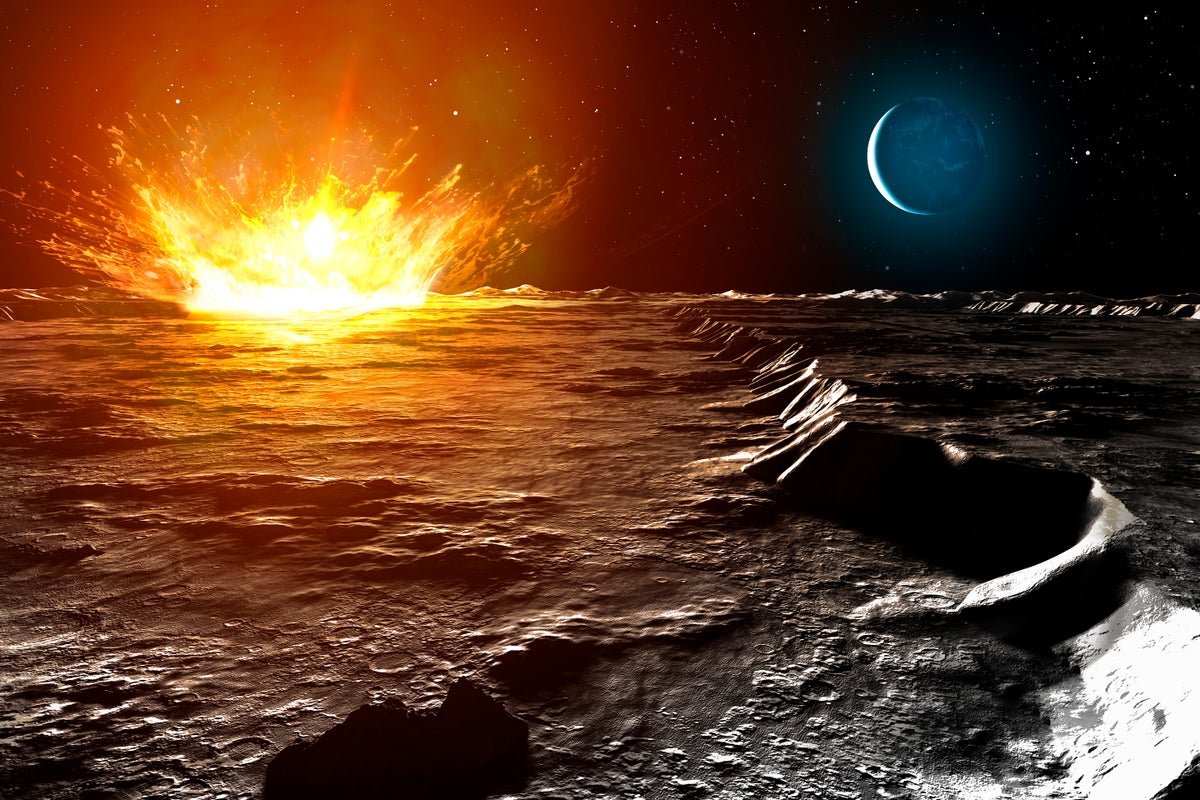
Given the uncertainties in the asteroid’s exact trajectory, the scientists found that—if the asteroid were to hit at all—its chance of striking the moon’s near side would be around 86 percent, meaning we’d likely get a good view of the fireworks. If so, Earth-based observers could see a brief flash as 2024 YR4’s immense kinetic energy—its energy of motion—would convert into light and heat, though it’s difficult to predict just how bright this would be.
In January 2019, however, a meteoroid impacted the moon during a lunar eclipse, so we can use that as a comparison.
That flash was bright enough to be seen by eye, reaching about magnitude 4.2, and came from an object estimated to be less than half a meter across. The asteroid 2024 YR4 is more than 100 times wider, so its volume is well more than a million times larger, which means the energy of its impact would be that much more powerful. If the amount of light released were to scale in a similar way, the flash could be brighter than the full moon! But it would be concentrated in a single point on the surface, so it would be exceedingly bright as seen from Earth.
The astronomers calculated that 2024 YR4’s impact would carve out a crater approximately one kilometer in diameter—small for a lunar crater but big enough that the material excavated and ejected would total about 100 million metric tons. That’s a considerable amount, but even the moon’s low gravity would pull most of the material back down to the surface; 99.8 percent or more of the debris wouldn’t have enough speed to escape. Given the uncertainties in the researchers’ calculation, however, this still means that some 10,000 to 100,000 metric tons of lunar rock would be ejected, and a lot of it could be headed our way. How much?
That would depend on many factors, including the location of the asteroid’s impact on the moon. It’s possible that all the ejected debris could be flung into deep space, missing Earth entirely. But for other scenarios, it’s possible that approximately 10 percent of the material could be thrown into an Earth-impacting trajectory. In the latter case, that material would hit us within three to five days of the lunar impact, so around December 25 to 27, 2032. Happy holidays!
But this potential blow could be softened considerably if most of the ejecta were small particles rather than bigger chunks. How big would these lunar particles be? The paper’s authors caution that their calculations are rough and only yield an order-of-magnitude estimation, meaning it could be too high or low by a factor of 10. Still, their results are illuminating.
According to the astronomers’ back-of-the-envelope reckoning, it’s likely that the ejecta would be small. The researchers predict that many trillions to quadrillions of pieces of the ejected debris would be larger than a tenth of a millimeter. Of those, something like 100 billion to 10 trillion particles would be larger than a millimeter in size (roughly that of a grain of sand), and 100,000 to a billion would be bigger than a centimeter.
Happily, at these size ranges, they would all burn up safely in our atmosphere, dozens of kilometers above the surface. At the high end, and averaged out across the globe, these numbers mean that a sugar-cube-size moon rock would burn up over every square kilometer of the planet! Something that size would make for a pretty bright meteor, and thousands of them might be visible from a given location over the course of several days.
The smaller sand-grain pieces would streak through Earth’s atmosphere in much larger numbers—10 to 1,000 times the usual background level of meteors that we see—which means an observer might witness as many as one per second. They would fall to Earth far slower than normal meteors coming in from interplanetary space, however, so they wouldn’t be nearly as bright. And the smallest particles wouldn’t be visible at all. In total, somewhere between 1,000 and 10,000 metric tons of debris could burn up in Earth’s skies from the lunar impact. For comparison, our planet typically sops up about 50 to 100 metric tons of space debris each day.
The bottom line, though, is that we’ll be safe because our air protects us.
But what about our assets in orbit, essentially above our protective atmosphere? What are the chances that a satellite will be hit?
There are more than 12,000 working satellites in orbit right now. By 2032, that number will increase ferociously because SpaceX and other companies plan to launch tens of thousands of additional satellites into orbit. Looking at the standard sizes of satellites and the number of meteoroids raining down, the paper’s co-authors estimate that if 2024 YR4 were to make lunar impact, hundreds to thousands of sand-grain-size impact fragments could strike satellites within a few days. That number is big enough to do damage but not necessarily to destroy satellites. The probability that any satellite would get hit by the bigger, centimeter-size pieces is only about 10 percent (taken, of course, with a sand-size grain of salt due because of the various uncertainties).
At the moment, we don’t know the trajectory of 2024 YR4 well enough to make better predictions. During its next close approach to our planet in 2028, more observations will likely nail down the impact probability even better.
So if the asteroid does strike the moon—and that’s still a big if—we’ll get quite the light show, but our satellites could be at risk. This shows us that while we rightly are concerned about mitigating Earth impacts from larger asteroids, even smaller ones hitting the moon are a cause for concern and may be worth trying to prevent as well. The good news is that such 2024 YR4–size lunar impacts are extremely rare, and the chance of one in 2032 is still slim. It would make for a spectacular event, but we’d be far better off if the asteroid missed.
