
Close Menu

    Subscribe to Updates

    Get the latest creative news from FooBar about art, design and business.

    What's Hot

    Jeremy Bamber banned from communicating with media from prison | Jeremy Bamber

    Sometimes less is more. Next time you see your doctor ask about ‘de-prescribing’ | Ranjana Srivastava

    GameStop shares fall 10% after CEO skirts questions over eBay acquisition details | eBay

    Facebook X (Twitter) Instagram
    Facebook X (Twitter) YouTube LinkedIn
    Naija Global News |
    Tuesday, May 5
    • Business
    • Health
    • Politics
    • Science
    • Sports
    • Education
    • Social Issues
    • Technology
    • More
      • Crime & Justice
      • Environment
      • Entertainment
    Naija Global News |
    You are at:Home»Environment»NASA’s James Webb Space Telescope Discovers New Moon of Uranus
    Environment

    NASA’s James Webb Space Telescope Discovers New Moon of Uranus

    onlyplanz_80y6mtBy onlyplanz_80y6mtAugust 20, 2025003 Mins Read
    Share Facebook Twitter Pinterest LinkedIn Tumblr Email
    NASA’s James Webb Space Telescope Discovers New Moon of Uranus

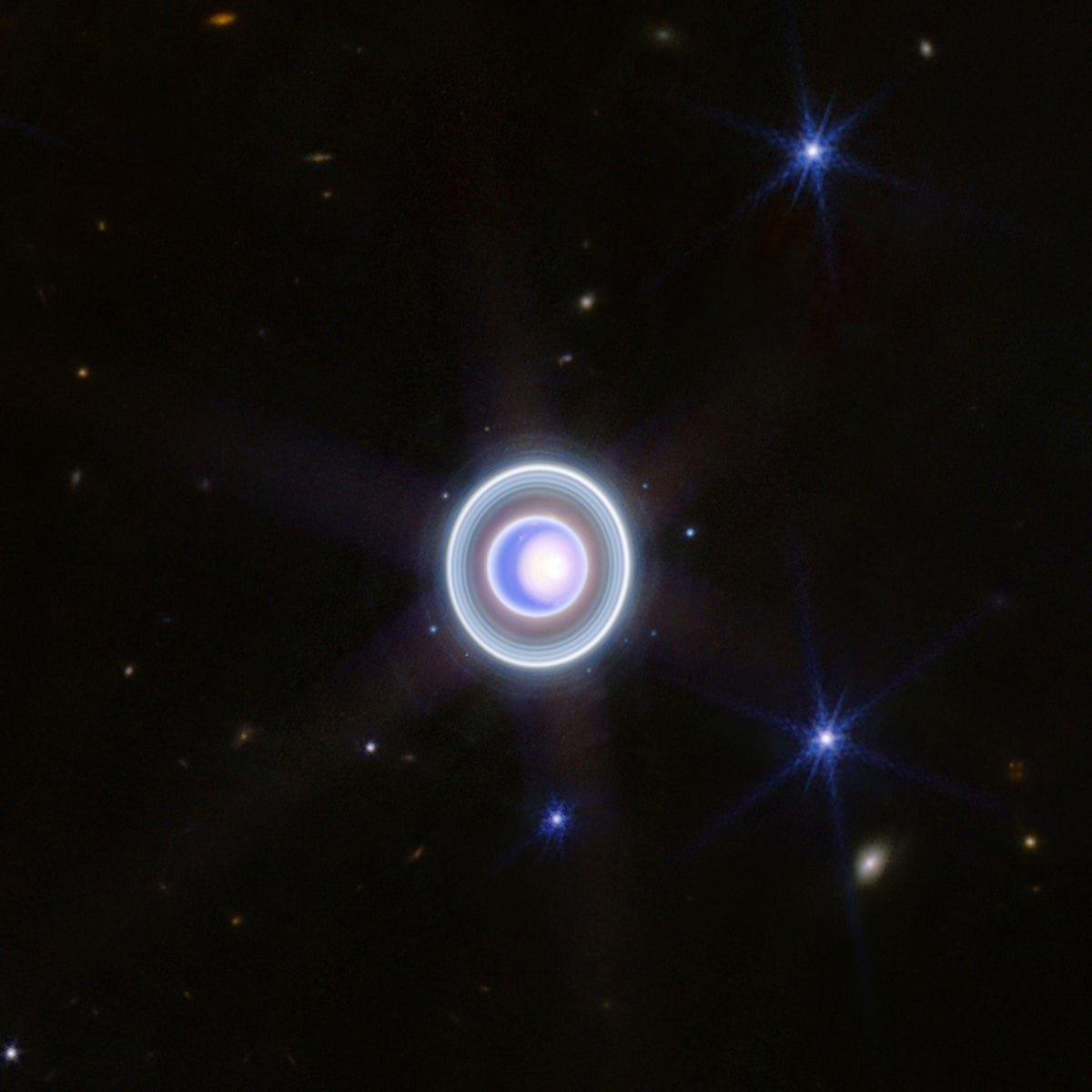
    An image of Uranus taken by NASA's James Webb Space Telescope's NIRCam (Near-Infrared Camera) vividly shows the planet and its rings, as well as many of its moons. JWST images have now revealed a 29th moon orbiting the planet that is not visible here.

    NASA/UPI/Alamy Stock Photo

    Share
    Facebook Twitter LinkedIn Pinterest Email

    August 19, 2025

    2 min read

    NASA’s James Webb Space Telescope Discovers New Moon of Uranus

    Using the powerful James Webb Space Telescope, scientists have spotted a moon nestled near Uranus’s rings that’s so small you could walk around it

    By Andrea Tamayo edited by Sarah Lewin Frasier

    An image of Uranus taken by NASA’s James Webb Space Telescope’s NIRCam (Near-Infrared Camera) vividly shows the planet and its rings, as well as many of its moons. JWST images have now revealed a 29th moon orbiting the planet that is not visible here.

    NASA/UPI/Alamy Stock Photo

    Scientists have discovered a new, elusive moon around Uranus, making it the 29th natural satellite known to orbit the ice giant.

    The research team that made the discovery estimates that the moon, dubbed S/2025 U1 for now (at least, until the International Astronomical Union assigns an official name), is just 10 kilometers, or six miles, across, making it particularly small. “I could walk around this moon,” says Heidi Hammel, a planetary scientist and astrophysicist, who was not involved in the research.

    In 1986 Voyager 2 flew within 81,800 km of Uranus’s cloud tops and gave humans their first close-up glimpse of this giant planet. The spacecraft returned with images of 11 new moons, on top of the five that were already known. Since Voyager, astronomers using the Hubble Space Telescope and ground-based telescopes have spotted other tiny moons—ones as little 12 to 16 km in diameter. But “this one was so small and so faint and so close to the bright ring system around Uranus that we missed it,” Hammel says.

    On supporting science journalism

    If you’re enjoying this article, consider supporting our award-winning journalism by subscribing. By purchasing a subscription you are helping to ensure the future of impactful stories about the discoveries and ideas shaping our world today.

    Astronomers using NASA’s James Webb Space Telescope discovered a new moon orbiting Uranus in images taken by Webb’s NIRCam (Near-Infrared Camera). This composite image shows the moon, designated S/2025 U1, as well as 13 of the 28 other known moons orbiting the planet.

    NASA, ESA, CSA, STScI, M. El Moutamid (SwRI), M. Hedman (University of Idaho)

    A team led by the Southwest Research Institute detected the moon in images captured by the high-resolution Near-Infrared Camera on the James Webb Space Telescope (JWST) during a series of 10 40-minute-long exposures. “The cameras on [JWST] are very sensitive,” Hammel says. “They were designed to see the faintest galaxies in the universe,” as well as faint things that are close to very bright ones (such as the planet Uranus). NASA announced the moon’s discovery today via a blog post.

    “One of the reasons this moon is interesting is that it’s very close to the main ring system,” Hammel says. Unlike Saturn’s rings, which are packed together, Uranus’s rings are more like Hula-Hoops, with lots of separation between each. The rings cluster between a main inner system and a faint outer one, Hammel says, and researchers speculate that the rings are sculpted by the planet’s little orbiting moons.

    There are still many questions about the new minuscule moon for astronomers to explore: How does it compare with other moons? What is its color and composition? JWST might help answer a few of these questions. But regardless of what comes next, the discovery shows “how we can extend the horizons of our knowledge, even in our own solar system, using an advanced telescope like JWST,” Hammel says. “And it helps us get a better understanding of what drives the phenomena in our solar system—like “‘What is crafting that ring system around the planet Uranus?’”

    Discovers James moon NASAs space telescope Uranus Webb
    Share. Facebook Twitter Pinterest LinkedIn Tumblr Email
    Previous ArticleYoung vape users three times as likely to start smoking, study finds | Vaping
    Next Article Why Hurricanes like Erin Trigger Rip Currents Hundreds of Miles Away
    onlyplanz_80y6mt
    • Website

    Related Posts

    Student-Built Instruments Head to Space

    April 11, 2026

    Living Space

    April 4, 2026

    Astronauts Prepare for Artemis II Moon Mission

    March 31, 2026
    Add A Comment
    Leave A Reply Cancel Reply

    Top Posts

    Watch Lady Gaga’s Perform ‘Vanish Into You’ on ‘Colbert’

    September 9, 20251 Views

    Advertisers flock to Fox seeking an ‘audience of one’ — Donald Trump

    July 13, 20251 Views

    A Setback for Maine’s Free Community College Program

    June 19, 20251 Views
    Stay In Touch
    • Facebook
    • YouTube
    • TikTok
    • WhatsApp
    • Twitter
    • Instagram
    Latest Reviews

    At Chile’s Vera Rubin Observatory, Earth’s Largest Camera Surveys the Sky

    By onlyplanz_80y6mtJune 19, 2025

    SpaceX Starship Explodes Before Test Fire

    By onlyplanz_80y6mtJune 19, 2025

    How the L.A. Port got hit by Trump’s Tariffs

    By onlyplanz_80y6mtJune 19, 2025

    Subscribe to Updates

    Get the latest tech news from FooBar about tech, design and biz.

    Most Popular

    Watch Lady Gaga’s Perform ‘Vanish Into You’ on ‘Colbert’

    September 9, 20251 Views

    Advertisers flock to Fox seeking an ‘audience of one’ — Donald Trump

    July 13, 20251 Views

    A Setback for Maine’s Free Community College Program

    June 19, 20251 Views
    Our Picks

    Jeremy Bamber banned from communicating with media from prison | Jeremy Bamber

    Sometimes less is more. Next time you see your doctor ask about ‘de-prescribing’ | Ranjana Srivastava

    GameStop shares fall 10% after CEO skirts questions over eBay acquisition details | eBay

    Recent Posts
    • Jeremy Bamber banned from communicating with media from prison | Jeremy Bamber
    • Sometimes less is more. Next time you see your doctor ask about ‘de-prescribing’ | Ranjana Srivastava
    • GameStop shares fall 10% after CEO skirts questions over eBay acquisition details | eBay
    • Modern slavery at record levels in UK and expected to worsen, report warns | Modern slavery
    • Women with perinatal OCD are still being failed | Pregnancy
    © 2026 naijaglobalnews. Designed by Pro.
    • About Us
    • Disclaimer
    • Get In Touch
    • Privacy Policy
    • Terms and Conditions

    Type above and press Enter to search. Press Esc to cancel.