
Close Menu

    Subscribe to Updates

    Get the latest creative news from FooBar about art, design and business.

    What's Hot

    Svalbard’s polar bears are showing remarkable resilience to climate change

    Nursing a skink: endangered alpine lizard numbers set to rise after Omeo falls pregnant in Victoria | Reptiles

    Brent crude tops $70 per barrel on Iran concerns, pushing FTSE 100 to record high, as gold and copper rally – business live | Business

    Facebook X (Twitter) Instagram
    Facebook X (Twitter) YouTube LinkedIn
    Naija Global News |
    Thursday, January 29
    • Business
    • Health
    • Politics
    • Science
    • Sports
    • Education
    • Social Issues
    • Technology
    • More
      • Crime & Justice
      • Environment
      • Entertainment
    Naija Global News |
    You are at:Home»Science»A mysterious comet is shooting through our solar system. Why are scientists so excited about 3I/Atlas? | Space
    Science

    A mysterious comet is shooting through our solar system. Why are scientists so excited about 3I/Atlas? | Space

    onlyplanz_80y6mtBy onlyplanz_80y6mtAugust 18, 2025004 Mins Read
    Share Facebook Twitter Pinterest LinkedIn Tumblr Email
    A mysterious comet is shooting through our solar system. Why are scientists so excited about 3I/Atlas? | Space
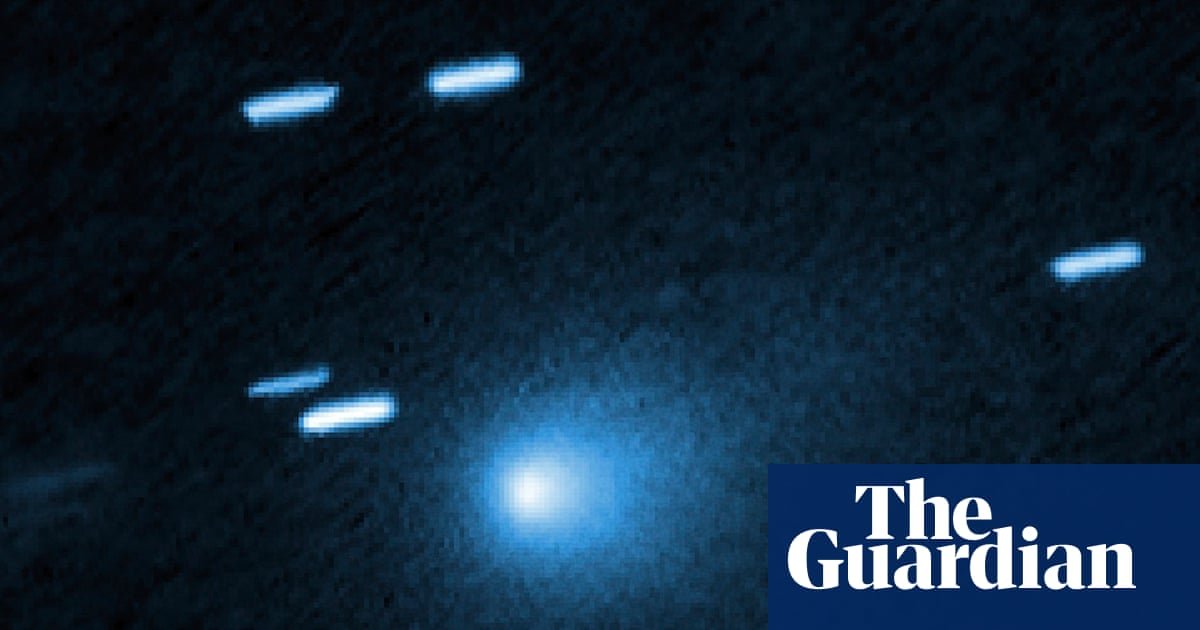
    An image captured by the Hubble space telescope of the 3I/Atlas comet, an interstellar object that is visiting our solar system. Photograph: AP
    Share
    Facebook Twitter LinkedIn Pinterest Email

    An object that came from outside our solar system is hurtling towards the sun at roughly 61km (38 miles) a second.

    First detected in July, this visitor from outer space – known as 3I/Atlas – is only the third known interstellar object to have been observed, after ‘Oumuamua in 2017 and 2I/Borisov in 2019.

    Excitement has been growing since the Hubble space telescope captured an image of the interstellar interloper, offering scientists a rare opportunity to analyse its size and chemical makeup.

    “We’ve never had an object like this to study before,” says Dr Rebecca Allen, co-director of Swinburne’s Space Technology and Industry Institute.

    What exactly is 3I/Atlas?

    “We don’t know exactly where it came from, but it definitely came from outside the solar system,” says Dr Laura Driessen, a radio astronomer at the University of Sydney.

    The name comes from “i” for interstellar, “3” as the third such object detected, and Atlas for the network of telescopes that identified it, called the Asteroid Terrestrial-impact Last Alert System.

    While some have speculated about an alien incursion, scientists say 3I/Atlas is probably a comet. You may remember the speculation over ’Oumuamua, which astronomers checked for radio signals in case it was an alien craft. It wasn’t.

    “There’s no evidence to point towards [3I/Atlas] being anything other than a really fun space rock that came from outside the solar system,” Driessen says. “Which, to be honest, is cool enough.”

    Why are scientists excited about the interstellar object?

    In the Hubble image, 3I/Atlas looks a bit like a “fuzzy snowball”, Allen says. Its hazy appearance is due to its “coma”, which is formed as the comet’s surface is heated by the sun, releasing dust and gas, and there are signs of a comet tail.

    Those chemical signatures – of elements and molecules from outside our solar system – will become more visible the closer it gets to the sun, Allen says. 

    “We can use a tool called spectroscopy, and we can use light to actually understand exactly what that material is. Does this comet represent a solar system that had very similar conditions to our own, or is it something completely different?”

    Researchers have already used the Hubble image to estimate the diameter of 3I/Atlas to be less than 5.6km, and potentially as small as 320 metres.

    Where is 3I/Atlas heading?

    The space object is travelling at more than 200,000km/h, Allen says.

    “It’s going to kind of cruise through the inner solar system – in between Mars and Earth’s orbit – and then it will fly past the sun.

    “This one is on what we call a hyperbolic orbit. So it’s not gravitationally bound to the sun. It’s travelling much too fast, and so it will just fly out the other side of the solar system.”

    Its interstellar origins make 3I/Atlas different from other comets that orbit within the solar system, such as Halley’s comet, says Con Stoitsis, the comet and meteor director at the Astronomical Society of Victoria.

    It is expected to make its closest approach to the sun between October and December – coming within about 210m kilometres – and then continue its journey into space.

    According to Nasa, the closest 3I/Atlas will come to Earth is about 270m kilometres.

    “We’re not really sure where it’s going to end up until it comes around from the other side of the sun, and starts heading out to the outer solar system again,” Stoitsis says.

    Can we see the comet?

    While faint at the moment, the comet is expected to brighten as it approaches the sun, eventually bringing it “within reach of most large amateur telescopes”, Stoitsis says. 

    Even then, 3I/Atlas will probably appear like a smudge, he says.

    “We get bright-ish comets, three or four times a year, which are visible with small telescopes and binoculars. This is definitely not one of those,” he says. “Unless you’ve got a decent-sized telescope, you won’t see it.”

    3IAtlas Comet excited Mysterious Scientists Shooting Solar space System
    Share. Facebook Twitter Pinterest LinkedIn Tumblr Email
    Previous ArticleSoho House to go private in $2.7bn deal as Ashton Kutcher joins board | Business
    Next Article Zelensky, European Leaders Push Trump for Security Guarantees
    onlyplanz_80y6mt
    • Website

    Related Posts

    Five ways to make the academic workplace happier and healthier this year

    January 29, 2026

    Bangladesh approves shooting team India tour, days after T20 World Cup ban | Olympics News

    January 29, 2026

    Does Antarctica really have the bluest sky in the world? | Science

    January 29, 2026
    Add A Comment
    Leave A Reply Cancel Reply

    Top Posts

    Watch Lady Gaga’s Perform ‘Vanish Into You’ on ‘Colbert’

    September 9, 20251 Views

    Advertisers flock to Fox seeking an ‘audience of one’ — Donald Trump

    July 13, 20251 Views

    A Setback for Maine’s Free Community College Program

    June 19, 20251 Views
    Stay In Touch
    • Facebook
    • YouTube
    • TikTok
    • WhatsApp
    • Twitter
    • Instagram
    Latest Reviews

    At Chile’s Vera Rubin Observatory, Earth’s Largest Camera Surveys the Sky

    By onlyplanz_80y6mtJune 19, 2025

    SpaceX Starship Explodes Before Test Fire

    By onlyplanz_80y6mtJune 19, 2025

    How the L.A. Port got hit by Trump’s Tariffs

    By onlyplanz_80y6mtJune 19, 2025

    Subscribe to Updates

    Get the latest tech news from FooBar about tech, design and biz.

    Most Popular

    Watch Lady Gaga’s Perform ‘Vanish Into You’ on ‘Colbert’

    September 9, 20251 Views

    Advertisers flock to Fox seeking an ‘audience of one’ — Donald Trump

    July 13, 20251 Views

    A Setback for Maine’s Free Community College Program

    June 19, 20251 Views
    Our Picks

    Svalbard’s polar bears are showing remarkable resilience to climate change

    Nursing a skink: endangered alpine lizard numbers set to rise after Omeo falls pregnant in Victoria | Reptiles

    Brent crude tops $70 per barrel on Iran concerns, pushing FTSE 100 to record high, as gold and copper rally – business live | Business

    Recent Posts
    • Svalbard’s polar bears are showing remarkable resilience to climate change
    • Nursing a skink: endangered alpine lizard numbers set to rise after Omeo falls pregnant in Victoria | Reptiles
    • Brent crude tops $70 per barrel on Iran concerns, pushing FTSE 100 to record high, as gold and copper rally – business live | Business
    • Survey of over-50s women finds almost two in three struggle with mental health | Mental health
    • L.A. Community Colleges Boost Work-Based Learning
    © 2026 naijaglobalnews. Designed by Pro.
    • About Us
    • Disclaimer
    • Get In Touch
    • Privacy Policy
    • Terms and Conditions

    Type above and press Enter to search. Press Esc to cancel.